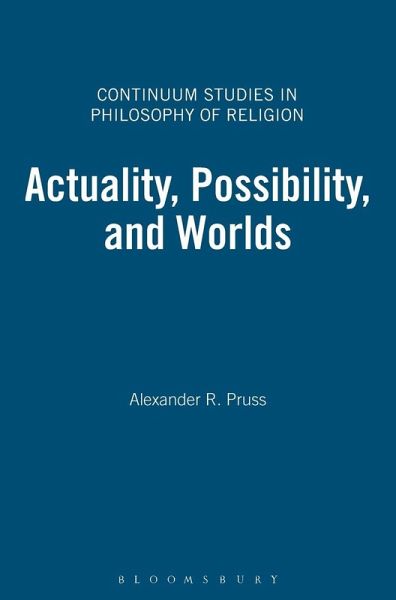
Actuality, Possibility and Worlds is an exploration of the Aristotelian account that sees possibilities as grounded in causal powers. On his way to that account, Pruss surveys a number of historical approaches and argues that logicist approaches to possibility are implausible. The notion of possible worlds appears to be useful for many purposes, such as the analysis of counterfactuals or elucidating the nature of propositions and properties. This usefulness of possible worlds makes for a second general question: Are there any possible worlds and, if so, what are they? Are they concrete…mehr
Actuality, Possibility and Worlds is an exploration of the Aristotelian account that sees possibilities as grounded in causal powers. On his way to that account, Pruss surveys a number of historical approaches and argues that logicist approaches to possibility are implausible. The notion of possible worlds appears to be useful for many purposes, such as the analysis of counterfactuals or elucidating the nature of propositions and properties. This usefulness of possible worlds makes for a second general question: Are there any possible worlds and, if so, what are they? Are they concrete universes as David Lewis thinks, Platonic abstracta as per Robert M. Adams and Alvin Plantinga, or maybe linguistic or mathematical constructs such as Heller thinks? Or is perhaps Leibniz right in thinking that possibilia are not on par with actualities and that abstracta can only exist in a mind, so that possible worlds are ideas in the mind of God?
Alexander R. Pruss is Associate Professor of Philosophy at Baylor University, TX, USA. He has PhDs in both Philosophy as well as Mathematics and is the author of The Principle of Sufficient Reason: A Reassessment (CUP, 2006) and co-editor, with Richard M. Gale, of The Existence of God (Ashgate, 2003).
Inhaltsangabe
Preface Part I. Introduction Section 1 Generic definitions and basic modal realism >Section 2 Metaphysical versus logical possibility? >Section 3 S5 >Section 4 Eight views of possibility > Part II. Applications and pseudo-applications Section 1 Modality >Section 2 Counterfactuals and causality >Section 3 Propositions >Section 4 Properties >Section 5 Overall assessment > Part III. The Lewisian ontology of extreme modal realism >Section 1 The Lewisian account of possible worlds >Section 2 Identity vs. counterpart theory >Section 3 Indiscernible worlds? >Section 4 Lewis's arguments for his ontology >Section 5 Objections to Lewis's account of actuality >Section 6 The possibility of spatio-temporally unrelated co-actual entities >Section 7 Cardinality and the "set" of all possible worlds >Section 8 Ethical issues >Section 9 Induction and actuality >Section 10 The epistemological objection >Section 11 Explaining the actual in terms of the necessary Section 12 A final assessment of extreme modal realism > Part IV. Platonic ersatz ontologies >Section 1 The general strategy >Section 2 Linguistic approaches >Section 3 Platonism Section 4 Conclusions > Part V. Sketches towards a Spinozistic-Tractarian account of modality >Section 1 Asserting, naming and infallibility >Section 2 Spinoza >Section 3 A radical theory of modality Section 4 Costs >Section 5 The less radical theory > Part VI. Aristotelian-Leibnizian ontology Section 1 Leibniz's approach >Section 2 Aristotelian possibility and causality >Section 3 Combining with the Spinozistic-Tractarian view >Section 4 Ordinary alethic modal talk >Section 5 The Principle of Sufficient Reason >Section 6 Ontology and implications >Section 7 The main challenges to Lewisian and Platonic ontologies can be resolved Section 9 Objections to the A-L view > Part VII. Final conclusions >Section 1 Cost-benefit arguments for the Aristotelian-Leibnizian ontology of possible worlds >Section 2 Choosing between accounts of possibility Bibliography
Preface Part I. Introduction Section 1 Generic definitions and basic modal realism >Section 2 Metaphysical versus logical possibility? >Section 3 S5 >Section 4 Eight views of possibility > Part II. Applications and pseudo-applications Section 1 Modality >Section 2 Counterfactuals and causality >Section 3 Propositions >Section 4 Properties >Section 5 Overall assessment > Part III. The Lewisian ontology of extreme modal realism >Section 1 The Lewisian account of possible worlds >Section 2 Identity vs. counterpart theory >Section 3 Indiscernible worlds? >Section 4 Lewis's arguments for his ontology >Section 5 Objections to Lewis's account of actuality >Section 6 The possibility of spatio-temporally unrelated co-actual entities >Section 7 Cardinality and the "set" of all possible worlds >Section 8 Ethical issues >Section 9 Induction and actuality >Section 10 The epistemological objection >Section 11 Explaining the actual in terms of the necessary Section 12 A final assessment of extreme modal realism > Part IV. Platonic ersatz ontologies >Section 1 The general strategy >Section 2 Linguistic approaches >Section 3 Platonism Section 4 Conclusions > Part V. Sketches towards a Spinozistic-Tractarian account of modality >Section 1 Asserting, naming and infallibility >Section 2 Spinoza >Section 3 A radical theory of modality Section 4 Costs >Section 5 The less radical theory > Part VI. Aristotelian-Leibnizian ontology Section 1 Leibniz's approach >Section 2 Aristotelian possibility and causality >Section 3 Combining with the Spinozistic-Tractarian view >Section 4 Ordinary alethic modal talk >Section 5 The Principle of Sufficient Reason >Section 6 Ontology and implications >Section 7 The main challenges to Lewisian and Platonic ontologies can be resolved Section 9 Objections to the A-L view > Part VII. Final conclusions >Section 1 Cost-benefit arguments for the Aristotelian-Leibnizian ontology of possible worlds >Section 2 Choosing between accounts of possibility Bibliography
Es gelten unsere Allgemeinen Geschäftsbedingungen: www.buecher.de/agb
Impressum
www.buecher.de ist ein Internetauftritt der buecher.de internetstores GmbH
Geschäftsführung: Monica Sawhney | Roland Kölbl | Günter Hilger
Sitz der Gesellschaft: Batheyer Straße 115 - 117, 58099 Hagen
Postanschrift: Bürgermeister-Wegele-Str. 12, 86167 Augsburg
Amtsgericht Hagen HRB 13257
Steuernummer: 321/5800/1497
USt-IdNr: DE450055826