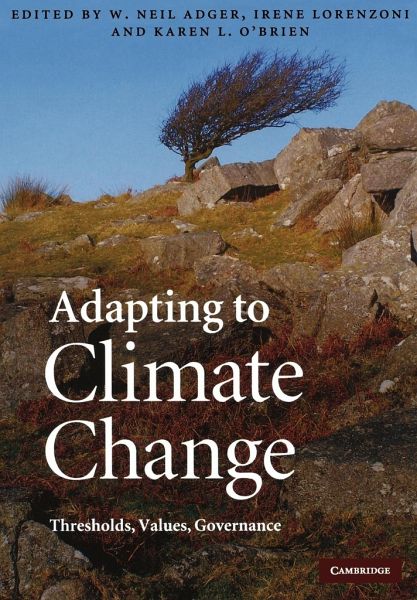
Adapting to Climate Change
Thresholds, Values, Governance
Herausgeber: Adger, W. Neil; O'Brien, Karen L.; Lorenzoni, Irene
Adapting to Climate Change
Thresholds, Values, Governance
Herausgeber: Adger, W. Neil; O'Brien, Karen L.; Lorenzoni, Irene
- Broschiertes Buch
- Merkliste
- Auf die Merkliste
- Bewerten Bewerten
- Teilen
- Produkt teilen
- Produkterinnerung
- Produkterinnerung
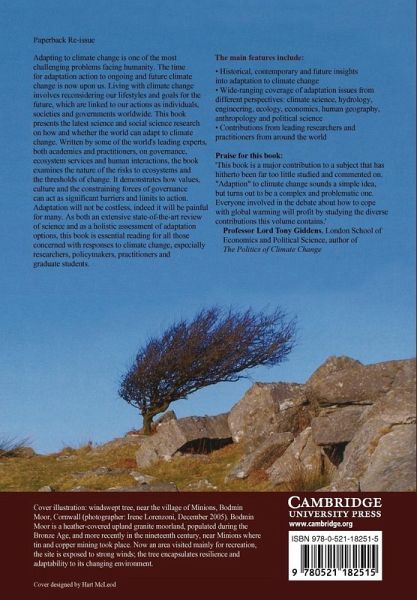
This book presents top research on the critical issue of whether the world can adapt to climate change. Examining how humans and ecosystems respond to new and unpredictable climates, and the role played by culture and governance in this, it is essential reading for researchers, policymakers, practitioners, and graduates.
Andere Kunden interessierten sich auch für
Adapting to Climate Change in Europe141,99 €
Kathleen Gallagher Cunningham (University of Maryland)Rebel Governance in the Age of Climate Change22,99 €
J. David Neelin (Los Angeles University of California)Climate Change and Climate Modeling77,99 €
Adapting the Built Environment for Climate Change205,99 €
David G. Andrews (University of Oxford)An Introduction to Atmospheric Physics70,99 €
Intergovernmental Panel on Climate Change (IPCC)Climate Change and Land129,99 €
Kevin E. TrenberthThe Changing Flow of Energy Through the Climate System56,99 €-
-
-
This book presents top research on the critical issue of whether the world can adapt to climate change. Examining how humans and ecosystems respond to new and unpredictable climates, and the role played by culture and governance in this, it is essential reading for researchers, policymakers, practitioners, and graduates.
Produktdetails
- Produktdetails
- Verlag: Cambridge University Press
- Seitenzahl: 532
- Erscheinungstermin: 9. Dezember 2010
- Englisch
- Abmessung: 244mm x 170mm x 28mm
- Gewicht: 882g
- ISBN-13: 9780521182515
- ISBN-10: 0521182514
- Artikelnr.: 32916773
- Herstellerkennzeichnung
- Libri GmbH
- Europaallee 1
- 36244 Bad Hersfeld
- gpsr@libri.de
- Verlag: Cambridge University Press
- Seitenzahl: 532
- Erscheinungstermin: 9. Dezember 2010
- Englisch
- Abmessung: 244mm x 170mm x 28mm
- Gewicht: 882g
- ISBN-13: 9780521182515
- ISBN-10: 0521182514
- Artikelnr.: 32916773
- Herstellerkennzeichnung
- Libri GmbH
- Europaallee 1
- 36244 Bad Hersfeld
- gpsr@libri.de
Introduction; 1. Adaptation now; Part I. Adapting to Thresholds in Physical
and Ecological Systems: 2. Ecological limits of adaptation to climate
change; 3. Adapting to the effects of climate change on water supply
reliability; 4. Protecting London from tidal flooding: limits to
engineering adaptation; 5. Climate prediction: a limit to adaptation?; 6.
Learning to crawl: how to use seasonal climate forecasts to build adaptive
capacity; 7. Norse Greenland settlement and limits to adaptation; 8. Sea
ice change in Arctic Canada: are there limits to Inuit adaptation?; Part
II. The Role of Value and Culture in Adaptation: 9. The past, present and
some possible futures of adaptation; 10. Do values subjectively define the
limits to climate change adaptation?; 11. Conceptual and practical barriers
to adaptation: vulnerability and responses to heat waves in the UK; 12.
Values and cost-benefit analysis: economic efficiency criteria in
adaptation; 13. Hidden costs and disparate uncertainties: trade-offs in
approaches to climate policy; 14. Community based adaptation and culture in
theory and practice; 15. Exploring the invisibility of local knowledge in
decision-making: the Boscastle harbour flood disaster; 16. Adaptation and
conflict within fisheries: insights for living with climate change; 17.
Exploring cultural dimensions of adaptation to climate change; 18. Adapting
to an uncertain climate on the great plains: testing hypotheses on
historical populations; 19. Climate change and adaptive human migration:
lessons from rural North America; Part III. Governance, Knowledge and
Technologies for Adaptation: 20. Are our levers long and our fulcra strong
enough? Exploring the soft underbelly of adaptation decisions and actions;
21. Decentralized planning and climate adaptation: toward transparent
governance; 22. Climate adaptation, local institutions and rural
livelihoods; 23. Adaptive governance for a changing coastline: science,
policy and publics in search of a sustainable future; 24. Climate change,
international cooperation and adaptation in transboundary water management;
25. Decentralization: a window of opportunity for successful adaptation to
climate change?; 26. Adapting to climate change: the nation-state as
problem and solution; 27. Limits to adaptation: analysing institutional
constraints; 28. Accessing diversification, networks and traditional
resource management as adaptations to climate extremes; 29. Governance
limits to effective global financial support for adaptation; 30.
Organizational learning and governance in adaptation in urban development;
31. Conclusions: transforming the world; Index.
and Ecological Systems: 2. Ecological limits of adaptation to climate
change; 3. Adapting to the effects of climate change on water supply
reliability; 4. Protecting London from tidal flooding: limits to
engineering adaptation; 5. Climate prediction: a limit to adaptation?; 6.
Learning to crawl: how to use seasonal climate forecasts to build adaptive
capacity; 7. Norse Greenland settlement and limits to adaptation; 8. Sea
ice change in Arctic Canada: are there limits to Inuit adaptation?; Part
II. The Role of Value and Culture in Adaptation: 9. The past, present and
some possible futures of adaptation; 10. Do values subjectively define the
limits to climate change adaptation?; 11. Conceptual and practical barriers
to adaptation: vulnerability and responses to heat waves in the UK; 12.
Values and cost-benefit analysis: economic efficiency criteria in
adaptation; 13. Hidden costs and disparate uncertainties: trade-offs in
approaches to climate policy; 14. Community based adaptation and culture in
theory and practice; 15. Exploring the invisibility of local knowledge in
decision-making: the Boscastle harbour flood disaster; 16. Adaptation and
conflict within fisheries: insights for living with climate change; 17.
Exploring cultural dimensions of adaptation to climate change; 18. Adapting
to an uncertain climate on the great plains: testing hypotheses on
historical populations; 19. Climate change and adaptive human migration:
lessons from rural North America; Part III. Governance, Knowledge and
Technologies for Adaptation: 20. Are our levers long and our fulcra strong
enough? Exploring the soft underbelly of adaptation decisions and actions;
21. Decentralized planning and climate adaptation: toward transparent
governance; 22. Climate adaptation, local institutions and rural
livelihoods; 23. Adaptive governance for a changing coastline: science,
policy and publics in search of a sustainable future; 24. Climate change,
international cooperation and adaptation in transboundary water management;
25. Decentralization: a window of opportunity for successful adaptation to
climate change?; 26. Adapting to climate change: the nation-state as
problem and solution; 27. Limits to adaptation: analysing institutional
constraints; 28. Accessing diversification, networks and traditional
resource management as adaptations to climate extremes; 29. Governance
limits to effective global financial support for adaptation; 30.
Organizational learning and governance in adaptation in urban development;
31. Conclusions: transforming the world; Index.
Introduction; 1. Adaptation now; Part I. Adapting to Thresholds in Physical
and Ecological Systems: 2. Ecological limits of adaptation to climate
change; 3. Adapting to the effects of climate change on water supply
reliability; 4. Protecting London from tidal flooding: limits to
engineering adaptation; 5. Climate prediction: a limit to adaptation?; 6.
Learning to crawl: how to use seasonal climate forecasts to build adaptive
capacity; 7. Norse Greenland settlement and limits to adaptation; 8. Sea
ice change in Arctic Canada: are there limits to Inuit adaptation?; Part
II. The Role of Value and Culture in Adaptation: 9. The past, present and
some possible futures of adaptation; 10. Do values subjectively define the
limits to climate change adaptation?; 11. Conceptual and practical barriers
to adaptation: vulnerability and responses to heat waves in the UK; 12.
Values and cost-benefit analysis: economic efficiency criteria in
adaptation; 13. Hidden costs and disparate uncertainties: trade-offs in
approaches to climate policy; 14. Community based adaptation and culture in
theory and practice; 15. Exploring the invisibility of local knowledge in
decision-making: the Boscastle harbour flood disaster; 16. Adaptation and
conflict within fisheries: insights for living with climate change; 17.
Exploring cultural dimensions of adaptation to climate change; 18. Adapting
to an uncertain climate on the great plains: testing hypotheses on
historical populations; 19. Climate change and adaptive human migration:
lessons from rural North America; Part III. Governance, Knowledge and
Technologies for Adaptation: 20. Are our levers long and our fulcra strong
enough? Exploring the soft underbelly of adaptation decisions and actions;
21. Decentralized planning and climate adaptation: toward transparent
governance; 22. Climate adaptation, local institutions and rural
livelihoods; 23. Adaptive governance for a changing coastline: science,
policy and publics in search of a sustainable future; 24. Climate change,
international cooperation and adaptation in transboundary water management;
25. Decentralization: a window of opportunity for successful adaptation to
climate change?; 26. Adapting to climate change: the nation-state as
problem and solution; 27. Limits to adaptation: analysing institutional
constraints; 28. Accessing diversification, networks and traditional
resource management as adaptations to climate extremes; 29. Governance
limits to effective global financial support for adaptation; 30.
Organizational learning and governance in adaptation in urban development;
31. Conclusions: transforming the world; Index.
and Ecological Systems: 2. Ecological limits of adaptation to climate
change; 3. Adapting to the effects of climate change on water supply
reliability; 4. Protecting London from tidal flooding: limits to
engineering adaptation; 5. Climate prediction: a limit to adaptation?; 6.
Learning to crawl: how to use seasonal climate forecasts to build adaptive
capacity; 7. Norse Greenland settlement and limits to adaptation; 8. Sea
ice change in Arctic Canada: are there limits to Inuit adaptation?; Part
II. The Role of Value and Culture in Adaptation: 9. The past, present and
some possible futures of adaptation; 10. Do values subjectively define the
limits to climate change adaptation?; 11. Conceptual and practical barriers
to adaptation: vulnerability and responses to heat waves in the UK; 12.
Values and cost-benefit analysis: economic efficiency criteria in
adaptation; 13. Hidden costs and disparate uncertainties: trade-offs in
approaches to climate policy; 14. Community based adaptation and culture in
theory and practice; 15. Exploring the invisibility of local knowledge in
decision-making: the Boscastle harbour flood disaster; 16. Adaptation and
conflict within fisheries: insights for living with climate change; 17.
Exploring cultural dimensions of adaptation to climate change; 18. Adapting
to an uncertain climate on the great plains: testing hypotheses on
historical populations; 19. Climate change and adaptive human migration:
lessons from rural North America; Part III. Governance, Knowledge and
Technologies for Adaptation: 20. Are our levers long and our fulcra strong
enough? Exploring the soft underbelly of adaptation decisions and actions;
21. Decentralized planning and climate adaptation: toward transparent
governance; 22. Climate adaptation, local institutions and rural
livelihoods; 23. Adaptive governance for a changing coastline: science,
policy and publics in search of a sustainable future; 24. Climate change,
international cooperation and adaptation in transboundary water management;
25. Decentralization: a window of opportunity for successful adaptation to
climate change?; 26. Adapting to climate change: the nation-state as
problem and solution; 27. Limits to adaptation: analysing institutional
constraints; 28. Accessing diversification, networks and traditional
resource management as adaptations to climate extremes; 29. Governance
limits to effective global financial support for adaptation; 30.
Organizational learning and governance in adaptation in urban development;
31. Conclusions: transforming the world; Index.