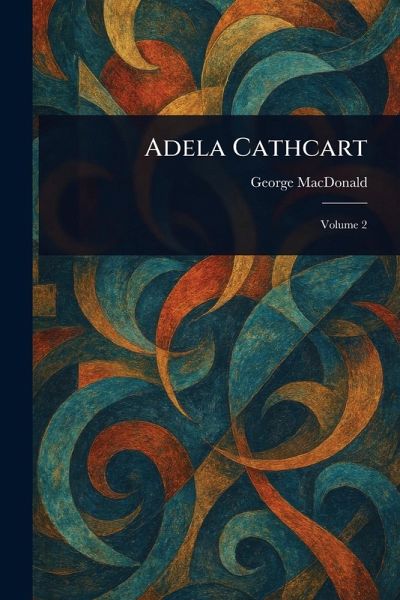
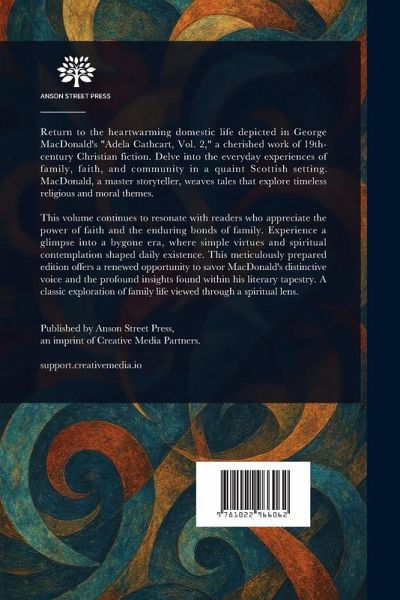
Return to the heartwarming domestic life depicted in George MacDonald's "Adela Cathcart, Vol. 2," a cherished work of 19th-century Christian fiction. Delve into the everyday experiences of family, faith, and community in a quaint Scottish setting. MacDonald, a master storyteller, weaves tales that explore timeless religious and moral themes. This volume continues to resonate with readers who appreciate the power of faith and the enduring bonds of family. Experience a glimpse into a bygone era, where simple virtues and spiritual contemplation shaped daily existence. This meticulously prepared…mehr
Return to the heartwarming domestic life depicted in George MacDonald's "Adela Cathcart, Vol. 2," a cherished work of 19th-century Christian fiction. Delve into the everyday experiences of family, faith, and community in a quaint Scottish setting. MacDonald, a master storyteller, weaves tales that explore timeless religious and moral themes. This volume continues to resonate with readers who appreciate the power of faith and the enduring bonds of family. Experience a glimpse into a bygone era, where simple virtues and spiritual contemplation shaped daily existence. This meticulously prepared edition offers a renewed opportunity to savor MacDonald's distinctive voice and the profound insights found within his literary tapestry. A classic exploration of family life viewed through a spiritual lens. This work has been selected by scholars as being culturally important, and is part of the knowledge base of civilization as we know it. This work is in the public domain in the United States of America, and possibly other nations. Within the United States, you may freely copy and distribute this work, as no entity (individual or corporate) has a copyright on the body of the work. Scholars believe, and we concur, that this work is important enough to be preserved, reproduced, and made generally available to the public. We appreciate your support of the preservation process, and thank you for being an important part of keeping this knowledge alive and relevant.
George MacDonald was a prolific novelist. He is now known particularly for his poignant fairy tales and fantasy works, and their influence on later authors, such as W. H. Auden, C. S. Lewis, E. Nesbit and Madeleine L'Engle. C. S. Lewis wrote that he regarded MacDonald as his "master": "Picking up a copy of Phantastes one day at a train-station bookstall, I began to read. A few hours later," said Lewis, "I knew that I had crossed a great frontier." G. K. Chesterton cited The Princess and the Goblin as a book that had "made a difference to my whole existence." Even Mark Twain, who initially disliked MacDonald, became friends with him, and there is some evidence that Twain was influenced by MacDonald. 'MacDonald grew up in the Congregational Church, with an atmosphere of Calvinism.He took his degree at the University of Aberdeen, and then went to London, studying at Highbury College for the Congregational ministry. George MacDonald best-known works are Phantastes, The Princess and the Goblin, At the Back of the North Wind, and Lilith, all fantasy novels, and fairy tales such as "The Light Princess", "The Golden Key", and "The Wise Woman". "I write, not for children," he wrote, "but for the child-like, whether they be of five, or fifty, or seventy-five." MacDonald also published some volumes of sermons, the pulpit not having proved an unreservedly successful venue. 'MacDonald also served as a mentor to Lewis Carroll (the pen-name of Rev. Charles Lutwidge Dodgson); it was MacDonald's advice, and the enthusiastic reception of Alice by MacDonald's many sons and daughters, that convinced Carroll to submit Alice for publication.[6] Carroll, one of the finest Victorian photographers, also created photographic portraits of several of the MacDonald children. 'MacDonald was also friends with John Ruskin and served as a go-between in Ruskin's long courtship with Rose La Touche. 'MacDonald was acquainted with most of the literary luminaries of the day; a surviving group photograph shows him with Tennyson, Dickens, Wilkie Collins, Trollope, Ruskin, Lewes, and Thackeray. While in America he was a friend of Longfellow and Walt Whitman. 'MacDonald's use of fantasy as a literary medium for exploring the human condition greatly influenced a generation of such notable authors as C. S. Lewis (who featured him as a character in his The Great Divorce), J. R. R. Tolkien, and Madeleine L'Engle. MacDonald's non-fantasy novels, such as Alec Forbes, had their influence as well; they were among the first realistic Scottish novels.'
Es gelten unsere Allgemeinen Geschäftsbedingungen: www.buecher.de/agb
Impressum
www.buecher.de ist ein Internetauftritt der buecher.de internetstores GmbH
Geschäftsführung: Monica Sawhney | Roland Kölbl | Günter Hilger
Sitz der Gesellschaft: Batheyer Straße 115 - 117, 58099 Hagen
Postanschrift: Bürgermeister-Wegele-Str. 12, 86167 Augsburg
Amtsgericht Hagen HRB 13257
Steuernummer: 321/5800/1497
USt-IdNr: DE450055826