
Andere Kunden interessierten sich auch für
 Adsorption mit pulverisierter Aktivkohle49,90 €
 Ecological and Toxicological studies on algae in drinking water supply37,99 €
 The Rapid Movement toward Clean Green World40,99 €
 Hydrology and Water Supply for Pond Aquaculture151,99 €
 Hydrology and Water Supply for Pond Aquaculture203,99 €
 Aspects of the phytoplankton ecology in Lake Chivero, Harare, Zimbabwe32,99 €
 Integrated Soil and Sediment Research: A Basis for Proper Protection229,99 €


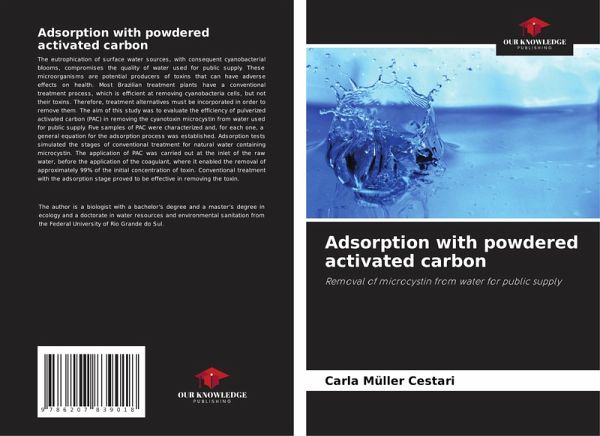
The eutrophication of surface water sources, with consequent cyanobacterial blooms, compromises the quality of water used for public supply. These microorganisms are potential producers of toxins that can have adverse effects on health. Most Brazilian treatment plants have a conventional treatment process, which is efficient at removing cyanobacteria cells, but not their toxins. Therefore, treatment alternatives must be incorporated in order to remove them. The aim of this study was to evaluate the efficiency of pulverized activated carbon (PAC) in removing the cyanotoxin microcystin from water used for public supply. Five samples of PAC were characterized and, for each one, a general equation for the adsorption process was established. Adsorption tests simulated the stages of conventional treatment for natural water containing microcystin. The application of PAC was carried out at the inlet of the raw water, before the application of the coagulant, where it enabled the removal of approximately 99% of the initial concentration of toxin. Conventional treatment with the adsorption stage proved to be effective in removing the toxin.