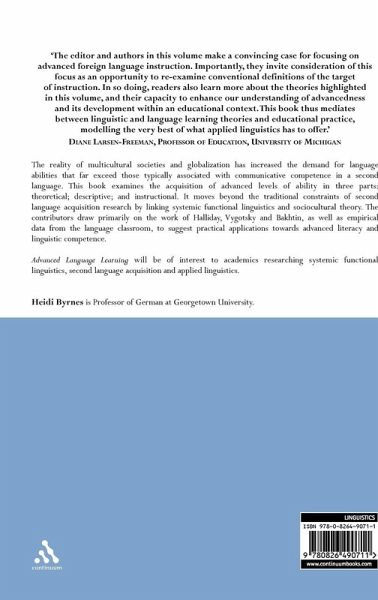
The reality of multicultural societies and globalization has increased the demand for language abilities. This book examines the acquisition of advanced levels of ability in three parts: theoretical; descriptive; and instructional. It also links systemic functional linguistics and sociocultural theory.
The reality of multicultural societies and globalization has increased the demand for language abilities. This book examines the acquisition of advanced levels of ability in three parts: theoretical; descriptive; and instructional. It also links systemic functional linguistics and sociocultural theory.
Heidi Byrnes is Professor of German at Georgetown University.
Inhaltsangabe
Introduction: What kind of resource is language and why does it matter for advanced language learning? Part I: Theoretical considerations in advanced instructed learning 1. Educating for advanced foreign language capacities, Christian M I M Matthiessen (Macquarie University, Australia) 2. Generalised collective dialogue and advanced foreign language capacities, James V. Wertsch (Washington University, USA) 3. Re(de)fining langauge proficiency in light of the concept of "languaculture", James P. Lantolf (Pennsylvania State University, USA) Part II: Description and Pedagogy 4. Languaging, agency and collaboration in advanced language proficiency, Merrill Swain (University of Toronto, Canada) 5. Grammar as a resource for constructing language logic for advanced language learning, Kazuhiro Teruya (Macquarie University, Australia) 6. The linguistic features of advanced language use: the grammar of exposition, Mary Schleppegrell (The University of Michigan, USA) 7. Grammatical metaphor: academic language development in Latino students in Spanish, M. Cecilia Colombi (The University of California, USA) 8. Creating textual worlds in advanced L2 writing, Marianna Ryshina-Pankova (George Mason University, Australia) 9. The dialogic constuction of meaning in advanced L2 writing, Susan Strass, Parastou Feiz, Xuehua Xian, Dessislava Ivanova (all at Pennsylvania State University, USA) 10. Learning advanced French through SF, Alice Caffarel (The University of Sydney, Australia) Part III: Programmatic and curricular issues 11. Modeling a gerne-based foreign language curriculum, Cori Crane (University of Illinois at Urbana Champaign, USA) 12. Advanced Language for intermediate learners, Nick Moore (Etisalat University College, UAE) Index
Introduction: What kind of resource is language and why does it matter for advanced language learning? Part I: Theoretical considerations in advanced instructed learning 1. Educating for advanced foreign language capacities, Christian M I M Matthiessen (Macquarie University, Australia) 2. Generalised collective dialogue and advanced foreign language capacities, James V. Wertsch (Washington University, USA) 3. Re(de)fining langauge proficiency in light of the concept of "languaculture", James P. Lantolf (Pennsylvania State University, USA) Part II: Description and Pedagogy 4. Languaging, agency and collaboration in advanced language proficiency, Merrill Swain (University of Toronto, Canada) 5. Grammar as a resource for constructing language logic for advanced language learning, Kazuhiro Teruya (Macquarie University, Australia) 6. The linguistic features of advanced language use: the grammar of exposition, Mary Schleppegrell (The University of Michigan, USA) 7. Grammatical metaphor: academic language development in Latino students in Spanish, M. Cecilia Colombi (The University of California, USA) 8. Creating textual worlds in advanced L2 writing, Marianna Ryshina-Pankova (George Mason University, Australia) 9. The dialogic constuction of meaning in advanced L2 writing, Susan Strass, Parastou Feiz, Xuehua Xian, Dessislava Ivanova (all at Pennsylvania State University, USA) 10. Learning advanced French through SF, Alice Caffarel (The University of Sydney, Australia) Part III: Programmatic and curricular issues 11. Modeling a gerne-based foreign language curriculum, Cori Crane (University of Illinois at Urbana Champaign, USA) 12. Advanced Language for intermediate learners, Nick Moore (Etisalat University College, UAE) Index
Es gelten unsere Allgemeinen Geschäftsbedingungen: www.buecher.de/agb
Impressum
www.buecher.de ist ein Internetauftritt der buecher.de internetstores GmbH
Geschäftsführung: Monica Sawhney | Roland Kölbl | Günter Hilger
Sitz der Gesellschaft: Batheyer Straße 115 - 117, 58099 Hagen
Postanschrift: Bürgermeister-Wegele-Str. 12, 86167 Augsburg
Amtsgericht Hagen HRB 13257
Steuernummer: 321/5800/1497
USt-IdNr: DE450055826