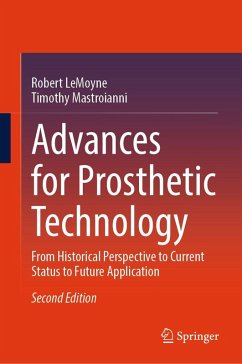
This book offers insights into the complexities associated with neurological control of gait and details extrinsic capabilities demonstrating conceptual advancements in prosthetic control. The first edition of this book achieved 15,000 accesses by January 2025. This subsequent edition explores the current advancements in powered transtibial prosthetics. The development of electromyography (EMG) feedback to enhance prosthetic control is thoroughly analyzed. Evolved control architectures and their corresponding components and subsystems in prosthetic technology are concisely summarized.…mehr
This book offers insights into the complexities associated with neurological control of gait and details extrinsic capabilities demonstrating conceptual advancements in prosthetic control. The first edition of this book achieved 15,000 accesses by January 2025. This subsequent edition explores the current advancements in powered transtibial prosthetics. The development of electromyography (EMG) feedback to enhance prosthetic control is thoroughly analyzed. Evolved control architectures and their corresponding components and subsystems in prosthetic technology are concisely summarized. Furthermore, the rapidly advancing patents relevant to powered prosthetics are examined. Lastly, the integration of artificial intelligence (AI) and robotics is discussed, with a focus on their implications for advancements in prosthetic technology. This edition not only delves into the realm of cutting-edge powered prosthetic systems but also addresses the intersection of AI (machine learning) and robotics. It encompasses extrinsic capabilities critical for advanced control in prosthetic technology, appealing not only to those with a vested interest in prosthetic innovations but also to enthusiasts in the fast-evolving fields of AI and robotics.
Dr. Robert LeMoyne presently is an Adjunct Professor for Northern Arizona University for the Department of Biological Sciences and an Adjunct Professor for Czech Technical University in Prague for the Department of Biomedical Technology. Dr. LeMoyne is researching advanced concepts for prosthetic technology, such as machine learning, which is an aspect of artificial intelligence. His Ph.D. in Biomedical Engineering was earned at University of California Los Angeles (UCLA) (2010). He has first authored more than 150 technical proceedings, including six books, which have been cited more than 2000 times, spanning a broad array of subjects, such as an assortment of applications for advanced concepts for prosthetic technology. Timothy Mastroianni is a cognitive scientist, researcher, and entrepreneur. He pioneered the non-invasive use of computer vision and pattern recognition to uncover the internal states of random number generators in machines (HiLoClient2002). Mastroianni developed the first model and algorithms capable of predicting a person's thoughts using machine learning and fMRI, presenting these groundbreaking methods at Carnegie Mellon University to map the human brain and identify brain states during specific tasks. He is also the founder of Cognition Engineering, a subsidiary of Cognition International LLC.
Inhaltsangabe
1. Amputations and Prostheses, a Topic of Global Concern. 2. Ankle Foot Complex and the Fundamental Aspects of Gait. 3. Prosthetic Gait Asymmetry and Discomfort While Walking with a Transtibial Prosthesis. 4. Testing and Evaluation Strategies for the Powered Prosthesis, a Global Perspective. 5. Passive Transtibial Prosthesis and Associated Prosthetic Components. 6. Energy Storage and Return (ESAR) Prosthesis. 7. Architecture of a Powered Prosthesis System: Actuators, Sensors, and Control. 8. Transtibial Powered Prostheses: Single and Dual Actuator Configurations. 9. The MIT Inspired Powered Prosthesis Leading to the Commercialized BiOM Powered Prosthesis, a Precedence in Transtibial Prosthetic Technology. 10. Future and Advanced Concepts for the Powered Prosthesis. 11. Evolutions of Advanced Powered Prosthetics. 12. Neurological Foundation for Gait Control. 13. Extrinsic Capabilities for Proof of Concept for Advanced Powered Prosthetic Technology. 14. Recently Developed Advanced Powered Prosthetics. 15. Advanced Control Strategies. 16. Patent Review of Advanced Powered Prosthetic Technology. 17. Advanced Concepts for Evolving Powered Prosthetic Technology. Index.
Amputations and prostheses, a topic of global concern.- Ankle-foot complex and the fundamental aspects of gait.- Prosthetic gait asymmetry and discomfort while walking with a transtibial prosthesis.- Testing and evaluation strategies for the powered prosthesis, a global perspective.- Passive transtibial prosthesis and associated prosthetic components.- Energy Storage and Return (ESAR) prosthesis.- Architecture of a powered prosthesis system: actuators, sensors, and control.- Transtibial powered prostheses: single and dual actuator configurations.- The MIT inspired powered prosthesis leading to the commercialized BiOM powered prosthesis, a precedence in transtibial prosthetic technology.- Future and advanced concepts for the powered prosthesis.
1. Amputations and Prostheses, a Topic of Global Concern. 2. Ankle Foot Complex and the Fundamental Aspects of Gait. 3. Prosthetic Gait Asymmetry and Discomfort While Walking with a Transtibial Prosthesis. 4. Testing and Evaluation Strategies for the Powered Prosthesis, a Global Perspective. 5. Passive Transtibial Prosthesis and Associated Prosthetic Components. 6. Energy Storage and Return (ESAR) Prosthesis. 7. Architecture of a Powered Prosthesis System: Actuators, Sensors, and Control. 8. Transtibial Powered Prostheses: Single and Dual Actuator Configurations. 9. The MIT Inspired Powered Prosthesis Leading to the Commercialized BiOM Powered Prosthesis, a Precedence in Transtibial Prosthetic Technology. 10. Future and Advanced Concepts for the Powered Prosthesis. 11. Evolutions of Advanced Powered Prosthetics. 12. Neurological Foundation for Gait Control. 13. Extrinsic Capabilities for Proof of Concept for Advanced Powered Prosthetic Technology. 14. Recently Developed Advanced Powered Prosthetics. 15. Advanced Control Strategies. 16. Patent Review of Advanced Powered Prosthetic Technology. 17. Advanced Concepts for Evolving Powered Prosthetic Technology. Index.
Amputations and prostheses, a topic of global concern.- Ankle-foot complex and the fundamental aspects of gait.- Prosthetic gait asymmetry and discomfort while walking with a transtibial prosthesis.- Testing and evaluation strategies for the powered prosthesis, a global perspective.- Passive transtibial prosthesis and associated prosthetic components.- Energy Storage and Return (ESAR) prosthesis.- Architecture of a powered prosthesis system: actuators, sensors, and control.- Transtibial powered prostheses: single and dual actuator configurations.- The MIT inspired powered prosthesis leading to the commercialized BiOM powered prosthesis, a precedence in transtibial prosthetic technology.- Future and advanced concepts for the powered prosthesis.
Rezensionen
"The book aims to define the broad knowledge base required to inform research on transtibial prosthetic management. ... a fair job of surveying a considerable body of knowledge and presenting it in an easily readable manner appropriate for engineers and biomechanists new to the transtibial prosthetic patient population. While the vast majority of prosthetic-oriented books focus on their clinical aspects, the engineering and research focus of this one likely will appeal to those working in academic and product development settings." (Christopher Robinson, Doody's Book Reviews, February, 2017)
Es gelten unsere Allgemeinen Geschäftsbedingungen: www.buecher.de/agb
Impressum
www.buecher.de ist ein Internetauftritt der buecher.de internetstores GmbH
Geschäftsführung: Monica Sawhney | Roland Kölbl | Günter Hilger
Sitz der Gesellschaft: Batheyer Straße 115 - 117, 58099 Hagen
Postanschrift: Bürgermeister-Wegele-Str. 12, 86167 Augsburg
Amtsgericht Hagen HRB 13257
Steuernummer: 321/5800/1497
USt-IdNr: DE450055826