Advances in Fermented Foods and Beverages: Improving Quality, Technologies and Health Benefits
Herausgegeben:Holzapfel, Wilhelm
Advances in Fermented Foods and Beverages: Improving Quality, Technologies and Health Benefits
Herausgegeben:Holzapfel, Wilhelm
- Broschiertes Buch
- Merkliste
- Auf die Merkliste
- Bewerten Bewerten
- Teilen
- Produkt teilen
- Produkterinnerung
- Produkterinnerung
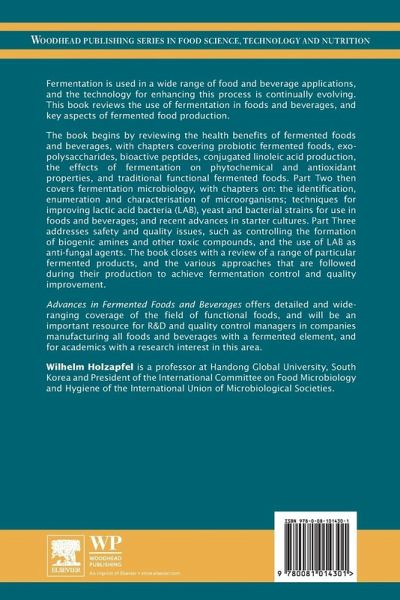
Fermentation is used in a wide range of food and beverage applications, and the technology for enhancing this process is continually evolving. This book reviews the use of fermentation in foods and beverages and key aspects of fermented food production. Part one covers the health benefits of fermented foods. Part two includes chapters on fermentation microbiology, while part three looks at ways of controlling and monitoring the quality and safety of fermented foods. Part four covers advances in fermentation technology. Finally, part five covers particular fermented food products.
Andere Kunden interessierten sich auch für
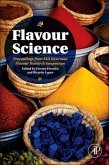
Flavour Science101,99 €
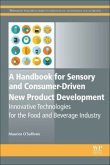
Maurice O'SullivanA Handbook for Sensory and Consumer-Driven New Product Development68,99 €
Edward IshiguroGut Microbiota67,99 €
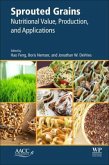
Sprouted Grains133,99 €
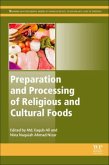
Preparation and Processing of Religious and Cultural Foods156,99 €
Gluten-Free Ancient Grains140,99 €
Postharvest and Postmortem Processing of Raw Food Materials176,99 €-
-
-
Fermentation is used in a wide range of food and beverage applications, and the technology for enhancing this process is continually evolving. This book reviews the use of fermentation in foods and beverages and key aspects of fermented food production. Part one covers the health benefits of fermented foods. Part two includes chapters on fermentation microbiology, while part three looks at ways of controlling and monitoring the quality and safety of fermented foods. Part four covers advances in fermentation technology. Finally, part five covers particular fermented food products.
Produktdetails
- Produktdetails
- Woodhead Publishing Series in Food Science, Technology and Nutrition
- Verlag: Elsevier Science & Technology / Woodhead Publishing
- Artikelnr. des Verlages: C2013-0-16431-8
- Seitenzahl: 586
- Erscheinungstermin: 2. September 2016
- Englisch
- Abmessung: 229mm x 152mm x 30mm
- Gewicht: 941g
- ISBN-13: 9780081014301
- ISBN-10: 0081014309
- Artikelnr.: 45194207
- Herstellerkennzeichnung Die Herstellerinformationen sind derzeit nicht verfügbar.
- Woodhead Publishing Series in Food Science, Technology and Nutrition
- Verlag: Elsevier Science & Technology / Woodhead Publishing
- Artikelnr. des Verlages: C2013-0-16431-8
- Seitenzahl: 586
- Erscheinungstermin: 2. September 2016
- Englisch
- Abmessung: 229mm x 152mm x 30mm
- Gewicht: 941g
- ISBN-13: 9780081014301
- ISBN-10: 0081014309
- Artikelnr.: 45194207
- Herstellerkennzeichnung Die Herstellerinformationen sind derzeit nicht verfügbar.
- Related titles
- List of contributors
- Woodhead Publishing Series in Food Science, Technology and Nutrition
- Part One. Fermented foods and health
- 1. Probiotic fermented foods and health promotion
- 1.1. Introduction
- 1.2. Probiotic fermented foods and health promotion
- 1.3. Health benefits deriving from the consumption of probiotics
- 1.4. Gastrointestinal health
- 1.5. Immune health
- 1.6. Metabolic health
- 1.7. Summary
- 1.8. Future trends
- 1.9. Sources of further information and advice
- 2. Exopolysaccharides from fermented dairy products and health promotion
- 2.1. Introduction
- 2.2. Exopolysaccharides (EPSs) from fermented dairy products
- 2.3. Interaction with the human intestinal microbiome
- 2.4. Interaction with the immune system
- 2.5. Interaction with enteric pathogens and toxins
- 2.6. Diverse interactions and potential health benefits
- 2.7. Conclusions
- 3. Bioactive peptides from fermented foods and health promotion
- 3.1. Introduction
- 3.2. Release of bioactive peptides during microbial fermentation
- 3.3. Bioactive peptides in fermented dairy and soy products
- 3.4. Bioactive peptides in health promotion
- 3.5. Conclusions and future trends
- 4. Conjugated linoleic acid production in fermented foods
- 4.1. Introduction
- 4.2. Basic knowledge of conjugated linoleic acid (CLA)
- 4.3. CLA content of unprocessed food ingredients
- 4.4. Factors influencing the CLA content of raw materials, and the effect of animal diet on CLA content of milk and meat
- 4.5. CLA content of fermented food products
- 4.6. Health effects of CLA
- 4.7. Future trends
- 5. Effect of fermentation on the phytochemical contents and antioxidant properties of plant foods
- 5.1. Introduction
- 5.2. Effect of fermentation on phytochemical profiles of plant foods and the bioavailability of nutrients
- 5.3. Effect of fermentation on antioxidant properties of plant foods
- 5.4. Health-promoting effects of fermented plant foods: a case of phytochemical and antioxidant property changes
- 5.5. Conclusions
- 6. Traditional cereal fermented foods as sources of functional microorganisms
- 6.1. Introduction
- 6.2. Food fermentation processes
- 6.3. Antimicrobial proteins isolated from boza-related lactic acid bacteria
- 6.4. Fermented cereal-based food from Africa and Latin America
- 6.5. Starter cultures and cereal-based fermented food
- 6.6. Cereal-based probiotic foods
- 1. Probiotic fermented foods and health promotion
- Part Two. Fermentation microbiology
- 7. Advanced methods for the identification, enumeration, and characterization of microorganisms in fermented foods
- 7.1. The fermented food microbial ecosystem
- 7.2. Culture-dependent methods
- 7.3. Culture-independent methods: diversity in microbial communities
- 7.4. Culture-independent methods: metabolic activity in microbial communities
- 7.5. Recent insights: pyrosequencing
- 7.6. Conclusions
- 8. Systems biology and metabolic engineering of lactic acid bacteria for improved fermented foods
- 8.1. Introduction
- 8.2. Metabolic engineering in industrial lactic acid bacteria (LAB)
- 8.3. Systems biology and metabolic engineering in LAB
- 8.4. Conclusions
- 8.5. Sources of further information and advice
- 9. Designing wine yeast for the future
- 9.1. Introduction
- 9.2. Accidental beginnings and ancient wisdom
- 9.3. Turning hindsight into foresight
- 9.4. The ancient art of winemaking meets frontier yeast science
- 9.5. Engineering yeast to make better wine
- 9.6. Future trends
- 10. Modern approaches
- 7. Advanced methods for the identification, enumeration, and characterization of microorganisms in fermented foods
- Related titles
- List of contributors
- Woodhead Publishing Series in Food Science, Technology and Nutrition
- Part One. Fermented foods and health
- 1. Probiotic fermented foods and health promotion
- 1.1. Introduction
- 1.2. Probiotic fermented foods and health promotion
- 1.3. Health benefits deriving from the consumption of probiotics
- 1.4. Gastrointestinal health
- 1.5. Immune health
- 1.6. Metabolic health
- 1.7. Summary
- 1.8. Future trends
- 1.9. Sources of further information and advice
- 2. Exopolysaccharides from fermented dairy products and health promotion
- 2.1. Introduction
- 2.2. Exopolysaccharides (EPSs) from fermented dairy products
- 2.3. Interaction with the human intestinal microbiome
- 2.4. Interaction with the immune system
- 2.5. Interaction with enteric pathogens and toxins
- 2.6. Diverse interactions and potential health benefits
- 2.7. Conclusions
- 3. Bioactive peptides from fermented foods and health promotion
- 3.1. Introduction
- 3.2. Release of bioactive peptides during microbial fermentation
- 3.3. Bioactive peptides in fermented dairy and soy products
- 3.4. Bioactive peptides in health promotion
- 3.5. Conclusions and future trends
- 4. Conjugated linoleic acid production in fermented foods
- 4.1. Introduction
- 4.2. Basic knowledge of conjugated linoleic acid (CLA)
- 4.3. CLA content of unprocessed food ingredients
- 4.4. Factors influencing the CLA content of raw materials, and the effect of animal diet on CLA content of milk and meat
- 4.5. CLA content of fermented food products
- 4.6. Health effects of CLA
- 4.7. Future trends
- 5. Effect of fermentation on the phytochemical contents and antioxidant properties of plant foods
- 5.1. Introduction
- 5.2. Effect of fermentation on phytochemical profiles of plant foods and the bioavailability of nutrients
- 5.3. Effect of fermentation on antioxidant properties of plant foods
- 5.4. Health-promoting effects of fermented plant foods: a case of phytochemical and antioxidant property changes
- 5.5. Conclusions
- 6. Traditional cereal fermented foods as sources of functional microorganisms
- 6.1. Introduction
- 6.2. Food fermentation processes
- 6.3. Antimicrobial proteins isolated from boza-related lactic acid bacteria
- 6.4. Fermented cereal-based food from Africa and Latin America
- 6.5. Starter cultures and cereal-based fermented food
- 6.6. Cereal-based probiotic foods
- 1. Probiotic fermented foods and health promotion
- Part Two. Fermentation microbiology
- 7. Advanced methods for the identification, enumeration, and characterization of microorganisms in fermented foods
- 7.1. The fermented food microbial ecosystem
- 7.2. Culture-dependent methods
- 7.3. Culture-independent methods: diversity in microbial communities
- 7.4. Culture-independent methods: metabolic activity in microbial communities
- 7.5. Recent insights: pyrosequencing
- 7.6. Conclusions
- 8. Systems biology and metabolic engineering of lactic acid bacteria for improved fermented foods
- 8.1. Introduction
- 8.2. Metabolic engineering in industrial lactic acid bacteria (LAB)
- 8.3. Systems biology and metabolic engineering in LAB
- 8.4. Conclusions
- 8.5. Sources of further information and advice
- 9. Designing wine yeast for the future
- 9.1. Introduction
- 9.2. Accidental beginnings and ancient wisdom
- 9.3. Turning hindsight into foresight
- 9.4. The ancient art of winemaking meets frontier yeast science
- 9.5. Engineering yeast to make better wine
- 9.6. Future trends
- 10. Modern approaches
- 7. Advanced methods for the identification, enumeration, and characterization of microorganisms in fermented foods