In Vitro Production of Secondary Metabolites of Industrial Interest Herausgeber: Del Villar-Martínez, Alma Angélica; Vanegas-Espinoza, Pablo Emilio; Ragazzo-Sánchez, Juan Arturo
In Vitro Production of Secondary Metabolites of Industrial Interest Herausgeber: Del Villar-Martínez, Alma Angélica; Vanegas-Espinoza, Pablo Emilio; Ragazzo-Sánchez, Juan Arturo
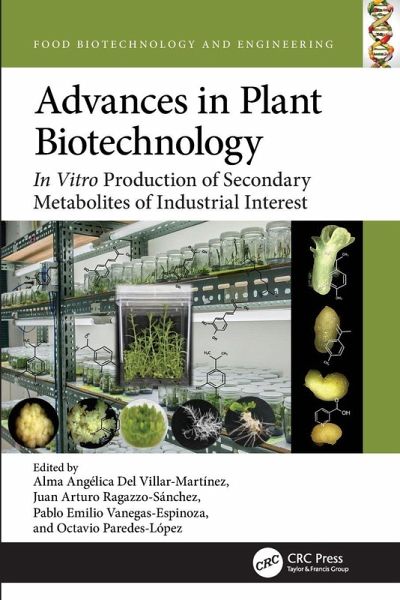
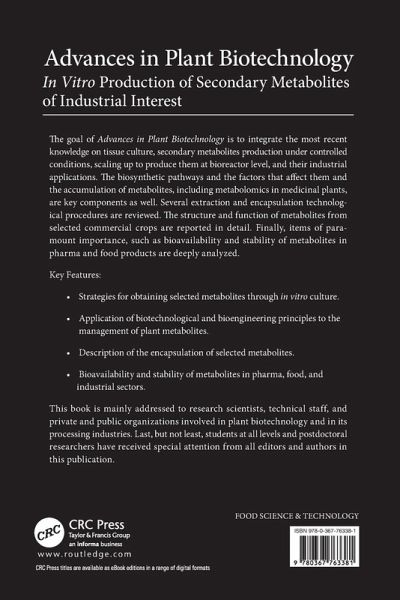
The goal of Advances in Plant Biotechnology is to integrate the most recent knowledge on tissue culture, secondary metabolites production under controlled conditions, scaling-up to produce them at bioreactor level, and their industrial applications.
The goal of Advances in Plant Biotechnology is to integrate the most recent knowledge on tissue culture, secondary metabolites production under controlled conditions, scaling-up to produce them at bioreactor level, and their industrial applications.
Alma Angélica Del Villar-Martínez, Ph.D is a Scientist at the Molecular Biology Laboratory, from the Department of Biotechnology at Centro de Desarrollo de Productos Bióticos (CEPROBI) in the Instituto Politécnico Nacional (IPN) in Morelos, México. She received her bachelor's degree in Bio-pharmaceutical Chemistry, MSc, and Ph.D. in Plant Biotechnology from the Department of Biotechnology at CINVESTAV-IRAPUATO, Mexico, as well as being a member of the National System of Researchers (Sistema Nacional de Investigadores, SNI-CONACYT). Dr. Del Villar-Martínez develops research projects related to the study of medicinal plants, with pharmacological potential; she has been involved in the biological potential of extracts from plant sources, in the development and induction of compounds with an antioxidant and anticancer effect, in the analysis of the chemical profile of extracts from different medicinal plants and the study of pigments of pharmacological and food interest; through the use of different biotechnological tools to improve the biosynthesis of the metabolites of interest from in vitro cultures. Del Villar-Martínez has published 25 peer-reviewed research papers, 2 book chapters, among other reviews and abstracts. Juan Arturo Ragazzo-Sánchez, Ph.D is a Professor-Researcher at Tecnológico Nacional de México / Instituto Tecnológico de Tepic, in the Biotechnology and Food Engineering, Department of Food Science. He is Chemical Engineering and MSc in Biochemical Engineering, from Instituto Tecnológico de Veracruz. Later, he received PhD in "Food Sciences" from Doctoral School of Biological and Industrial Sciences and Processes (University of Montpellier -France). Ragazzo-Sanchez has published 75 peer-reviewed research papers, 12 book chapters, edited 1 book, leaded more than 50 research projects, 5 patents and many other reviews and abstracts. In 2019 he is Co-Coordinator of the DESEAAR- CYTED Network, 319RT0576 (Desarrollo sostenible en Agroalimentación y Aprovechamiento de Residuos industriales). Pablo Emilio Vanegas-Espinoza, Ph.D is a Researcher at Centro de Desarrollo de Productos Bióticos (CEPROBI) of Instituto Politécnico Nacional (IPN), in the Molecular Biology Laboratory, from the Department of Biotechnology. As a professor, he teaches subjects such as Molecular Biology, Selected Topics on Secondary Metabolites in Plants, Biotechnology of in vitro Cultures, he supervises research of ungraduated/graduate students. He is an Agricultural Engineer in Horticulture and MSc and Ph.D in Plant Biotechology, from Centro de Investigación y de Estudios Avanzados (CINVESTAV-IPN), Campus Guanajuato, México. Working in plant cell culture and genetic transformation for more than 25 years. Octavio Paredes-López, Ph.D., is a biochemical engineer and food scientist, obtained bachelor's and master's degrees in biochemical engineering at the National Polytechnic Institute in Mexico City, and later earned a master's degree in biochemical engineering at Czechoslovak Academy of Sciences in Prague. He earned a PhD (1980) at the University of Manitoba, Canada, which awarded him an honorary Doctor of Science in 2005. He has authored over 300 publications in indexed journals, book chapters, and books and over 150 articles in newspapers in Mexico, USA and France. His h-index is 55.
Inhaltsangabe
1. Cell culture, somatic embryogenesis, and plant regeneration. 2. Secondary metabolites of Mesoamerican plants Castilleja tenuiflor Benth. and Baccharis conferta Kunth with anti-inflammatory effects. 3. Production of secondary metabolites by hairy root cultures. 4. Differentiated plant cell suspension cultures: the new promise for secondary metabolite production. 5. Metabolomics in medicinal plants. 6. Extraction, encapsulation, and biological activity of phenolic compounds, alkaloids, and acetogenins from the Annona genus. 7. Importance of plant secondary metabolites with biological activity on selected commercial crops. 8. Encapsulation of plant secondary metabolites of industrial interest. 9. Bioaccessibility and stability of plant secondary metabolites in pharmaceutical and food matrices.
1. Cell culture, somatic embryogenesis, and plant regeneration. 2. Secondary metabolites of Mesoamerican plants Castilleja tenuiflor Benth. and Baccharis conferta Kunth with anti-inflammatory effects. 3. Production of secondary metabolites by hairy root cultures. 4. Differentiated plant cell suspension cultures: the new promise for secondary metabolite production. 5. Metabolomics in medicinal plants. 6. Extraction, encapsulation, and biological activity of phenolic compounds, alkaloids, and acetogenins from the Annona genus. 7. Importance of plant secondary metabolites with biological activity on selected commercial crops. 8. Encapsulation of plant secondary metabolites of industrial interest. 9. Bioaccessibility and stability of plant secondary metabolites in pharmaceutical and food matrices.
Es gelten unsere Allgemeinen Geschäftsbedingungen: www.buecher.de/agb
Impressum
www.buecher.de ist ein Internetauftritt der buecher.de internetstores GmbH
Geschäftsführung: Monica Sawhney | Roland Kölbl | Günter Hilger
Sitz der Gesellschaft: Batheyer Straße 115 - 117, 58099 Hagen
Postanschrift: Bürgermeister-Wegele-Str. 12, 86167 Augsburg
Amtsgericht Hagen HRB 13257
Steuernummer: 321/5800/1497
USt-IdNr: DE450055826