
Andere Kunden interessierten sich auch für
 Prediction of breast cancer using various machine learning methods36,99 €
 Ensemble Feature Selection Method For Prediction of Chronic Datasets29,99 €
 DeepCOPD: COPD DETECTION USING DEEP LEARNING29,99 €
 Breast Cancer Prediction Using Genetic algorithm in machine learning27,99 €
 Framework for Intelligent CDSS to Diagnose Chronic Myeloid Leukemia33,99 €
 Machine Learning for Identification of Optimal Cluster in MRI Images27,99 €
 Missing Child Prediction Using Machine Learning Algorithms29,99 €

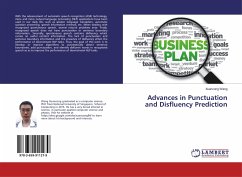
With the advancement of automatic speech recognition (ASR) technology, more and more natural language processing (NLP) applications have been used in our daily life, such as spoken language translation, automatic question answering, speech information retrieval, etc. When dealing with recognized spontaneous speech, several natural problems arise. Firstly, recognized speech does not have punctuation or sentence boundary information. Secondly, spontaneous speech contains disfluency which carries no useful content information. The lack of punctuation and sentence boundary information and the presence of disfluency affect the performance of downstream NLP tasks. Thus, the goal of this work is to develop or improve algorithms to automatically detect sentence boundaries, add punctuation, and identify disfluent words in recognized speech so as to improve the performance of downstream NLP tasks.