
Andere Kunden interessierten sich auch für
 Advances in Synchronization of Coupled Fractional Order Systems38,99 €
 Statistical Physics of Synchronization46,99 €
 Adventure Diffusion28,99 €
 Network-Oriented Modeling76,99 €
 Dynamics On and Of Complex Networks III76,99 €
 Two-dimensional Self-independent Variable Cubic Nonlinear Systems113,99 €
 Chaos, Synchronization and Structures in Dynamics of Systems with Cylindrical Phase Space76,99 €
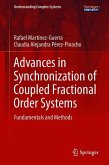




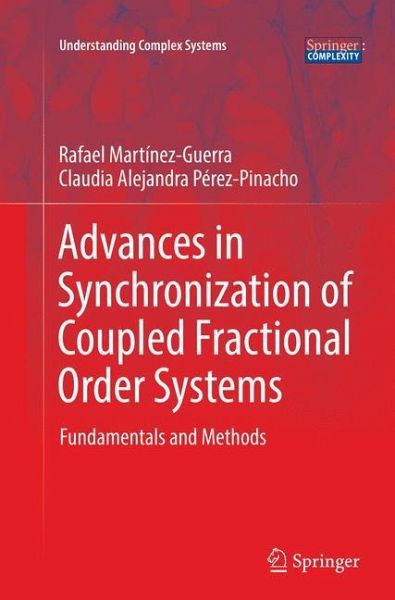
After a short introduction to the fundamentals, this book provides a detailed account of major advances in applying fractional calculus to dynamical systems. Fractional order dynamical systems currently continue to gain further importance in many areas of science and engineering.
As with many other approaches to mathematical modeling, the first issue to be addressed is the need to couple a definition of the fractional differentiation or integration operator with the types of dynamical systems that are analyzed. As such, for the fundamentals the focus is on basic aspects of fractional calculus, in particular stability analysis, which is required to tackle synchronization in coupled fractional order systems, to understand the essence of estimators for related integer order systems, and to keep track of the interplay between synchronization and parameter observation. This serves as the common basis for the more advanced topics and applications presented in the subsequent chapters, which include an introduction to the 'Immersion and Invariance' (I&I) methodology, the masterslave synchronization scheme for partially known nonlinear fractional order systems, Fractional Algebraic Observability (FAO) and Fractional Generalized quasi-Synchronization (FGqS) to name but a few.
This book is intended not only for applied mathematicians and theoretical physicists, but also for anyone in applied science dealing with complex nonlinear systems.
As with many other approaches to mathematical modeling, the first issue to be addressed is the need to couple a definition of the fractional differentiation or integration operator with the types of dynamical systems that are analyzed. As such, for the fundamentals the focus is on basic aspects of fractional calculus, in particular stability analysis, which is required to tackle synchronization in coupled fractional order systems, to understand the essence of estimators for related integer order systems, and to keep track of the interplay between synchronization and parameter observation. This serves as the common basis for the more advanced topics and applications presented in the subsequent chapters, which include an introduction to the 'Immersion and Invariance' (I&I) methodology, the masterslave synchronization scheme for partially known nonlinear fractional order systems, Fractional Algebraic Observability (FAO) and Fractional Generalized quasi-Synchronization (FGqS) to name but a few.
This book is intended not only for applied mathematicians and theoretical physicists, but also for anyone in applied science dealing with complex nonlinear systems.