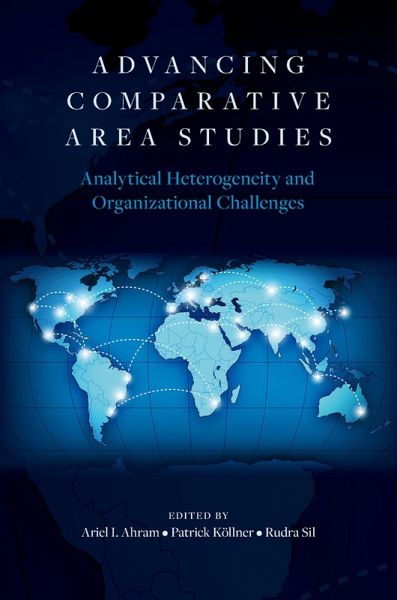
Advancing Comparative Area Studies responds to questions about the analytic range of the comparative area studies (CAS) field and the organizational challenges it must navigate. The chapters demonstrate that CAS can cover a broad range of scholarship beyond cross-national comparisons, including interpretive work across different sites, sub-national comparisons at the sectoral level, and inter-regional comparisons addressing topics such as the behavior of regional powers. The volume also considers how the institutional architecture of research universities can be adapted so as to better support…mehr
Advancing Comparative Area Studies responds to questions about the analytic range of the comparative area studies (CAS) field and the organizational challenges it must navigate. The chapters demonstrate that CAS can cover a broad range of scholarship beyond cross-national comparisons, including interpretive work across different sites, sub-national comparisons at the sectoral level, and inter-regional comparisons addressing topics such as the behavior of regional powers. The volume also considers how the institutional architecture of research universities can be adapted so as to better support cross-regional research and collaboration without sacrificing the quality of area expertise.
Ariel I. Ahram is Professor at the Virginia Tech School of Public & International Affairs in Arlington. He is an Associate of the Institute of Middle East Studies of the GIGA, the German Institute for Global and Area Studies. He earned his PhD in government and MA in Arab studies at Georgetown University and BA at Brandeis University. Patrick Köllner is Vice President of the German Institute for Global and Area Studies (GIGA), Director of the GIGA Institute for Asian Studies, and a professor of political science at the University of Hamburg. He studied politics and management as well as modern Japan studies at the universities of Konstanz and Essex and holds a doctorate and a habilitation in political science from Humboldt University of Berlin and the University of Trier, respectively. Rudra Sil is Professor of Political Science at the University of Pennsylvania, where he has taught since obtaining his PhD from the University of California, Berkeley. His scholarly interests encompass Russian/post-communist studies, Asian studies, labor politics, international development, qualitative methodology, and philosophy of social science.
Inhaltsangabe
* List of Contributors * Prologue * Comparative Area Studies: Implications for Institutional Architecture * Timothy J. Power * Chapter 1. Introduction * Extending the Horizons of Comparative Area Studies (CAS): Analytical Heterogeneity and Organizational Challenges * Patrick Köllner, Rudra Sil, and Ariel I. Ahram * Part I. CAS and the Prospects for Interpretation across Contexts * Chapter 2. Communicating Across Contexts: How Translation Can Benefit Comparative Area Studies * Erica S. Simmons and Nicholas Rush Smith * Chapter 3. Comparative Area Studies and Interpretivism: Towards an Interpretive-Comparative Research Approach * Anna Fünfgeld * Part II. How CAS Benefits, and Benefits from, Varied Strategies of Causal Analysis * Chapter 4. Causal Explanation with Ideal Types: Opportunities for Comparative Area Studies * Ryan Saylor * Chapter 5. Advancing Theory Development in Comparative Area Studies: Practical Recommendations for Evaluating the Equifinality of Causal Mechanisms * Marissa Brookes and Jesse Dillon Savage * Chapter 6. The Best of Two Worlds? Generalizing and Individualizing through Multi-Method Research in Comparative Area Studies * Matthias Basedau and David Kuehn * Part III. Rethinking the Sites and Spaces of Comparison * Chapter 7. Crossing the Boundaries of Comparison: Comparative Area Studies and Comparative Historical Analysis * Amel Ahmed * Chapter 8. Comparison as Ontology, Region as Concept: On the Synergies of Comparative Area Studies * Erik Martinez Kuhonta * Chapter 9. The Contextualized Comparative Sector Approach: Comparative Area Studies at the Sectoral Level of Analysis * Roselyn Hsueh * Part IV . CAS and the Promise of Global IR * Chapter 10. The Promise of Comparative Area Studies for the Study of Human Rights * Eileen Doherty-Sil * Chapter 11. Revisionist (Eurasian) Powers and the West: A Comparative Area Studies Bridge * between International Relations Theory and Area Expertise * Nora Fisher-Onar * Part V. Organizational Challenges and Institutional Frameworks for CAS * Chapter 12. Comparative Area Studies: Programs, Departments, Constraints, Opportunities * Sara Wallace Goodman and Thomas Pepinsky * Chapter 13. Comparative Area Studies in the Great Brain Race: Institutional Legacies and * Programmatic Innovation in the Global Age * Ariel I. Ahram and Connie Stovall * Epilogue * Amrita Narlikar
* List of Contributors * Prologue * Comparative Area Studies: Implications for Institutional Architecture * Timothy J. Power * Chapter 1. Introduction * Extending the Horizons of Comparative Area Studies (CAS): Analytical Heterogeneity and Organizational Challenges * Patrick Köllner, Rudra Sil, and Ariel I. Ahram * Part I. CAS and the Prospects for Interpretation across Contexts * Chapter 2. Communicating Across Contexts: How Translation Can Benefit Comparative Area Studies * Erica S. Simmons and Nicholas Rush Smith * Chapter 3. Comparative Area Studies and Interpretivism: Towards an Interpretive-Comparative Research Approach * Anna Fünfgeld * Part II. How CAS Benefits, and Benefits from, Varied Strategies of Causal Analysis * Chapter 4. Causal Explanation with Ideal Types: Opportunities for Comparative Area Studies * Ryan Saylor * Chapter 5. Advancing Theory Development in Comparative Area Studies: Practical Recommendations for Evaluating the Equifinality of Causal Mechanisms * Marissa Brookes and Jesse Dillon Savage * Chapter 6. The Best of Two Worlds? Generalizing and Individualizing through Multi-Method Research in Comparative Area Studies * Matthias Basedau and David Kuehn * Part III. Rethinking the Sites and Spaces of Comparison * Chapter 7. Crossing the Boundaries of Comparison: Comparative Area Studies and Comparative Historical Analysis * Amel Ahmed * Chapter 8. Comparison as Ontology, Region as Concept: On the Synergies of Comparative Area Studies * Erik Martinez Kuhonta * Chapter 9. The Contextualized Comparative Sector Approach: Comparative Area Studies at the Sectoral Level of Analysis * Roselyn Hsueh * Part IV . CAS and the Promise of Global IR * Chapter 10. The Promise of Comparative Area Studies for the Study of Human Rights * Eileen Doherty-Sil * Chapter 11. Revisionist (Eurasian) Powers and the West: A Comparative Area Studies Bridge * between International Relations Theory and Area Expertise * Nora Fisher-Onar * Part V. Organizational Challenges and Institutional Frameworks for CAS * Chapter 12. Comparative Area Studies: Programs, Departments, Constraints, Opportunities * Sara Wallace Goodman and Thomas Pepinsky * Chapter 13. Comparative Area Studies in the Great Brain Race: Institutional Legacies and * Programmatic Innovation in the Global Age * Ariel I. Ahram and Connie Stovall * Epilogue * Amrita Narlikar
Es gelten unsere Allgemeinen Geschäftsbedingungen: www.buecher.de/agb
Impressum
www.buecher.de ist ein Internetauftritt der buecher.de internetstores GmbH
Geschäftsführung: Monica Sawhney | Roland Kölbl | Günter Hilger
Sitz der Gesellschaft: Batheyer Straße 115 - 117, 58099 Hagen
Postanschrift: Bürgermeister-Wegele-Str. 12, 86167 Augsburg
Amtsgericht Hagen HRB 13257
Steuernummer: 321/5800/1497
USt-IdNr: DE450055826