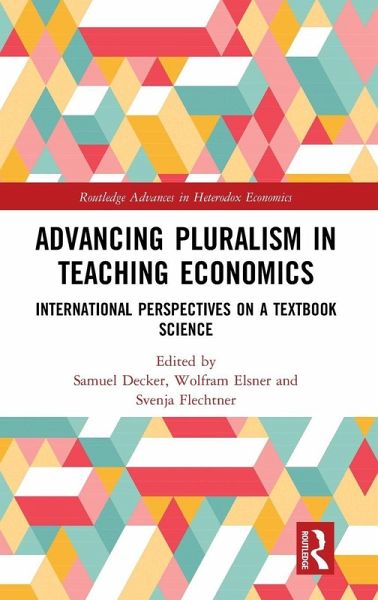
This state-of-the-art compilation of diverse and innovative perspectives on the methodology and appliance of pluralist economics teaching addresses questions around the important of pluralistic teaching. The result is a diverse book on teaching economics in the contemporary classroom with ideas and examples drawn from around the world.
This state-of-the-art compilation of diverse and innovative perspectives on the methodology and appliance of pluralist economics teaching addresses questions around the important of pluralistic teaching. The result is a diverse book on teaching economics in the contemporary classroom with ideas and examples drawn from around the world.
Samuel Decker is an economist and activist based in Berlin, Germany. He works as scientific assistant for the online learning platform Exploring Economics (www.exploring-economics.org/en/). He holds a master's degree in "Political Economy of European Integration" and is an active member of the student movement for pluralism in economics. Wolfram Elsner was Professor of Economics at the University of Bremen, Germany from 1995 until he retired in 2016. He has also worked as head of local economic development, head of the Planning Division of the Ministry of Economic Affairs of the State of Bremen, and as Director of the State of Bremen Government's economic research institute, 1986 to 1995. He was president of the European Association for Evolutionary Political Economy, 2012-2016. Svenja Flechtner is an Assistant Professor of Pluralist Economics at the University of Siegen, Germany. She has been a research assistant at Europa-Universität Flensburg and Freie Universität Berlin. From 2014-2018, she was a council member of the European Association for Evolutionary Political Economy.
Inhaltsangabe
List of Contributors. List of Referees. Economics and its teaching at a critical juncture: Introduction, Samuel Decker, Wolfram Elsner and Svenja Flechtner. Part I: Why Pluralism is Important for (Teaching) a Serious Social Science: Foundations. 1 Pluralist economics: is it scientific?, Sheila Dow. 2 Monism in Modern Science: the Case of Economics, Frank Beckenbach. 3 Pluralism in Economics: Epistemological Rationales and Pedagogical Implementation, Jakob Kapeller. 4 In and Against Orthodoxy: Teaching Economics in the Neoliberal Era, Ben Fine. 5 An Outsider's Perspective: What can economics teaching learn from History Didactics?, Astrid Schwabe. Part II: International Perspectives on Pluralist Teaching. 6 Issues in Teaching of Economics and Pluralism in Brazil, Rafael Galvão de Almeida and Ian Coelho de Souza Almeida. 7 Economics Education in India: from Pluralism to Neo-Liberalism and to 'Hindutva', Sudipta Bhattacharyya. 8 China's Idiosyncratic Economics: An Emerging Unknown Monism Driven by Pluralism, Shuanping Dai. 9 The Need for an Independent Perspective: Teaching Economics in Ghana, Hadrat Yusif. 10 Teaching the euro crisis: What do students in Germany and France learn about the causes of Europe's economic crisis?, Philipp Kortendiek and Till van Treeck. Part III: Economic Textbooks: Failures and new Pathways. 11 "Waging the War of Ideas": Economics as a Textbook Science and Its Possible Influence on Human Minds, Silja Graupe. 12 The schoolmaster's voice: How professional identities are formed by textbook discourses in mainstream economics, Jens Maesse. 13 Why economics textbooks must, and how they can, be changed into a real-world and pluralist economics: The example of a fundamentally new complexity-economics micro-textbook, Wolfram Elsner. 14 What can we learn from school economics education?, Janina Urban. Part IV: The Prospects of Pluralism in Economics. 15 Explaining difference and diversity in an increasingly complex economics, John Davis. 16 Towards a critical and transdisciplinary economic science?, Samuel Decker. A Pluralist Economics Teaching is Practicable and Illuminating: A Conclusion, Samuel Decker, Wolfram Elsner and Svenja Flechtner. Index
List of Contributors. List of Referees. Economics and its teaching at a critical juncture: Introduction, Samuel Decker, Wolfram Elsner and Svenja Flechtner. Part I: Why Pluralism is Important for (Teaching) a Serious Social Science: Foundations. 1 Pluralist economics: is it scientific?, Sheila Dow. 2 Monism in Modern Science: the Case of Economics, Frank Beckenbach. 3 Pluralism in Economics: Epistemological Rationales and Pedagogical Implementation, Jakob Kapeller. 4 In and Against Orthodoxy: Teaching Economics in the Neoliberal Era, Ben Fine. 5 An Outsider's Perspective: What can economics teaching learn from History Didactics?, Astrid Schwabe. Part II: International Perspectives on Pluralist Teaching. 6 Issues in Teaching of Economics and Pluralism in Brazil, Rafael Galvão de Almeida and Ian Coelho de Souza Almeida. 7 Economics Education in India: from Pluralism to Neo-Liberalism and to 'Hindutva', Sudipta Bhattacharyya. 8 China's Idiosyncratic Economics: An Emerging Unknown Monism Driven by Pluralism, Shuanping Dai. 9 The Need for an Independent Perspective: Teaching Economics in Ghana, Hadrat Yusif. 10 Teaching the euro crisis: What do students in Germany and France learn about the causes of Europe's economic crisis?, Philipp Kortendiek and Till van Treeck. Part III: Economic Textbooks: Failures and new Pathways. 11 "Waging the War of Ideas": Economics as a Textbook Science and Its Possible Influence on Human Minds, Silja Graupe. 12 The schoolmaster's voice: How professional identities are formed by textbook discourses in mainstream economics, Jens Maesse. 13 Why economics textbooks must, and how they can, be changed into a real-world and pluralist economics: The example of a fundamentally new complexity-economics micro-textbook, Wolfram Elsner. 14 What can we learn from school economics education?, Janina Urban. Part IV: The Prospects of Pluralism in Economics. 15 Explaining difference and diversity in an increasingly complex economics, John Davis. 16 Towards a critical and transdisciplinary economic science?, Samuel Decker. A Pluralist Economics Teaching is Practicable and Illuminating: A Conclusion, Samuel Decker, Wolfram Elsner and Svenja Flechtner. Index
Es gelten unsere Allgemeinen Geschäftsbedingungen: www.buecher.de/agb
Impressum
www.buecher.de ist ein Internetauftritt der buecher.de internetstores GmbH
Geschäftsführung: Monica Sawhney | Roland Kölbl | Günter Hilger
Sitz der Gesellschaft: Batheyer Straße 115 - 117, 58099 Hagen
Postanschrift: Bürgermeister-Wegele-Str. 12, 86167 Augsburg
Amtsgericht Hagen HRB 13257
Steuernummer: 321/5800/1497
USt-IdNr: DE450055826