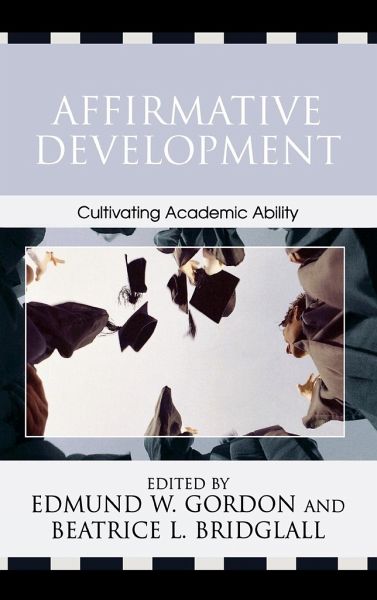
Affirmative Development makes the case theoretically for deliberate intervention to develop academic ability for students not naturally disposed to develop such ability by the conditions under which they live. The book includes discussions of intellective competence and intellective character as products of the development of academic ability and reviews of the research evidence for the feasibility and morality of such action.
Affirmative Development makes the case theoretically for deliberate intervention to develop academic ability for students not naturally disposed to develop such ability by the conditions under which they live. The book includes discussions of intellective competence and intellective character as products of the development of academic ability and reviews of the research evidence for the feasibility and morality of such action.
Edmund W. Gordon is the Richard March Hoe Professor of Psychology and Education, Emeritus and Director of the Institute for Urban and Minority Education at Teachers College, Columbia University. He is also the John M. Musser Professor of Psychology, Emeritus at Yale University; and the Senior Scholar in Residence at The College Board. He has authored or edited over 15 books and monographs, including Compensatory Education: Preschool through College, which continues to be regarded as the classic work in its field. Edmund W. Gordon is one of the conceptual leaders of several of the major developments in public education, viz. Head Start, compensatory education, career education, school desegregation, alternatives in educational assessment, and supplementary education. Beatrice L. Bridglall is currently Research Scientist & Editor in the National Center for Children & Families at Teacher's College, Columbia University and Assistant Professor in the Department of Health and Behavior Studies at Teachers College, Columbia University. Bridglall is conducting several programs of research, including one directed at investigating the correlates of minority high academic achievement. An emerging area of interest is early childhood education, particularly the role of parental practices/investment in mediating academic achievement. Dr. Bridglall has recently published a co-edited book, Supplementary Education: The hidden curriculum of high academic achievement (Rowman & Littlefield 2005).
Inhaltsangabe
Part 1 Part I: Affirmative Action and Affirmative Development Chapter 2 Toward the Development of Intellective Character Chapter 2 Intellective Competence: The Universal Currency in Technologically Advanced Societies Chapter 3 Intelligence as a Socialized Phenomenon Chapter 4 Affirmative Development as an Alternative to Affirmative Action Chapter 5 Meritocracy and the Opportunity to Learn Chapter 6 Cultural Experience, Academic Cultures and Academic Ability Part 7 Part II: Affirmative Development of Academic Ability Chapter 8 The Curriculum and Its Functions Chapter 9 The Teaching and Learning of Intellective Competence Chapter 10 Psychosocial Processes in the Cultivation of Intellective Competence: The Interpenetration of Affective, Cognitive, and Situative Processes in Intellective Behavior Chapter 11 Politicalization: A Neglected Pedagogical Process Chapter 12 The Problem of Transfer and Adaptability: Applying the Learning Sciences to the Challenge of the Acheivement Gap Chapter 14 Task Force Report on the Affirmative Development of Academic Ability: All Students Reaching the Top: Strategies for Closing Academic Achievement Gaps
Part 1 Part I: Affirmative Action and Affirmative Development Chapter 2 Toward the Development of Intellective Character Chapter 2 Intellective Competence: The Universal Currency in Technologically Advanced Societies Chapter 3 Intelligence as a Socialized Phenomenon Chapter 4 Affirmative Development as an Alternative to Affirmative Action Chapter 5 Meritocracy and the Opportunity to Learn Chapter 6 Cultural Experience, Academic Cultures and Academic Ability Part 7 Part II: Affirmative Development of Academic Ability Chapter 8 The Curriculum and Its Functions Chapter 9 The Teaching and Learning of Intellective Competence Chapter 10 Psychosocial Processes in the Cultivation of Intellective Competence: The Interpenetration of Affective, Cognitive, and Situative Processes in Intellective Behavior Chapter 11 Politicalization: A Neglected Pedagogical Process Chapter 12 The Problem of Transfer and Adaptability: Applying the Learning Sciences to the Challenge of the Acheivement Gap Chapter 14 Task Force Report on the Affirmative Development of Academic Ability: All Students Reaching the Top: Strategies for Closing Academic Achievement Gaps
Es gelten unsere Allgemeinen Geschäftsbedingungen: www.buecher.de/agb
Impressum
www.buecher.de ist ein Internetauftritt der buecher.de internetstores GmbH
Geschäftsführung: Monica Sawhney | Roland Kölbl | Günter Hilger
Sitz der Gesellschaft: Batheyer Straße 115 - 117, 58099 Hagen
Postanschrift: Bürgermeister-Wegele-Str. 12, 86167 Augsburg
Amtsgericht Hagen HRB 13257
Steuernummer: 321/5800/1497
USt-IdNr: DE450055826