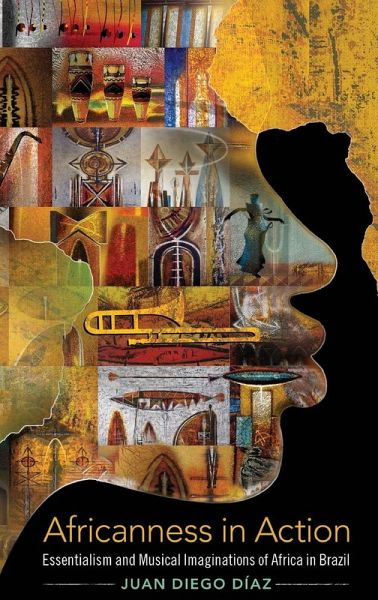
When many people think of African music, the first ideas that come to mind are often of rhythm, drums, and dancing. These perceptions are rooted in emblematic African and African-derived genres such as West African drumming, funk, salsa, or samba and, more importantly, essentialized notions about Africa which have been fueled over centuries of contact between the "West," Africa, and the African diaspora. These notions, of course, tend to reduce and often portray Africa and the diaspora as primitive, exotic, and monolithic. In Africanness in Action, author Juan Diego Díaz explores this dynamic…mehr
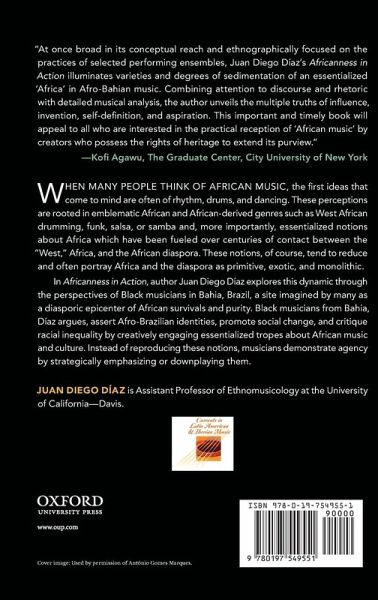
When many people think of African music, the first ideas that come to mind are often of rhythm, drums, and dancing. These perceptions are rooted in emblematic African and African-derived genres such as West African drumming, funk, salsa, or samba and, more importantly, essentialized notions about Africa which have been fueled over centuries of contact between the "West," Africa, and the African diaspora. These notions, of course, tend to reduce and often portray Africa and the diaspora as primitive, exotic, and monolithic. In Africanness in Action, author Juan Diego Díaz explores this dynamic through the perspectives of Black musicians in Bahia, Brazil, a site imagined by many as a diasporic epicenter of African survivals and purity. Black musicians from Bahia, Díaz argues, assert Afro-Brazilian identities, promote social change, and critique racial inequality by creatively engaging essentialized tropes about African music and culture. Instead of reproducing these notions, musicians demonstrate agency by strategically emphasizing or downplaying them.
Juan Diego Díaz is Assistant Professor of Ethnomusicology at UC Davis. Prior to UC Davis, Díaz held posts as a lecturer at the University of Ghana and postdoctoral fellow at the University of Essex, the latter funded by the Social Sciences and Humanities Research Council of Canada. The funded research investigates the music of the descendants of freed enslaved Africans who resettled from Brazil to Ghana, Togo, and Benin during the nineteenth century. This research has produced a book called Tabom Voices: A History of the Ghanaian Afro-Brazilian Community in Their Own Words (2016) and the documentary film Tabom in Bahia (2017), documenting the visit of a Ghanaian master drummer to Bahia, Brazil. His articles appear in journals such as Ethnomusicology, Ethnomusicology Forum, Analytical Approaches to World Music, and Latin American Music Review.
Inhaltsangabe
Introduction 1. Bahia as an Epicenter of African Diasporic Culture 2. Redeeming the Study of African Essentialism 3. Orkestra Rumpilezz: A Big Band Playing Percussion 4. Orkestra Rumpilezz: Complications of African Rhythm 5. Orquestra Afrosinfônica: The Africanization of Erudite Music 6. The Nzinga Berimbau Orchestra: Performances of Bantu Heritage 7. The Tuned Berimbaus of OBADX: Melodic Performances of Africanness Conclusion: Lessons from Essentialism
Introduction 1. Bahia as an Epicenter of African Diasporic Culture 2. Redeeming the Study of African Essentialism 3. Orkestra Rumpilezz: A Big Band Playing Percussion 4. Orkestra Rumpilezz: Complications of African Rhythm 5. Orquestra Afrosinfônica: The Africanization of Erudite Music 6. The Nzinga Berimbau Orchestra: Performances of Bantu Heritage 7. The Tuned Berimbaus of OBADX: Melodic Performances of Africanness Conclusion: Lessons from Essentialism
Es gelten unsere Allgemeinen Geschäftsbedingungen: www.buecher.de/agb
Impressum
www.buecher.de ist ein Internetauftritt der buecher.de internetstores GmbH
Geschäftsführung: Monica Sawhney | Roland Kölbl | Günter Hilger
Sitz der Gesellschaft: Batheyer Straße 115 - 117, 58099 Hagen
Postanschrift: Bürgermeister-Wegele-Str. 12, 86167 Augsburg
Amtsgericht Hagen HRB 13257
Steuernummer: 321/5800/1497
USt-IdNr: DE450055826