Relatively little is known about Africa's endangered languages. Unlike indigenous languages in Australia, North Asia, and the Americas, which are predominantly threatened by colonizers, African languages are threatened most immediately by other local languages. As a result, the threat of language extinction is perceived as lower in Africa than in other parts of the globe, and a disproportionate amount of research is devoted to the study of endangered African languages when compared to any other linguistically threatened region in the world. There are approximately 308 highly endangered…mehr
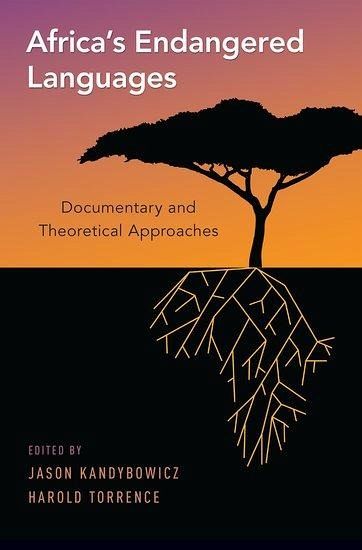
Relatively little is known about Africa's endangered languages. Unlike indigenous languages in Australia, North Asia, and the Americas, which are predominantly threatened by colonizers, African languages are threatened most immediately by other local languages. As a result, the threat of language extinction is perceived as lower in Africa than in other parts of the globe, and a disproportionate amount of research is devoted to the study of endangered African languages when compared to any other linguistically threatened region in the world. There are approximately 308 highly endangered languages spoken in Africa (roughly 12% of all African languages) and at least 201 extinct African languages. This volume hopes to illuminate and challenge this trend. Chapters offer both documentary and theoretical perspectives, emphasizing the symbiotic relationship between the two approaches and its implications for the preservation of endangered languages, both in the African context and more broadly. Documentary-oriented chapters deal with key issues in African language documentation including language preservation and revitalization, community activism, and data collection and dissemination methodologies, among others. Theoretically-oriented chapters provide detailed descriptions and analyses of phonetic, phonological, morphological, syntactic, and semantic phenomena, and connect these to current theoretical issues and debates. Africa's Endangered Languages provides thorough coverage of a continent's neglected languages that will spur linguists and Africanists alike to work to protect them.
Jason Kandybowicz is Associate Professor of Linguistics at The Graduate Center, City University of New York. He is the author of The Grammar of Repetition: Nupe Grammar at the Syntax-Phonology Interfacethe syntax-phonology interface, field linguistics and language documentation, and African linguistics (particularly, the languages of West Africa).
Inhaltsangabe
* List of contributors * Chapter 1 - Africa's Endangered Languages: An Overview * Jason Kandybowicz and Harold Torrence * Chapter 2 - The Challenge of Documenting Africa's Least Known Languages * Bonny Sands * Chapter 3 - The Nata Documentation Project: An Overview * Joash J. Gambarage, Andrei Anghelescu, Strang Burton, Joel Dunham, Erin Guntly, Hermann Keupdjio, Zoe Wai-Man Lam, Adriana Osa-Gomez, Douglas Pulleyblank, Dayanqi Si, Yoshiko Yoshino and Rose-Marie Déchaine * Chapter 4 - Tongue Root Harmony in Nata: An Allomorphy-based Account * Joash J. Gambarage and Douglas Pulleyblank * Chapter 5 - Nominal and Verbal Tone in Nata: An Allomorphy-based Account * Andrei Anghelescu, Joash J. Gambarage, Zoe Wai-Man Lam and Douglas Pulleyblank * Chapter 6 - Nata Deverbal Nominalizations * Rose-Marie Déchaine, Dayanqi Si and Joash J. Gambarage * Chapter 7 - Busy Intersections: A Framework for Revitalization * G. Tucker Childs * Chapter 8 - Documenting Ekegusii: How 'Empowering' Research Fulfills Community and Academic Goals * Carlos M Nash * Chapter 9 - The Role of Theory in Documentation: Intervention Effects and Missing Gaps in the Krachi Documentary Record * Jason Kandybowicz and Harold Torrence * Chapter 10 - Documenting Raising and Control in Moro * Peter Jenks and Sharon Rose * Chapter 11 - The Linker in the Khoisan Languages * Chris Collins * Chapter 12 - Theory and Description: Understanding the Syntax of Eegimaa Verb Stem Morphology * Mamadou Bassene and Ken Safir * Chapter 13 - On (Ir)realis in Seenku (Mande, Burkina Faso) * Laura McPherson * Chapter 14 - Contributions of Micro-comparative Research to Language Documentation: Two Bantu Case Studies * Michael R. Marlo * Chapter 15 - Sebirwa in Contact with Setswana: A Natural Experiment in Learning an * Unnatural Alternation * Elizabeth C. Zsiga and One Tlale Boyer * Chapter 16 - Three Analyses of Underlying Plosives in Caning, A Nilo Saharan Language of Sudan * Timothy M. Stirtz * Chapter 17 - Exceptions to Hiatus Resolution in Mushunguli (Somali Chizigula) * Katherine Hout * Chapter 18 - Acoustic and Aerodynamic Data on Somali Chizigula Stops * Michal Temkin Martinez and Vanessa Rosenbaum * Chapter 19 - Unmasking the Bantu Orthographic Vowels: The Challenge for Language Documentation and Description * Joash J. Gambarage
Es gelten unsere Allgemeinen Geschäftsbedingungen: www.buecher.de/agb
Impressum
www.buecher.de ist ein Internetauftritt der buecher.de internetstores GmbH
Geschäftsführung: Monica Sawhney | Roland Kölbl | Günter Hilger
Sitz der Gesellschaft: Batheyer Straße 115 - 117, 58099 Hagen
Postanschrift: Bürgermeister-Wegele-Str. 12, 86167 Augsburg
Amtsgericht Hagen HRB 13257
Steuernummer: 321/5800/1497
USt-IdNr: DE450055826