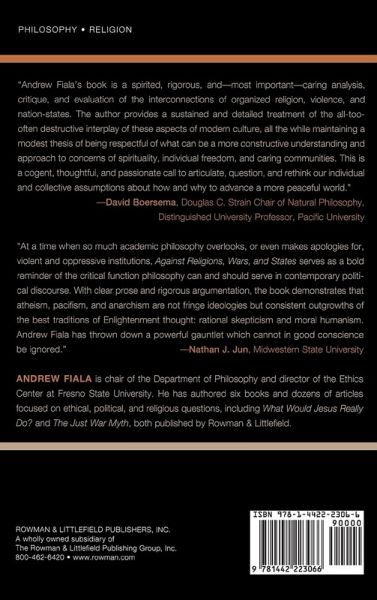
In Against Religion, Wars, and States: The Case for Enlightenment Atheism, Just War Pacifism, and Liberal-Democratic Anarchism, Andrew Fiala argues that, societally, we must radically redefine our goals. A renewed focus on global justice, a heightened criticism of religion and a fuller embrace of enlightened humanism and the sciences are just some of the ways in which we can begin to address some of the problems endemic to our society, and ultimately bring about more lasting peace. Fiala argues both theoretically and empirically, moving from analyses of theology, ethics and political…mehr
In Against Religion, Wars, and States: The Case for Enlightenment Atheism, Just War Pacifism, and Liberal-Democratic Anarchism, Andrew Fiala argues that, societally, we must radically redefine our goals. A renewed focus on global justice, a heightened criticism of religion and a fuller embrace of enlightened humanism and the sciences are just some of the ways in which we can begin to address some of the problems endemic to our society, and ultimately bring about more lasting peace. Fiala argues both theoretically and empirically, moving from analyses of theology, ethics and political philosophy to case studies and data mined from these respective disciplines, and from the fallout of recent world events involving all three. Fiala attempts to wean us off of our deferral to the oppressive forces that spark movements like Occupy, and the Arab Spring, forces that manifest themselves in the brutal drug wars along our borders, and in the currently fractious and bigoted rhetoric of some of our most powerful political and religious leaders. Against Religion, Wars, and States provides a provocative, unified, and revolutionary critical theory for all who are skeptical of the religious, political, and military powers that be, and points the way towards a more peaceful, just and reasoned future.
Andrew Fiala is professor of philosophy and director of the Ethics Center at Fresno State. He is the author or editor of more than a dozen books and more than fifty scholarly articles. His most recent books are: Nonviolence: A Quick Immersion (2020) and The Routledge Handbook of Pacifism and Nonviolence (editor, 2018). Peter Admirand is lecturer in theology and director of the Centre for Interreligious Dialogue at Dublin City University. His most recent books are Humbling Faith: Brokenness, Doubt, Dialogue--What Unites Atheists, Theists, and Nontheists (2019) and a forthcoming book exploring ethics in the comics Y: The Last Man and Saga.
Inhaltsangabe
Preface Chapter 1: Against Religions, Wars, and States Argument and Method Civilization, Authority, and Bullshit Costs and Benefits: A Preliminary Account Conclusion Chapter 2: Five Principles of Criticism Methodological Considerations The Individual Liberty Principle The Caring Community Principle The Skeptical Principle The Peace Principle The Cosmopolitan Principles Conclusion Chapter 3: Agnosticism and Atheism Skepticism about Religion Individual Liberty and Religion Genuine Community, Universal Justice, and Peace Conclusion Chapter 4: Religion, The Military, and the Secular Challenge The Unholy Conjunction of Religion, Politics, and Violence Toward a More Secular Union Thank God for the First Amendment Science and Religion in the Public Sphere Conclusion Chapter 5: Religion, The Family, and Criminal Justice Religion and Demography Women and Children Violence Against Children Free Will and Criminal Justice Conclusion Chapter 6: Skeptical Pacifism The Peace Principle Agnosticism and The Just War Tradition Military Service, The Individual, and The Community Atheism, Cosmopolitanism, and Pacifism Conclusion Chapter 7: The War-System, Profit, and the Failure of Just War Ethics Standing Armies and Spending Priorities The War Racket and Just War Theory A Case Study from the Eastern Mediterranean Defense Contractor Profits Arms Dealers, Power, Politics, and the Revolving Door Global Profits and Unjust Arms Deals Conclusion Chapter 8: One-Sided Wars: Torture, Nukes, Religion, and Collective Narcissism Good Guys and Bad Guys Religion and the War on Terror Nuclear Madness Humanitarian Interventions Conclusion Chapter 9: Social Contract Anarchism and Cosmopolitan Democracy Against the Organic Platonic State Skepticism and the Liberal Social Contract Theory Individual Liberty, Nation-States, and Genuine Communities The Cosmopolitan Principle and The Peace Principle Conclusion Chapter 10: Civil Religion, Voting, and Oligarchy Patriotism, Civil Religion, and Military Service Voting, Consent, and Political Power The Money Problem A Constitutional Crisis? Oligarchy Getting Away with Murder Conclusion Chapter 11: State Violence, the Prison-Industrial Complex, and Immigration Civilization and State Violence Restorative Justice and Police Brutality Drug War Profits Deterring Crime Convicting the Innocent Defining Crime and Defending Punishment The Prison-Industrial Complex Conclusion Chapter 12: Conclusion Bibliography
Preface Chapter 1: Against Religions, Wars, and States Argument and Method Civilization, Authority, and Bullshit Costs and Benefits: A Preliminary Account Conclusion Chapter 2: Five Principles of Criticism Methodological Considerations The Individual Liberty Principle The Caring Community Principle The Skeptical Principle The Peace Principle The Cosmopolitan Principles Conclusion Chapter 3: Agnosticism and Atheism Skepticism about Religion Individual Liberty and Religion Genuine Community, Universal Justice, and Peace Conclusion Chapter 4: Religion, The Military, and the Secular Challenge The Unholy Conjunction of Religion, Politics, and Violence Toward a More Secular Union Thank God for the First Amendment Science and Religion in the Public Sphere Conclusion Chapter 5: Religion, The Family, and Criminal Justice Religion and Demography Women and Children Violence Against Children Free Will and Criminal Justice Conclusion Chapter 6: Skeptical Pacifism The Peace Principle Agnosticism and The Just War Tradition Military Service, The Individual, and The Community Atheism, Cosmopolitanism, and Pacifism Conclusion Chapter 7: The War-System, Profit, and the Failure of Just War Ethics Standing Armies and Spending Priorities The War Racket and Just War Theory A Case Study from the Eastern Mediterranean Defense Contractor Profits Arms Dealers, Power, Politics, and the Revolving Door Global Profits and Unjust Arms Deals Conclusion Chapter 8: One-Sided Wars: Torture, Nukes, Religion, and Collective Narcissism Good Guys and Bad Guys Religion and the War on Terror Nuclear Madness Humanitarian Interventions Conclusion Chapter 9: Social Contract Anarchism and Cosmopolitan Democracy Against the Organic Platonic State Skepticism and the Liberal Social Contract Theory Individual Liberty, Nation-States, and Genuine Communities The Cosmopolitan Principle and The Peace Principle Conclusion Chapter 10: Civil Religion, Voting, and Oligarchy Patriotism, Civil Religion, and Military Service Voting, Consent, and Political Power The Money Problem A Constitutional Crisis? Oligarchy Getting Away with Murder Conclusion Chapter 11: State Violence, the Prison-Industrial Complex, and Immigration Civilization and State Violence Restorative Justice and Police Brutality Drug War Profits Deterring Crime Convicting the Innocent Defining Crime and Defending Punishment The Prison-Industrial Complex Conclusion Chapter 12: Conclusion Bibliography
Es gelten unsere Allgemeinen Geschäftsbedingungen: www.buecher.de/agb
Impressum
www.buecher.de ist ein Internetauftritt der buecher.de internetstores GmbH
Geschäftsführung: Monica Sawhney | Roland Kölbl | Günter Hilger
Sitz der Gesellschaft: Batheyer Straße 115 - 117, 58099 Hagen
Postanschrift: Bürgermeister-Wegele-Str. 12, 86167 Augsburg
Amtsgericht Hagen HRB 13257
Steuernummer: 321/5800/1497
USt-IdNr: DE450055826