
Andere Kunden interessierten sich auch für
 Environmental Materials and Waste78,99 €
 Advances in Urban Stormwater and Agricultural Runoff Source Controls77,99 €
 Advances in Urban Stormwater and Agricultural Runoff Source Controls77,99 €
 Plants leaf adsorbents used for iron and phosphorus removal from water40,99 €
 Retaining Walls65,99 €
 The sorption of organic pollutants in the soil environment39,99 €
 Water deferrization in polystyrene foam filters with sediment layer27,99 €
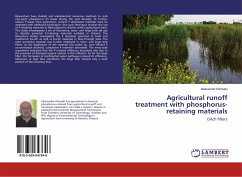
Researchers have studied and implemented numerous methods to curb non-point phosphorus (P) losses during the past decades. To further reduce P losses from agriculture, current P abatement methods must be amended with additional techniques. One such technique involves the use of P-retaining materials as filters placed in ditches within agricultural areas. This study encompasses a set of laboratory, meso- and large-scale set-ups to identify potential P-retaining materials available in Finland. The laboratory studies investigated the P retention potential of fresh and weathered Ca-rich as well as Fe-rich materials in flow-through tests. The most promising material was further employed in meso- and large-scale filters. As the application of the material was scaled up, and influent P concentration declined, cumulative P retention decreased. The meso-scale experiment indicated that the P removal efficiency decreased also due to the presence of dissolved organic carbon in the influents.As for the large filter, the formation of preferential water pathways reduced its efficiency. Moreover, in high flow conditions, the large filter treated only a small portion of the incoming flow.