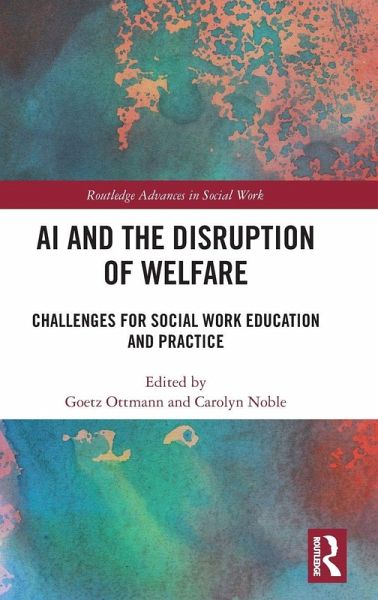
This book with 22 chapters from eminent scholars, focuses on the role of AI-enabled technology in surveillance and coercive 'welfare' bringing into view how advanced technology is used to shift the boundaries between welfare, penal, and carceral state and its very real impact on social work education and practice.
This book with 22 chapters from eminent scholars, focuses on the role of AI-enabled technology in surveillance and coercive 'welfare' bringing into view how advanced technology is used to shift the boundaries between welfare, penal, and carceral state and its very real impact on social work education and practice.
Goetz Ottmann, PhD, is a senior lecturer at Federation University, Melbourne. He is the author of five books, numerous book chapters, and many reports and peer-reviewed journal articles. Carolyn Noble, PhD, is a Professor Emerita at ACAP, Sydney, Victoria University, Melbourne, Australia. She is the author of several books and many book chapters and peer-reviewed articles.
Inhaltsangabe
1.AI and the disruption of welfare: Introduction. 2.Managerialism on Steroids: The rise of Artificial Intelligence. 3.The rise of the digitally enabled Carceral State and impact on social work. 4.A critical reflection on the changing capacity of surveillance in digitally mediated welfare services. 5.Automated algorithmic governance in the human services. 6.Automated algorithms, epistemological shifts, and the erosion of fundamental legal and ethical principles in the social services. 7."Even if Elon Musk was a social worker...": Coercive past and technological futures in social work in Lithuania, UK and Spain. 8.Ghost in the cell? Artificial Intelligence in prisoners' rehabilitation: Automation vs. individuality? 9.Data justice: The rise of a movement? 10.Critical responses to the impacts of generative Artificial Intelligence and Machine Learning on social work education and practice. 11.Resisting the enchantment of LLMs: Ethical implications for social work practice, research, and education - a case study. 12.AI, embedded biases, ethical challenges, and feminist counter discourse. 13.Decolonising Artificial Intelligence (AI) in higher education: A social work perspective. 14.Navigating ethical challenges in AI-enhanced Virtual Reality for social work education. 15.Co-designing culturally responsive simulation based learning: AI, First Peoples' knowledges, and the implications for social work field education. 16.The digital dimension of Violence Against Women: Conceptualising and integrating Technology-Facilitated Abuse (TFA) in social work education. 17.The challenges and impacts of digital intimate partner violence for social work. 18.Bridging the digital divide through developmental social work. 19.Digital vulnerability, Artificial Intelligence and coercive practices: Contributions from digital social work. 20.Social work/AI entanglements: Educating for a critical relationship-based ethics in social work. 21.Preparing social workers to resist coercive AI through social work education. 22.Social work education and Artificial Intelligence: Opportunities, challenges, and dilemmas.
1.AI and the disruption of welfare: Introduction. 2.Managerialism on Steroids: The rise of Artificial Intelligence. 3.The rise of the digitally enabled Carceral State and impact on social work. 4.A critical reflection on the changing capacity of surveillance in digitally mediated welfare services. 5.Automated algorithmic governance in the human services. 6.Automated algorithms, epistemological shifts, and the erosion of fundamental legal and ethical principles in the social services. 7."Even if Elon Musk was a social worker...": Coercive past and technological futures in social work in Lithuania, UK and Spain. 8.Ghost in the cell? Artificial Intelligence in prisoners' rehabilitation: Automation vs. individuality? 9.Data justice: The rise of a movement? 10.Critical responses to the impacts of generative Artificial Intelligence and Machine Learning on social work education and practice. 11.Resisting the enchantment of LLMs: Ethical implications for social work practice, research, and education - a case study. 12.AI, embedded biases, ethical challenges, and feminist counter discourse. 13.Decolonising Artificial Intelligence (AI) in higher education: A social work perspective. 14.Navigating ethical challenges in AI-enhanced Virtual Reality for social work education. 15.Co-designing culturally responsive simulation based learning: AI, First Peoples' knowledges, and the implications for social work field education. 16.The digital dimension of Violence Against Women: Conceptualising and integrating Technology-Facilitated Abuse (TFA) in social work education. 17.The challenges and impacts of digital intimate partner violence for social work. 18.Bridging the digital divide through developmental social work. 19.Digital vulnerability, Artificial Intelligence and coercive practices: Contributions from digital social work. 20.Social work/AI entanglements: Educating for a critical relationship-based ethics in social work. 21.Preparing social workers to resist coercive AI through social work education. 22.Social work education and Artificial Intelligence: Opportunities, challenges, and dilemmas.
Es gelten unsere Allgemeinen Geschäftsbedingungen: www.buecher.de/agb
Impressum
www.buecher.de ist ein Internetauftritt der buecher.de internetstores GmbH
Geschäftsführung: Monica Sawhney | Roland Kölbl | Günter Hilger
Sitz der Gesellschaft: Batheyer Straße 115 - 117, 58099 Hagen
Postanschrift: Bürgermeister-Wegele-Str. 12, 86167 Augsburg
Amtsgericht Hagen HRB 13257
Steuernummer: 321/5800/1497
USt-IdNr: DE450055826