38,99 €
inkl. MwSt.
Versandkostenfrei*Erscheint vorauss. 20. Februar 2026
Melden Sie sich
hier
hier
für den Produktalarm an, um über die Verfügbarkeit des Produkts informiert zu werden.

19 °P sammeln
Andere Kunden interessierten sich auch für
 Making Way in Corpus-based Interpreting Studies91,99 €
 New Perspectives on Corpus Translation Studies113,99 €
 New Perspectives on Corpus Translation Studies113,99 €
 Dynamics of Translation Studies / Potenziale der Translationswissenschaft59,80 €
 Literary Digital Stylistics in Translation Studies83,99 €
 Literary Digital Stylistics in Translation Studies83,99 €
 Key Issues in Translation Studies in China121,99 €
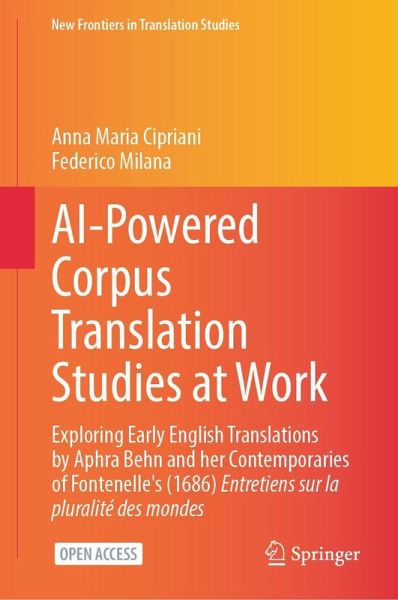
This open access book introduces a pioneering methodology in corpus translation studies by integrating generative artificial intelligence to assist in text annotation, alignment, and interpretative analysis, with an illustrative application. It focuses on early (re)translations by Aphra Behn and her contemporaries of Fontenelle s Entretiens sur la pluralité des mondes (1686), exploring literary strategies within their historical and socio-cultural contexts.
The approach combines human expertise with generative AI tools to identify linguistic and extralinguistic features, such as tone, rhetoric, and cultural references, aiming to improve annotation efficiency, scalability, and analytical depth.
The study presents an illustrative historical and literary exploration, examining lesser-known translations alongside Aphra Behn s 1688 version. It highlights authorial and ideological nuances in early modern translation, supported by AI-assisted categorisation.
The book covers traditional corpus methods, AI s role in translation studies, methodological design, historical context of the texts, application of AI analysis, ethical considerations, and future research directions.
The approach combines human expertise with generative AI tools to identify linguistic and extralinguistic features, such as tone, rhetoric, and cultural references, aiming to improve annotation efficiency, scalability, and analytical depth.
The study presents an illustrative historical and literary exploration, examining lesser-known translations alongside Aphra Behn s 1688 version. It highlights authorial and ideological nuances in early modern translation, supported by AI-assisted categorisation.
The book covers traditional corpus methods, AI s role in translation studies, methodological design, historical context of the texts, application of AI analysis, ethical considerations, and future research directions.