
Andere Kunden interessierten sich auch für
 Alembamento a Luanda16,99 €
 L'embaumement à Luanda16,99 €
 Alembamento em Luanda16,99 €
 Alembamento in Luanda23,90 €
 Alembamento en Luanda16,99 €
 Alembamento w Luande16,99 €
 Jetnostereotipy w qzyke sowremennoj pressy32,99 €

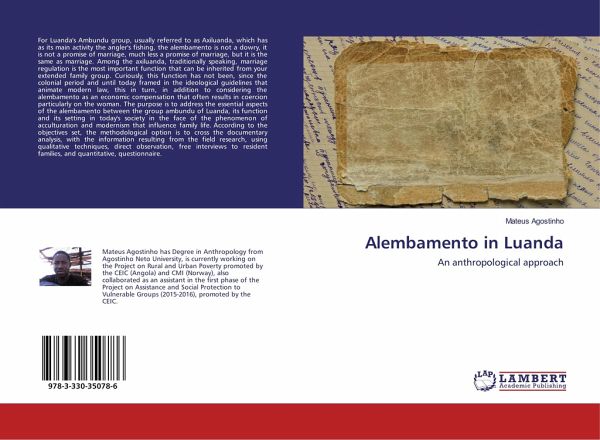
For Luanda's Ambundu group, usually referred to as Axiluanda, which has as its main activity the angler's fishing, the alembamento is not a dowry, it is not a promise of marriage, much less a promise of marriage, but it is the same as marriage. Among the axiluanda, traditionally speaking, marriage regulation is the most important function that can be inherited from your extended family group. Curiously, this function has not been, since the colonial period and until today framed in the ideological guidelines that animate modern law, this in turn, in addition to considering the alembamento as an economic compensation that often results in coercion particularly on the woman. The purpose is to address the essential aspects of the alembamento between the group ambundu of Luanda, its function and its setting in today's society in the face of the phenomenon of acculturation and modernism that influence family life. According to the objectives set, the methodological option is to cross the documentary analysis, with the information resulting from the field research, using qualitative techniques, direct observation, free interviews to resident families, and quantitative, questionnaire.