This book provides a detailed, empirically supported, and theoretically informed examination of alignment and subject assignment in Latin. The author challenges the myth of Latin as a language defined solely by a nominative-accusative alignment system through a comprehensive analysis of a wide range of constructions across the history of the language within a single, consistent framework. In accordance with the idea of a tension between a syntactically principled system and a semantically oriented system of alignment, the book offers an in-depth exploration of quirky case and alternating…mehr
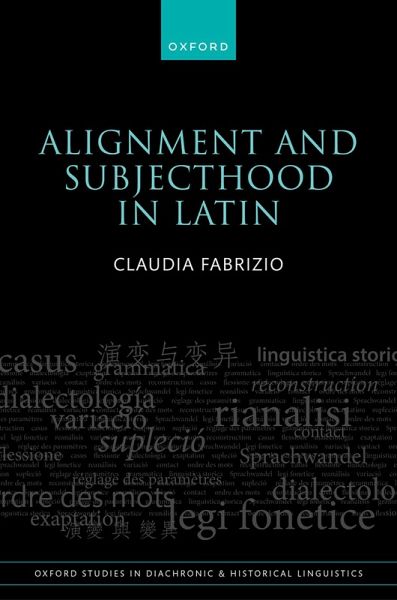
This book provides a detailed, empirically supported, and theoretically informed examination of alignment and subject assignment in Latin. The author challenges the myth of Latin as a language defined solely by a nominative-accusative alignment system through a comprehensive analysis of a wide range of constructions across the history of the language within a single, consistent framework. In accordance with the idea of a tension between a syntactically principled system and a semantically oriented system of alignment, the book offers an in-depth exploration of quirky case and alternating patterns of argument realization. The analysis demonstrates that alongside a tendency to neutralize the semantic roles of arguments for syntactic purposes, Latin displays numerous grammatical patterns that do depend on the semantic relation between the arguments and their predicate. The fundamental assumption is that the underlying principles of lexical semantics (i.e. for verbs, their Aktionsart and their argument structures) are crucial in accounting for those marked patterns that do not fit the canonical nominative-accusative alignment. The book also defends the idea that subjecthood in Latin should be understood as a split relation between a Privileged Syntactic Argument and a pivot, distinguishing between coding and behavioral properties of subjects. The findings shed new light on the grammar of Latin, and make a strong case for a rich, and fully analyzable, lexicon in the architecture of grammar.
Claudia Fabrizio is Professor of Historical and Theoretical Linguistics at Pegaso Digital University. She obtained her degree from Sapienza University of Rome and subsequently pursued advanced studies and research in Geneva, Naples, Manchester, Leiden, and Oxford. Her research primarily focuses on diachronic morphosyntax, with particular emphasis on Latin and Italo-Romance languages. Her work explores various aspects of linguistic structure, including argument marking and valency, the syntax of non-finite verb forms (such as infinitives and participles), the morphology and semantics of nominalization and verbalization, and semantically-driven coding phenomena within nominative-accusative systems, particularly in relation to alignment and subjecthood. She has also contributed to the study of the history of linguistic thought and the cultural reconstruction of the Indo-European context.
Inhaltsangabe
PART I. THEORETICAL PREMISES 1: The typology of argument alignment 2: On the notion of subject 3: Subjecthood in Latin: Coding and behavioral features 4: Subjecthood in Latin: Marked constructions 5: Subjecthood in Latin: A diachronic account PART II. THREE CASE STUDIES 6: The syntax of subject infinitives 7: On some puzzling past participles 8: Non-nominative subjects in Latin
PART I. THEORETICAL PREMISES 1: The typology of argument alignment 2: On the notion of subject 3: Subjecthood in Latin: Coding and behavioral features 4: Subjecthood in Latin: Marked constructions 5: Subjecthood in Latin: A diachronic account PART II. THREE CASE STUDIES 6: The syntax of subject infinitives 7: On some puzzling past participles 8: Non-nominative subjects in Latin
Es gelten unsere Allgemeinen Geschäftsbedingungen: www.buecher.de/agb
Impressum
www.buecher.de ist ein Internetauftritt der buecher.de internetstores GmbH
Geschäftsführung: Monica Sawhney | Roland Kölbl | Günter Hilger
Sitz der Gesellschaft: Batheyer Straße 115 - 117, 58099 Hagen
Postanschrift: Bürgermeister-Wegele-Str. 12, 86167 Augsburg
Amtsgericht Hagen HRB 13257
Steuernummer: 321/5800/1497
USt-IdNr: DE450055826