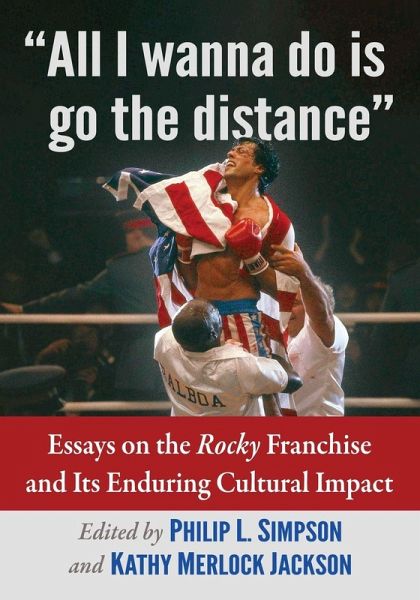
If any film has gone the distance, it's Rocky (1976), which spawned one of the longest running franchises in film history. Released in America's bicentennial year, Rocky, based on an original screenplay by then-unknown writer and actor Sylvester Stallone, surprised everyone. Shot on a shoestring budget by director John Avildsen, the film became a blockbuster and Academy Award-winning best picture, In addition to spawning a lucrative franchise and spin-offs, Rocky propelled the careers of Stallone and Talia Shire, raised interest in boxing and sports movies, and placed Philadelphia and its…mehr
If any film has gone the distance, it's Rocky (1976), which spawned one of the longest running franchises in film history. Released in America's bicentennial year, Rocky, based on an original screenplay by then-unknown writer and actor Sylvester Stallone, surprised everyone. Shot on a shoestring budget by director John Avildsen, the film became a blockbuster and Academy Award-winning best picture, In addition to spawning a lucrative franchise and spin-offs, Rocky propelled the careers of Stallone and Talia Shire, raised interest in boxing and sports movies, and placed Philadelphia and its architecture in the popular consciousness. Rocky has always been a contested text, raising questions about race, gender, and class in America, as well as debate about genre, storytelling, and film art--questions which are addressed at length in this rich collection of essays. As the contributing scholars show, Rocky and its sequels retain their power to rouse audiences well into the twenty-first century and continue to inspire audiences, athletes, and filmmakers.
Philip L. Simpson is vice president of Academic and Student Affairs at Eastern Florida State College on the Space Coast of Florida. He serves as co-chair of the Stephen King Area for the Popular Culture Association, chair of the Endowment Committee for the Popular Culture Association, and editorial board member of The Journal of American Culture. He has published numerous books, book chapters, and journal articles on film, literature, popular culture, and horror, as well as short fiction. Kathy Merlock Jackson is a professor of media and communication at Virginia Wesleyan University, where she teaches courses in media studies and children's culture. She is the author of over a hundred articles, chapters, and reviews and has published fifteen books. She is a former editor of The Journal of American Culture and a past president of the Popular Culture Association. She serves on the editorial boards of The Journal of American Culture and The Journal of Popular Culture and is co-chair of the Animals and Popular Culture Area of the Popular Culture Association.
Inhaltsangabe
Table of Contents Introduction Philip L. Simpson and Kathy Merlock Jackson I. Where It All Began: Rocky (1976) "And the winner is Rocky": The Disputed Champion for the Academy Awards' Best Picture of 1976 Kathy Merlock Jackson Caveman for the Win: Power Dynamics and the Bootstrapping Narrative in Rocky Melissa Ford Lucken II. The Story Continues: The Sequels With This Ring, I Thee Wed: Boxing, Violence, and Domesticity in Rocky Andrew Howe Rocky (IV) versus Creed: Formalism, Realism, and the Evolution of Fight Aesthetics in the Boxing Film Zachary Ingle "Yo, Adrian! I ended the Cold War!" Rocky IV and Rambo: First Blood Part II as Reagan-Era Propaganda Joshua Truelove It's Not a Man, It's a Machine: Rocky IV and the American Media System Joshua Botvin From Romantic Sports Drama to Social Thriller: A Critical Reevaluation of Rocky V Through Genre Theory Shane H. Weathers III. Rocky's Corner: Supporting Characters Adrian Pennino Balboa: A Gendered Perspective on Personal Growth and Relationship Changes Jacki Fitzpatrick "I don't sweat you": Going Beyond the "Bum" Characterization, Alcoholism, and Personal Failure Toward Redemption and Self-Reflection in Paulie Pennino Kevin Buckler and Heather Goltz "He ain't just another fighter": The Role of Rocky's Opponents in the Cinematic Franchise Philip L. Simpson and Andrew Lieb IV. Creative Components: Evolution of a Franchise Motivating Manhood? How "Gonna Fly Now (Theme from Rocky)" Defines/Defies Contemporary Interpretations of Masculinity Amy J. Lantinga Rocky/Creed: How the Franchise Has Endured Through Evolving Creative Visions Jonathan Winchell Stallone, Rocky, and the Mythologizing Notion of an Intellectual Property Auteur Garret L. Castleberry Grudgement Day: Stallone and De Niro Are "Two Old Guys Fighting" Josh Sopiarz V. Meaning and Interpretation: Rocky's Answers to Essential Questions "Time takes everybody out": Existential Anxiety and the Quest for Transcendence in the Rocky Balboa Franchise Jonathan F. Bassett The Rise and Fall of the American Dream in the Rocky Franchise Marcus Mallard The Eclectic Gospel of Rocky Balboa and Sylvester Stallone: From Pelagian Pugilist to Orthodox Christian Terry Lindvall Rocky: An Urban Fairy Tale Daniel Compora Reading with the "Eye of the Tiger": A Rocky Franchise Filmography and Bibliography Camille McCutcheon About the Contributors Index
Table of Contents Introduction Philip L. Simpson and Kathy Merlock Jackson I. Where It All Began: Rocky (1976) "And the winner is Rocky": The Disputed Champion for the Academy Awards' Best Picture of 1976 Kathy Merlock Jackson Caveman for the Win: Power Dynamics and the Bootstrapping Narrative in Rocky Melissa Ford Lucken II. The Story Continues: The Sequels With This Ring, I Thee Wed: Boxing, Violence, and Domesticity in Rocky Andrew Howe Rocky (IV) versus Creed: Formalism, Realism, and the Evolution of Fight Aesthetics in the Boxing Film Zachary Ingle "Yo, Adrian! I ended the Cold War!" Rocky IV and Rambo: First Blood Part II as Reagan-Era Propaganda Joshua Truelove It's Not a Man, It's a Machine: Rocky IV and the American Media System Joshua Botvin From Romantic Sports Drama to Social Thriller: A Critical Reevaluation of Rocky V Through Genre Theory Shane H. Weathers III. Rocky's Corner: Supporting Characters Adrian Pennino Balboa: A Gendered Perspective on Personal Growth and Relationship Changes Jacki Fitzpatrick "I don't sweat you": Going Beyond the "Bum" Characterization, Alcoholism, and Personal Failure Toward Redemption and Self-Reflection in Paulie Pennino Kevin Buckler and Heather Goltz "He ain't just another fighter": The Role of Rocky's Opponents in the Cinematic Franchise Philip L. Simpson and Andrew Lieb IV. Creative Components: Evolution of a Franchise Motivating Manhood? How "Gonna Fly Now (Theme from Rocky)" Defines/Defies Contemporary Interpretations of Masculinity Amy J. Lantinga Rocky/Creed: How the Franchise Has Endured Through Evolving Creative Visions Jonathan Winchell Stallone, Rocky, and the Mythologizing Notion of an Intellectual Property Auteur Garret L. Castleberry Grudgement Day: Stallone and De Niro Are "Two Old Guys Fighting" Josh Sopiarz V. Meaning and Interpretation: Rocky's Answers to Essential Questions "Time takes everybody out": Existential Anxiety and the Quest for Transcendence in the Rocky Balboa Franchise Jonathan F. Bassett The Rise and Fall of the American Dream in the Rocky Franchise Marcus Mallard The Eclectic Gospel of Rocky Balboa and Sylvester Stallone: From Pelagian Pugilist to Orthodox Christian Terry Lindvall Rocky: An Urban Fairy Tale Daniel Compora Reading with the "Eye of the Tiger": A Rocky Franchise Filmography and Bibliography Camille McCutcheon About the Contributors Index
Es gelten unsere Allgemeinen Geschäftsbedingungen: www.buecher.de/agb
Impressum
www.buecher.de ist ein Internetauftritt der buecher.de internetstores GmbH
Geschäftsführung: Monica Sawhney | Roland Kölbl | Günter Hilger
Sitz der Gesellschaft: Batheyer Straße 115 - 117, 58099 Hagen
Postanschrift: Bürgermeister-Wegele-Str. 12, 86167 Augsburg
Amtsgericht Hagen HRB 13257
Steuernummer: 321/5800/1497
USt-IdNr: DE450055826