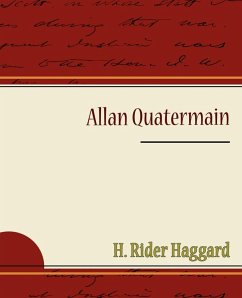
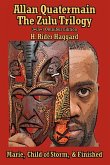
Allan Quatermain, sequel to King Solomon's Mines and based on Haggard's own experiences in Africa, was written in just ten weeks in 1885. Once more Alan Quatermain and his companions set out for Africa, this time in search of a white race reputed to live north of Mount Kenia. They survive fierce encounters with Masai warriors, undergo a terrifying subterranean journey, and discover a lost civilization before being caught up in a passionate love-triangle that engulfs the country in a ferocious civil war. The text is that of the first English book edition, with the more important corrections and…mehr
Allan Quatermain, sequel to King Solomon's Mines and based on Haggard's own experiences in Africa, was written in just ten weeks in 1885. Once more Alan Quatermain and his companions set out for Africa, this time in search of a white race reputed to live north of Mount Kenia. They survive fierce encounters with Masai warriors, undergo a terrifying subterranean journey, and discover a lost civilization before being caught up in a passionate love-triangle that engulfs the country in a ferocious civil war. The text is that of the first English book edition, with the more important corrections and revisions from the serialization of the novel in Longman's Magazine given in the Explanatory Notes.
Sir Henry Rider Haggard, born on June 22, 1856, in Bradenham, United Kingdom, was a prominent English writer known for his adventure fiction, particularly those set in exotic locations like Africa. His novels often blend thrilling adventures with elements of fantasy and exploration. Haggard was also active in land reform efforts across the British Empire, advocating for improvements in the lives of indigenous peoples. He married Mariana Louisa Margitson in 1880, with whom he had two daughters. Haggard's parents were William Meybohm Rider Haggard and Ella Doveton. Andrew Lang, born March 31, 1844, in Selkirk, United Kingdom, was a Scottish poet, novelist, and literary critic, best known for collecting folk and fairy tales. A scholar with a broad range of interests, Lang contributed to anthropology and was a notable figure at the University of St Andrews, where the Andrew Lang lectures were named in his honor. Lang's marriage to Leonora Blanche Alleyne in 1875 marked a personal chapter in his life. His legacy is deeply embedded in children's literature, with his fairy tale collections remaining influential. Lang passed away on July 20, 1912, in Banchory, United Kingdom.
Es gelten unsere Allgemeinen Geschäftsbedingungen: www.buecher.de/agb
Impressum
www.buecher.de ist ein Internetauftritt der buecher.de internetstores GmbH
Geschäftsführung: Monica Sawhney | Roland Kölbl | Günter Hilger
Sitz der Gesellschaft: Batheyer Straße 115 - 117, 58099 Hagen
Postanschrift: Bürgermeister-Wegele-Str. 12, 86167 Augsburg
Amtsgericht Hagen HRB 13257
Steuernummer: 321/5800/1497
USt-IdNr: DE450055826