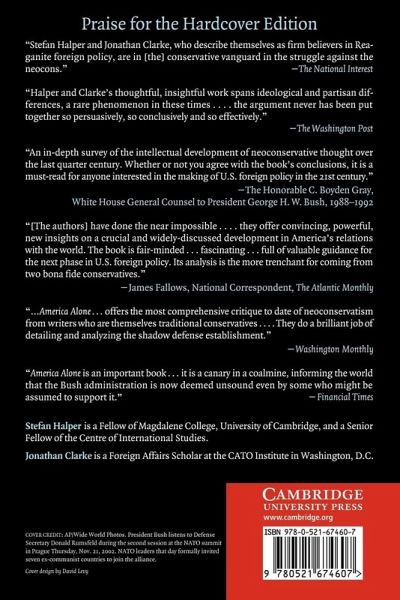
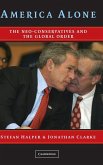
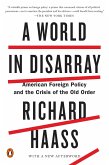
Americas immense military power is of concern to all. Used wisely, it can preserve freedom; used unwisely, it will fracture global stability. This book argue that so long as neo-conservative radicals dominate the nations national security process fracture is more likely, resulting in Americans witnessing increasing threats. America Alone identifies clearly, and for the first time, who these people are and what their agenda is, setting out an alternative approach based on a return to the mainstream principles that have successfully guided American diplomacy for half a century.
Americas immense military power is of concern to all. Used wisely, it can preserve freedom; used unwisely, it will fracture global stability. This book argue that so long as neo-conservative radicals dominate the nations national security process fracture is more likely, resulting in Americans witnessing increasing threats. America Alone identifies clearly, and for the first time, who these people are and what their agenda is, setting out an alternative approach based on a return to the mainstream principles that have successfully guided American diplomacy for half a century.
Stefan Halper is a Fellow of Magdalene College, University of Cambridge, and a Senior Fellow of the Centre of International Studies, where he directs the Donner Atlantic Studies Programme. He holds a B.A. from Stanford and doctorates from Oxford and Cambridge Universities. He was a White House and State Department official during the Nixon, Ford, and Reagan administrations. For twelve years he was executive editor and host of the weekly radio program This Week from Washington and then was executive editor and host of WorldWise, a weekly television program on foreign affairs. He has made contributions to numerous print media including the American Spectator, Chicago Tribune, Christian Science Monitor, Dallas Morning News, The International Wall Street Journal, Los Angeles Times, National Interest, National Review, Wall Street Journal, Washington Post, Washington Times, and Weekly Standard. Dr Halper is senior editor at the Cambridge Review of International Affairs and a Contributing Editor at the American Spectator. He is the co-editor of Latin America: The Dynamics of Social Change.
Inhaltsangabe
1. The neo-conservatives: a new political interest group 2. Origins and early development 3. The nineties: from near-death to resurrection 4. The neo-conservative association 5. The false history 6. Outreach to the media and evangelicals 7. Iraq: the false pretenses 8. America: perception and counter perception 9. The neo-conservative 'World War IV' and its impact on American society 10. The balance sheet and looking ahead Appendix.
1. The neo-conservatives: a new political interest group; 2. Origins and early development; 3. The nineties: from near-death to resurrection; 4. The neo-conservative association; 5. The false history; 6. Outreach to the media and evangelicals; 7. Iraq: the false pretenses; 8. America: perception and counter perception; 9. The neo-conservative 'World War IV' and its impact on American society; 10. The balance sheet and looking ahead; Appendix.
1. The neo-conservatives: a new political interest group 2. Origins and early development 3. The nineties: from near-death to resurrection 4. The neo-conservative association 5. The false history 6. Outreach to the media and evangelicals 7. Iraq: the false pretenses 8. America: perception and counter perception 9. The neo-conservative 'World War IV' and its impact on American society 10. The balance sheet and looking ahead Appendix.
1. The neo-conservatives: a new political interest group; 2. Origins and early development; 3. The nineties: from near-death to resurrection; 4. The neo-conservative association; 5. The false history; 6. Outreach to the media and evangelicals; 7. Iraq: the false pretenses; 8. America: perception and counter perception; 9. The neo-conservative 'World War IV' and its impact on American society; 10. The balance sheet and looking ahead; Appendix.
Rezensionen
'An in-depth survey of the intellectual development of neo-conservative thought over the last quarter century. Whether or not you agree with the book's conclusions, it is a must-read for anyone interested in the making of U.S. foreign policy in the 21st century.' C. Boyden Gray, White House General Counsel to President George H. W. Bush, 1988-1992
Es gelten unsere Allgemeinen Geschäftsbedingungen: www.buecher.de/agb
Impressum
www.buecher.de ist ein Internetauftritt der buecher.de internetstores GmbH
Geschäftsführung: Monica Sawhney | Roland Kölbl | Günter Hilger
Sitz der Gesellschaft: Batheyer Straße 115 - 117, 58099 Hagen
Postanschrift: Bürgermeister-Wegele-Str. 12, 86167 Augsburg
Amtsgericht Hagen HRB 13257
Steuernummer: 321/5800/1497
USt-IdNr: DE450055826