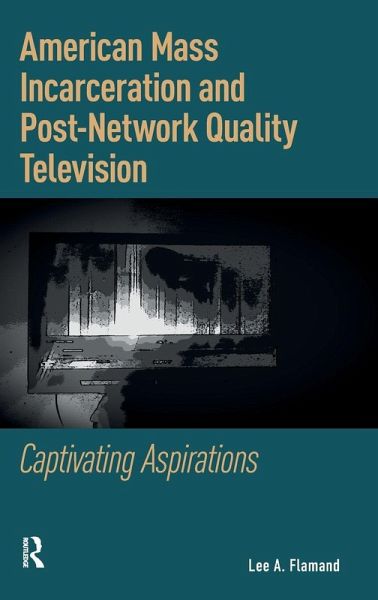
The prison relies upon gruesome stories circulated as commercial media to legitimize its institutional reproduction. This interdisciplinary work presents a series of investigations into some of the most influential and innovative treatments of American mass incarceration to hit our screens in recent decades.
The prison relies upon gruesome stories circulated as commercial media to legitimize its institutional reproduction. This interdisciplinary work presents a series of investigations into some of the most influential and innovative treatments of American mass incarceration to hit our screens in recent decades.
Lee A. Flamand, PhD is currently a Research Associate at Ruhr University Bochum.
Inhaltsangabe
The Captivating Aspirations of Post-Network Quality Television in the Age of Mass Incarceration: An Introduction Remediating Mass Incarceration The Political Economy of Post-Network Television Our Scheduled Programming 1. Mass (Mediating) Incarceration Captivity by the Numbers Invisible Punishments & Revolving Doors Socialized Precarity & Captive Profits Punitive Realism & Unruly Spectacles Conclusion 2. How Does Violent Spectacle Appear as TV Realism? Sources of OZ's Penal Imaginary Welcome to OZ What is TV Realism? The Prison as Hyper-Real Institution Looks Like America? Populating the Prison Nation Haunting Repetitions: Plotting the Prison's Archive Bizarre Realism Conclusion 3. If It's Not TV is It Sociology? The Wire A Surprising Debate Procedural Anxieties What is Sociology? Tele-visualizing the Surveillance Society Soft Eyes and the Sociological Imaginary Sociological Ambitions: Reform Critique Utopia Reassembling Mass Incarceration The Cultural Contradictions of Sociological Aspirations Conclusion 4. Is Entertainment the New Activism? Orange Is the New Black Women's Imprisonment and the Taste for Prisons We're Not in OZ Anymore Scripting Prison Practices Foregrounding Backstories through the Penological Carousel Celebrity and the Politics of Trans-Televisibility Articulating Communities of Concern Finding Oneself There: Inmate Receptions Feedback Loops Recommendation Engines and the Taste for Prisons Conclusion 5. Can Melodrama Redeem American History? Ava DuVernay's 13th and Queen Sugar Publicizing Ava DuVernay as Black Feminist Auteur The Story Never Changes? History: Assembly Required Homecomings: Melodrama and the State of Innocence The Black Family in American History Black Family Melodrama in the Age of Mass Incarceration The Possibilities and Perils of Popularizing Radical Epistemologies Conclusion Conclusion: American Politics and Prison Reform after TV's Digital Turn Bibliography Acknowledgements Index.
The Captivating Aspirations of Post-Network Quality Television in the Age of Mass Incarceration: An Introduction Remediating Mass Incarceration The Political Economy of Post-Network Television Our Scheduled Programming 1. Mass (Mediating) Incarceration Captivity by the Numbers Invisible Punishments & Revolving Doors Socialized Precarity & Captive Profits Punitive Realism & Unruly Spectacles Conclusion 2. How Does Violent Spectacle Appear as TV Realism? Sources of OZ's Penal Imaginary Welcome to OZ What is TV Realism? The Prison as Hyper-Real Institution Looks Like America? Populating the Prison Nation Haunting Repetitions: Plotting the Prison's Archive Bizarre Realism Conclusion 3. If It's Not TV is It Sociology? The Wire A Surprising Debate Procedural Anxieties What is Sociology? Tele-visualizing the Surveillance Society Soft Eyes and the Sociological Imaginary Sociological Ambitions: Reform Critique Utopia Reassembling Mass Incarceration The Cultural Contradictions of Sociological Aspirations Conclusion 4. Is Entertainment the New Activism? Orange Is the New Black Women's Imprisonment and the Taste for Prisons We're Not in OZ Anymore Scripting Prison Practices Foregrounding Backstories through the Penological Carousel Celebrity and the Politics of Trans-Televisibility Articulating Communities of Concern Finding Oneself There: Inmate Receptions Feedback Loops Recommendation Engines and the Taste for Prisons Conclusion 5. Can Melodrama Redeem American History? Ava DuVernay's 13th and Queen Sugar Publicizing Ava DuVernay as Black Feminist Auteur The Story Never Changes? History: Assembly Required Homecomings: Melodrama and the State of Innocence The Black Family in American History Black Family Melodrama in the Age of Mass Incarceration The Possibilities and Perils of Popularizing Radical Epistemologies Conclusion Conclusion: American Politics and Prison Reform after TV's Digital Turn Bibliography Acknowledgements Index.
Es gelten unsere Allgemeinen Geschäftsbedingungen: www.buecher.de/agb
Impressum
www.buecher.de ist ein Internetauftritt der buecher.de internetstores GmbH
Geschäftsführung: Monica Sawhney | Roland Kölbl | Günter Hilger
Sitz der Gesellschaft: Batheyer Straße 115 - 117, 58099 Hagen
Postanschrift: Bürgermeister-Wegele-Str. 12, 86167 Augsburg
Amtsgericht Hagen HRB 13257
Steuernummer: 321/5800/1497
USt-IdNr: DE450055826