Stephen M Engel
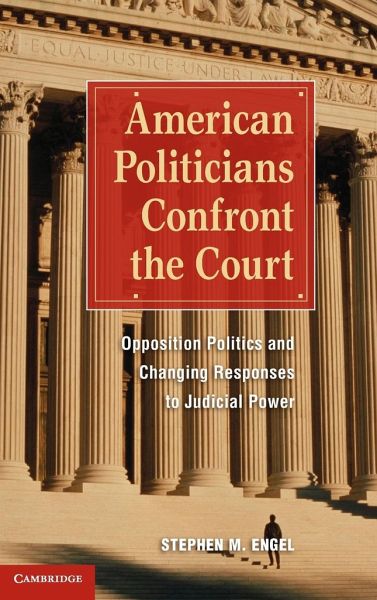
American Politicians Confront the Court
Stephen M Engel
American Politicians Confront the Court
- Gebundenes Buch
- Merkliste
- Auf die Merkliste
- Bewerten Bewerten
- Teilen
- Produkt teilen
- Produkterinnerung
- Produkterinnerung
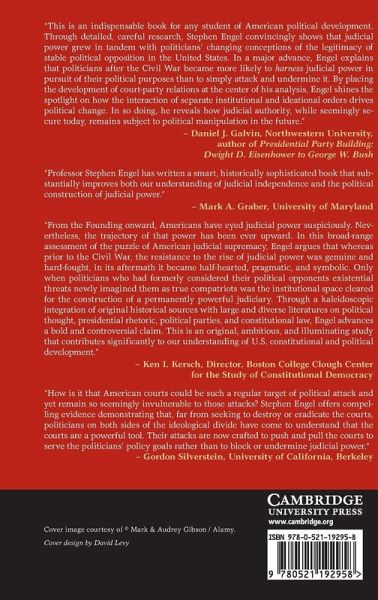
Engel examines changing politicians' perceptions of the threat posed by opposition and how it influenced manipulations of judicial authority.
Andere Kunden interessierten sich auch für
Paul M CollinsThe President and the Supreme Court114,99 €
The Pyschology of Politicians111,99 €
Tinsley E YarbroughThe Rehnquist Court and the Constitution46,99 €
John Gaddis / Philip Gordon / Ernest May / Jonathan Rosenberg (eds.)Cold War Statesmen Confront the Bomb209,99 €
Richard L. PacelleDecision Making by the Modern Supreme Court87,99 €
Kirsten WidnerThe Haves and Have-Nots in Supreme Court Representation and Participation, 2016 to 202161,99 €
Charles C JallohThe Legal Legacy of the Special Court for Sierra Leone122,99 €-
-
-
Engel examines changing politicians' perceptions of the threat posed by opposition and how it influenced manipulations of judicial authority.
Produktdetails
- Produktdetails
- Verlag: Cambridge University Press
- Seitenzahl: 406
- Erscheinungstermin: 13. Juni 2011
- Englisch
- Abmessung: 240mm x 161mm x 28mm
- Gewicht: 848g
- ISBN-13: 9780521192958
- ISBN-10: 0521192951
- Artikelnr.: 33213966
- Herstellerkennzeichnung
- Libri GmbH
- Europaallee 1
- 36244 Bad Hersfeld
- gpsr@libri.de
- Verlag: Cambridge University Press
- Seitenzahl: 406
- Erscheinungstermin: 13. Juni 2011
- Englisch
- Abmessung: 240mm x 161mm x 28mm
- Gewicht: 848g
- ISBN-13: 9780521192958
- ISBN-10: 0521192951
- Artikelnr.: 33213966
- Herstellerkennzeichnung
- Libri GmbH
- Europaallee 1
- 36244 Bad Hersfeld
- gpsr@libri.de
Stephen M. Engel is an Assistant Professor of Politics at Bates College in Lewiston, Maine. He holds a PhD in political science from Yale University as well as an MA in social thought from New York University and a BA in interdisciplinary social science from Wesleyan University. In 2007-08, he held a research fellowship at the American Bar Foundation where he conducted research on anti-Court activism in the United States. He is the author of The Unfinished Revolution: Social Movement Theory and the Gay and Lesbian Movement (Cambridge University Press, 2001). He has also published in Studies in American Political Development and Law and Social Inquiry.
1. Introduction: had Americans 'stopped understanding about the three
branches'?; Part I. Political Development and Elected-Branch Relations with
the Judiciary: 2. Beyond the countermajoritarian difficulty; 3. A
developmental theory of political manipulation of judicial power; Part II.
Hostility to Judicial Authority and the Political Idiom of Civic
Republicanism: 4. In the cause of unified governance: undermining the court
in an anti-party age; 5. Party against partisanship: single-party
constitutionalism and the quest for regime unity; 6. 'As party exigencies
require': republicanism, loyal opposition, and the emerging legitimacy of
multiple constitutional visions; Part III. Harnessing Judicial Power and
the Political Idiom of Liberal Pluralism: 7. Clashing progressive solutions
to the problem of judicial authority; 8. In a polity fully-developed for
harnessing (I): living constitutionalism and the policization of judicial
appointment; 9. In a polity fully-developed for harnessing (II): a
conservative insurgency and a self-styled majoritarian court responds; 10.
Conclusion: on the 'return' of opposition illegitimacy and the prospects
for new development.
branches'?; Part I. Political Development and Elected-Branch Relations with
the Judiciary: 2. Beyond the countermajoritarian difficulty; 3. A
developmental theory of political manipulation of judicial power; Part II.
Hostility to Judicial Authority and the Political Idiom of Civic
Republicanism: 4. In the cause of unified governance: undermining the court
in an anti-party age; 5. Party against partisanship: single-party
constitutionalism and the quest for regime unity; 6. 'As party exigencies
require': republicanism, loyal opposition, and the emerging legitimacy of
multiple constitutional visions; Part III. Harnessing Judicial Power and
the Political Idiom of Liberal Pluralism: 7. Clashing progressive solutions
to the problem of judicial authority; 8. In a polity fully-developed for
harnessing (I): living constitutionalism and the policization of judicial
appointment; 9. In a polity fully-developed for harnessing (II): a
conservative insurgency and a self-styled majoritarian court responds; 10.
Conclusion: on the 'return' of opposition illegitimacy and the prospects
for new development.
1. Introduction: had Americans 'stopped understanding about the three
branches'?; Part I. Political Development and Elected-Branch Relations with
the Judiciary: 2. Beyond the countermajoritarian difficulty; 3. A
developmental theory of political manipulation of judicial power; Part II.
Hostility to Judicial Authority and the Political Idiom of Civic
Republicanism: 4. In the cause of unified governance: undermining the court
in an anti-party age; 5. Party against partisanship: single-party
constitutionalism and the quest for regime unity; 6. 'As party exigencies
require': republicanism, loyal opposition, and the emerging legitimacy of
multiple constitutional visions; Part III. Harnessing Judicial Power and
the Political Idiom of Liberal Pluralism: 7. Clashing progressive solutions
to the problem of judicial authority; 8. In a polity fully-developed for
harnessing (I): living constitutionalism and the policization of judicial
appointment; 9. In a polity fully-developed for harnessing (II): a
conservative insurgency and a self-styled majoritarian court responds; 10.
Conclusion: on the 'return' of opposition illegitimacy and the prospects
for new development.
branches'?; Part I. Political Development and Elected-Branch Relations with
the Judiciary: 2. Beyond the countermajoritarian difficulty; 3. A
developmental theory of political manipulation of judicial power; Part II.
Hostility to Judicial Authority and the Political Idiom of Civic
Republicanism: 4. In the cause of unified governance: undermining the court
in an anti-party age; 5. Party against partisanship: single-party
constitutionalism and the quest for regime unity; 6. 'As party exigencies
require': republicanism, loyal opposition, and the emerging legitimacy of
multiple constitutional visions; Part III. Harnessing Judicial Power and
the Political Idiom of Liberal Pluralism: 7. Clashing progressive solutions
to the problem of judicial authority; 8. In a polity fully-developed for
harnessing (I): living constitutionalism and the policization of judicial
appointment; 9. In a polity fully-developed for harnessing (II): a
conservative insurgency and a self-styled majoritarian court responds; 10.
Conclusion: on the 'return' of opposition illegitimacy and the prospects
for new development.