
Andere Kunden interessierten sich auch für
 Australasian Artists At the French Salons38,99 €
 Australasian Artists At the French Salons38,99 €
 The Rise and Fall of American Art, 1940s-1980s170,99 €
 Berthe Morisot36,99 €
 The Snake and the Lightning25,00 €
 Living Pictures, Missing Persons48,99 €
 Special Effects and German Silent Film151,99 €

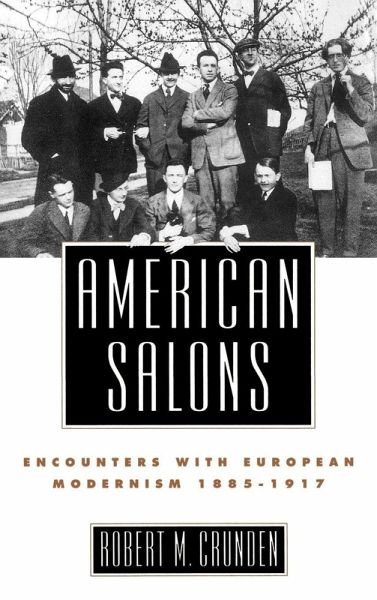
This book is a study of the beginnings of the modernist tradition in American culture, with special emphasis on the interchange of Americans with modernism in Europe. The first section discusses American precursors of modernism including Whistler, William and Henry James, and James Gibbons Huneker. There is a section on the influence of specific US cities on modernism. The final section concentrates on the interaction of Americans in European culture, first in London (with emphasis on Ezra Pound), Paris (the photographer Edward Steichen and the Stein family), and finally New York (the salon scene and the 1913 Armory Show of modern art).
In American Salons, Robert Crunden provides a sweeping account of the American encounter with European Modernism up to our entry into World War I. Crunden begins with deft portraits of the figures who were central to the birth of Modernism, including James Whistler, the eccentric expatriate American painter who became the archetypal artist in his dress and behavior, and Henry and William James, who broke new ground in the genre of the novel and in psychology, influencing an international audience in a broad range of fields. At the heart of the book are the American salons - the intimate, personal gatherings of artists and intellectuals where Modernism flourished. In Chicago, Floyd Dell and Margery Currey spread new ideas to Sherwood Anderson, Theodore Dreiser, and others. In London, Ezra Pound could be found behind everything from the cigars of W. B. Yeats to the prose of Ford Madox Hueffer. In Paris, the salons of Leo and Gertrude Stein, and Michael and Sarah Stein, gave Picasso and Matisse their first secure audiences and incomes; meanwhile, Gertrude Stein produced a new writing style that had an incalculable impact on the generation of Ernest Hemingway. Most important of all were the salons of New York City. Alfred Stieglitz pioneered new forms of photography at the famous 291 Gallery. Mabel Dodge brought together modernist playwrights and painters, introducing them to political reformers and radicals. At the salon of Walter and Louise Arensberg, Marcel Duchamp and Francis Picabia rubbed shoulders with Wallace Stevens, Man Ray, and William Carlos Williams. By 1917, no art in America remained untouched by these new institutions. From the journalism of H. L. Mencken to the famous 1913Armory Show in New York, Crunden illuminates this pivotal era, offering perceptive insights and evocative descriptions of the central personalities of Modernism.
In American Salons, Robert Crunden provides a sweeping account of the American encounter with European Modernism up to our entry into World War I. Crunden begins with deft portraits of the figures who were central to the birth of Modernism, including James Whistler, the eccentric expatriate American painter who became the archetypal artist in his dress and behavior, and Henry and William James, who broke new ground in the genre of the novel and in psychology, influencing an international audience in a broad range of fields. At the heart of the book are the American salons - the intimate, personal gatherings of artists and intellectuals where Modernism flourished. In Chicago, Floyd Dell and Margery Currey spread new ideas to Sherwood Anderson, Theodore Dreiser, and others. In London, Ezra Pound could be found behind everything from the cigars of W. B. Yeats to the prose of Ford Madox Hueffer. In Paris, the salons of Leo and Gertrude Stein, and Michael and Sarah Stein, gave Picasso and Matisse their first secure audiences and incomes; meanwhile, Gertrude Stein produced a new writing style that had an incalculable impact on the generation of Ernest Hemingway. Most important of all were the salons of New York City. Alfred Stieglitz pioneered new forms of photography at the famous 291 Gallery. Mabel Dodge brought together modernist playwrights and painters, introducing them to political reformers and radicals. At the salon of Walter and Louise Arensberg, Marcel Duchamp and Francis Picabia rubbed shoulders with Wallace Stevens, Man Ray, and William Carlos Williams. By 1917, no art in America remained untouched by these new institutions. From the journalism of H. L. Mencken to the famous 1913Armory Show in New York, Crunden illuminates this pivotal era, offering perceptive insights and evocative descriptions of the central personalities of Modernism.