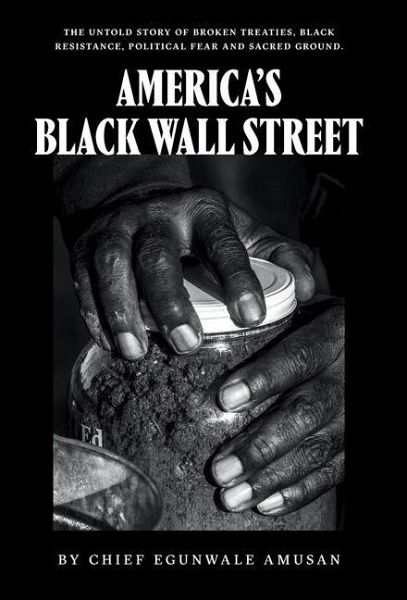
America's Black Wall Street goes beyond the usual account of the 1921 Tulsa Race Massacre and the destruction of Black Wall Street. Amusan provides a historical and political context, a brilliant, yet overlooked explanation for this massacre and others across the United States. He takes us back to the Indian Territory, the settlement of the Five Civilized Tribes, the political and financial conflict between the tribes, their freedman, black resistance, and political strides. Amusan proclaims "the biggest fear of white supremacists is Black political independence and domination." He makes a…mehr
America's Black Wall Street goes beyond the usual account of the 1921 Tulsa Race Massacre and the destruction of Black Wall Street. Amusan provides a historical and political context, a brilliant, yet overlooked explanation for this massacre and others across the United States. He takes us back to the Indian Territory, the settlement of the Five Civilized Tribes, the political and financial conflict between the tribes, their freedman, black resistance, and political strides. Amusan proclaims "the biggest fear of white supremacists is Black political independence and domination." He makes a connection with the historic roadblocks for Black voters as the present day efforts to suppress the Black vote. His conclusions based on his research support a deliberate campaign to destroy Black Wall Street and the Greenwood community, the financial threat it posed, and the threat of successful participation of Black citizens in the political process. America's Black Wall Street: The Untold Story of Broken Treaties, Black Resistance, Political Fear, and Sacred Ground is a must read for those seeking a thorough understanding of the 1921 Tulsa Race Massacre and the destruction of Black Wall Street.
Chief Egunwale Amusan - Historian, Author, and Cultural PreservationistChief Egunwale Amusan, a lifelong Tulsa resident and direct descendant of Tulsa's historic Black Wall Street, is a distinguished history recovery specialist and President of the African Ancestral Society. As the founder of the long-standing Black Wall Street Memorial March Weekend and owner of The Real Black Wall Street Tour, a family-operated heritage business, Chief Amusan has dedicated his career to preserving and interpreting the legacy of Greenwood and its survivors. His work as a social entrepreneur has been featured in Essence Magazine and other national media outlets.A respected voice in African American historical affairs, Chief Amusan has served as an advisor to the Black Wall Street Chamber of Commerce, is a board member of the Center for Public Secrets, and a member of the Tulsa Community Remembrance Coalition in partnership with Bryan Stevenson's Equal Justice Initiative. He works closely with the Justice for Greenwood Foundation to advance awareness, reparative justice, and community restoration efforts. In 2021, he testified before the U.S. Congress on behalf of Tulsa Race Massacre descendants and survivors.Chief Amusan is also a sought-after consultant and creative collaborator in film and media. He has worked with producers and directors including Tricia Woodgett, Darnell Martin, and Sterlin Harjo, and served as Executive Producer of the documentary Oaklawn, an investigative work examining the 1921 mass graves in Tulsa. His expertise appears in the Peabody Award-winning WNYC Studios podcast Blindspot, as well as the Emmy Award-winning LeBron James documentary Dreamland: The Rise and Fall of Black Wall Street and *Jeffrey Robinson's Who We Are Project.Amusan is the author of the acclaimed book America's Black Wall Street: The Untold Story of Broken Treaties, Black Resistance, Political Fear, and Sacred Ground, a definitive study of the political and economic forces behind the 1921 Tulsa Race Massacre. He is also a National Geographic "2892 Miles to Go" Storyteller and currently serves on the Preserve Route 66 Advisory Council, continuing his mission to protect and elevate African American heritage at both local and national levels.
Es gelten unsere Allgemeinen Geschäftsbedingungen: www.buecher.de/agb
Impressum
www.buecher.de ist ein Internetauftritt der buecher.de internetstores GmbH
Geschäftsführung: Monica Sawhney | Roland Kölbl | Günter Hilger
Sitz der Gesellschaft: Batheyer Straße 115 - 117, 58099 Hagen
Postanschrift: Bürgermeister-Wegele-Str. 12, 86167 Augsburg
Amtsgericht Hagen HRB 13257
Steuernummer: 321/5800/1497
USt-IdNr: DE450055826