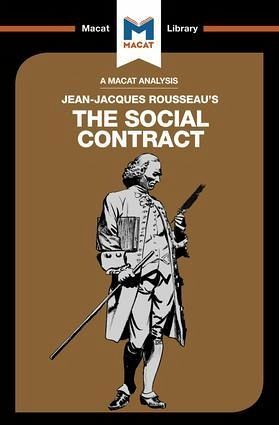
Few people can claim to have had minds as fertile and creative as the French philosopher Jean-Jacques Rousseau. One of the most influential political theorists of the modern age, he was also a composer and writer of opera, a novelist, and a memoirist whose Confessions ranks as one of the most striking works of autobiography ever written. Like many creative thinkers, Rousseau was someone whose restless mind could not help questioning accepted orthodoxies and looking at matters from novel and innovative angles. His 1762 treatise The Social Contract does exactly that. Examining the nature and…mehr
Few people can claim to have had minds as fertile and creative as the French philosopher Jean-Jacques Rousseau. One of the most influential political theorists of the modern age, he was also a composer and writer of opera, a novelist, and a memoirist whose Confessions ranks as one of the most striking works of autobiography ever written. Like many creative thinkers, Rousseau was someone whose restless mind could not help questioning accepted orthodoxies and looking at matters from novel and innovative angles. His 1762 treatise The Social Contract does exactly that. Examining the nature and sources of legitimate political power, it crafted a closely reasoned and passionately persuasive argument for democracy at a time when the most widely accepted form of government was absolute monarchy, legitimised by religious beliefs about the divine right of kings and queens to rule. In France, the book was banned by worried Catholic censors; in Rousseau's native Geneva, it was both banned and burned. But history soon pushed Rousseau's ideas into the mainstream of political theory, with the French and American revolutions paving the way for democratic government to gain ground across the Western world.
Though it was precisely what got Rousseau's book banned at the time, the novel idea that all legitimate government rests on the will of the people is now recognised as the core principle of democratic freedom and represents, for many people, the highest of ideals.
As a kid I got called out for daydreaming a lot. Reading was (and remains) a favorite pastime, so of course I'd rather conjure up worlds of mighty dragons, dashing heroes, and conniving villains than, oh, say, diagram a sentence or explain why the author calling the curtains blue mattered. Some of these imaginary jaunts made it onto paper. Eventually those ideas were combined into a story. It stunk, and Mr. Bakker, the English teacher, was kind enough to not say it outright when I showed him, but there was promise. It took ten years, a graduate degree in Software Engineering, copious quantities of brainstorming, some gentle prodding, and more false starts than a twitchy offensive line, but here we are. Better late than never. In those rarified moments when I'm not spaced out in worlds of my building, I'm usually roving around in someone else's. Nose deep in a book, smooshing zombies, or rolling dice on a disadvantaged charisma check, so long as the imagination is alive, the fun does not stop.
Inhaltsangabe
Ways in to the Text Who was Jean-Jacques Rousseau? What does The Social Contract Say? Why does The Social Contract Matter? Section 1: Influences Module 1: The Author and the Historical Context Module 2: Academic Context Module 3: The Problem Module 4: The Author's Contribution Section 2: Ideas Module 5: Main Ideas Module 6: Secondary Ideas Module 7: Achievement Module 8: Place in the Author's Work Section 3: Impact Module 9: The First Responses Module 10: The Evolving Debate Module 11: Impact and Influence Today Module 12: Where Next? Glossary of Terms People Mentioned in the Text Works Cited
Ways in to the Text Who was Jean-Jacques Rousseau? What does The Social Contract Say? Why does The Social Contract Matter? Section 1: Influences Module 1: The Author and the Historical Context Module 2: Academic Context Module 3: The Problem Module 4: The Author's Contribution Section 2: Ideas Module 5: Main Ideas Module 6: Secondary Ideas Module 7: Achievement Module 8: Place in the Author's Work Section 3: Impact Module 9: The First Responses Module 10: The Evolving Debate Module 11: Impact and Influence Today Module 12: Where Next? Glossary of Terms People Mentioned in the Text Works Cited
Es gelten unsere Allgemeinen Geschäftsbedingungen: www.buecher.de/agb
Impressum
www.buecher.de ist ein Internetauftritt der buecher.de internetstores GmbH
Geschäftsführung: Monica Sawhney | Roland Kölbl | Günter Hilger
Sitz der Gesellschaft: Batheyer Straße 115 - 117, 58099 Hagen
Postanschrift: Bürgermeister-Wegele-Str. 12, 86167 Augsburg
Amtsgericht Hagen HRB 13257
Steuernummer: 321/5800/1497
USt-IdNr: DE450055826