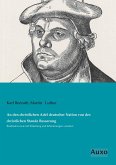
""An den christlichen Adel deutscher Nation von des christlichen Standes Besserung"" ist ein Buch von Martin Luther, das 1884 ver������ffentlicht wurde. Es ist eine Schrift, die sich an die christliche Oberschicht des Heiligen R������mischen Reiches Deutscher Nation richtet und sich mit der Verbesserung des christlichen Standes befasst. Luther kritisiert in diesem Werk die katholische Kirche und fordert eine Reformierung der Kirche. Er spricht sich f�����r eine R�����ckbesinnung auf die Bibel aus und betont die Bedeutung der individuellen Glaubensbeziehung zu Gott. Das Buch gilt als wichtiger…mehr
""An den christlichen Adel deutscher Nation von des christlichen Standes Besserung"" ist ein Buch von Martin Luther, das 1884 ver������ffentlicht wurde. Es ist eine Schrift, die sich an die christliche Oberschicht des Heiligen R������mischen Reiches Deutscher Nation richtet und sich mit der Verbesserung des christlichen Standes befasst. Luther kritisiert in diesem Werk die katholische Kirche und fordert eine Reformierung der Kirche. Er spricht sich f�����r eine R�����ckbesinnung auf die Bibel aus und betont die Bedeutung der individuellen Glaubensbeziehung zu Gott. Das Buch gilt als wichtiger Beitrag zur Reformation und hat bis heute Einfluss auf die evangelische Theologie.This scarce antiquarian book is a facsimile reprint of the old original and may contain some imperfections such as library marks and notations. Because we believe this work is culturally important, we have made it available as part of our commitment for protecting, preserving, and promoting the world's literature in affordable, high quality, modern editions, that are true to their original work.
Martin Luther was a German clergyman, theologian, author, hymnwriter, professor, and Augustinian friar who lived from 10 November 1483 to 18 February 1546. He was a pivotal player in the Protestant Reformation, and his theological convictions served as the foundation for Lutheranism. In 1507, Luther became ordained as a member of the clergy. He began to criticize various Roman Catholic Church teachings and practices, particularly the perspective on indulgences. In his Ninety-five Theses of 1517, Luther urged an academic examination of the practice and efficacy of indulgences. His refusal to disavow all of his publications at the request of Pope Leo X in 1520 and the Holy Roman Emperor Charles V at the Diet of Worms in 1521 ended in his excommunication by the pope and the Holy Roman Emperor's sentencing as an outlaw. Luther died in 1546, with Pope Leo X still excommunicating him. Luther preached that redemption, and hence eternal life, are not won through good works, but are only gained as a free gift of God's grace through the believer's faith in Jesus Christ, the redeemer from sin.
Es gelten unsere Allgemeinen Geschäftsbedingungen: www.buecher.de/agb
Impressum
www.buecher.de ist ein Internetauftritt der buecher.de internetstores GmbH
Geschäftsführung: Monica Sawhney | Roland Kölbl | Günter Hilger
Sitz der Gesellschaft: Batheyer Straße 115 - 117, 58099 Hagen
Postanschrift: Bürgermeister-Wegele-Str. 12, 86167 Augsburg
Amtsgericht Hagen HRB 13257
Steuernummer: 321/5800/1497
USt-IdNr: DE450055826