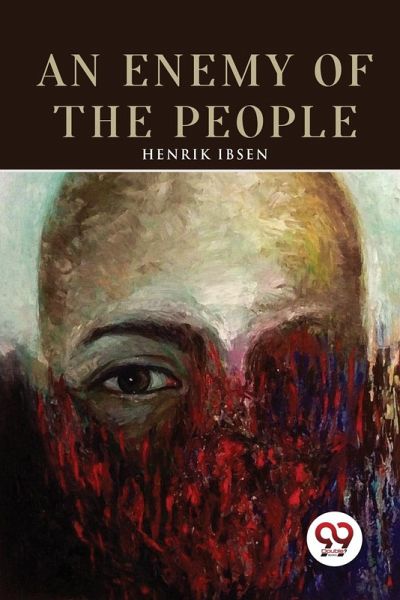
Henrik Ibsen, a Norwegian playwright, wrote An Enemy of the People (original title in Norwegian: En folkefiende) in 1882. Ibsen expressed some scepticism toward his protagonist, implying that his passion to speak the truth may have gone too far.The medical officer of a recently opened spa in a small town is Dr. Thomas Stockmann. According to Dr. Stockmann, there may be bacteria in the spa water. The local newspaper's editor makes the decision not to publish a story that questions how the spa treats its water.Dr. Stockmann's father-in-law believes the piece is a sophisticated hoax when it is…mehr
Henrik Ibsen, a Norwegian playwright, wrote An Enemy of the People (original title in Norwegian: En folkefiende) in 1882. Ibsen expressed some scepticism toward his protagonist, implying that his passion to speak the truth may have gone too far.The medical officer of a recently opened spa in a small town is Dr. Thomas Stockmann. According to Dr. Stockmann, there may be bacteria in the spa water. The local newspaper's editor makes the decision not to publish a story that questions how the spa treats its water.Dr. Stockmann's father-in-law believes the piece is a sophisticated hoax when it is published. The publication aims to take on the local administration and reveal its corruption.In order to comfort the audience, Dr. Peter Stockmann makes an appearance and offers a statement of his own. The town's residents are going to hear Dr. Stockmann read his water report. Respected local Aslaksen is chosen to preside over the assembly.Katrine worries that the populace will push her father-in-law out of town, but he has pledged to stay and protect the community.
Henrik Johan Ibsen was a prominent Norwegian playwright and theatre director born on March 20, 1828, in Skien, Norway. Widely regarded as one of the most influential dramatists in history, Ibsen is often referred to as the "father of modern drama" due to his pioneering work in introducing theatrical realism to the stage. His plays challenged societal norms and examined deep psychological and social issues, often with controversial themes that sparked public debate. His work influenced not only theatre but also broader discussions about the role of individuals within society, particularly regarding gender roles and the power structures of the time. Ibsen's most famous works include A Doll s House, Hedda Gabler, Ghosts, and The Master Builder. Throughout his career, Ibsen's plays were often criticized for their radical ideas, but they are now regarded as central to the development of modern theatre. Ibsen died on May 23, 1906, in Oslo, Norway, leaving behind a legacy that has shaped contemporary theatre worldwide. His works continue to be performed and studied for their insight into the complexities of human nature and society.
Es gelten unsere Allgemeinen Geschäftsbedingungen: www.buecher.de/agb
Impressum
www.buecher.de ist ein Internetauftritt der buecher.de internetstores GmbH
Geschäftsführung: Monica Sawhney | Roland Kölbl | Günter Hilger
Sitz der Gesellschaft: Batheyer Straße 115 - 117, 58099 Hagen
Postanschrift: Bürgermeister-Wegele-Str. 12, 86167 Augsburg
Amtsgericht Hagen HRB 13257
Steuernummer: 321/5800/1497
USt-IdNr: DE450055826