
Andere Kunden interessierten sich auch für
 Commercial Enfranchisement Of The Confederate States Of America, With Original Articles On A New System Of Weights And Measures, And New Coins For The25,99 €
 Historical Greek Coins30,99 €
 Coins and Coinage. The United States Mint, Philadelphia, History, Biography, Statistics, Work, Machinery, Products, Officials29,99 €
 SuperFreakonomics6,99 €
 Essays in Persuasion57,99 €
 Economic Effects Of The World War Upon Women And Children In Great Britain15,99 €
 Distributing Co-Operative Societies: An Essay On Social Economy30,99 €
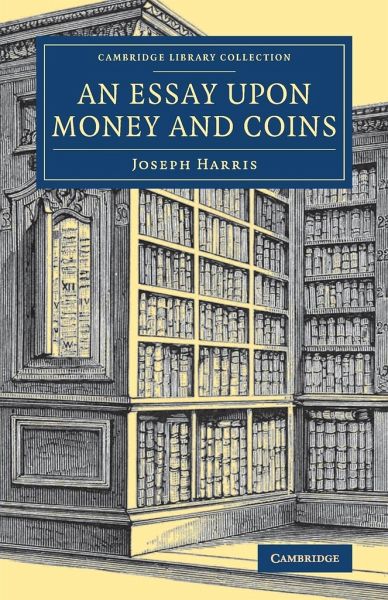
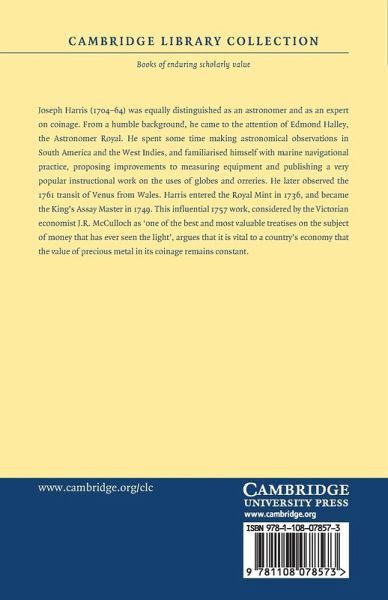
Joseph Harris (1704-64) was equally distinguished as an astronomer and as an expert on coinage. From a humble background, he came to the attention of Edmond Halley, the Astronomer Royal. He spent some time making astronomical observations in South America and the West Indies, and familiarised himself with marine navigational practice, proposing improvements to measuring equipment and publishing a very popular instructional work on the uses of globes and orreries. He later observed the 1761 transit of Venus from Wales. Harris entered the Royal Mint in 1736, and became the King's Assay Master in 1749. This influential 1757 work, considered by the Victorian economist J. R. McCulloch as 'one of the best and most valuable treatises on the subject of money that has ever seen the light', argues that it is vital to a country's economy that the value of precious metal in its coinage remains constant.