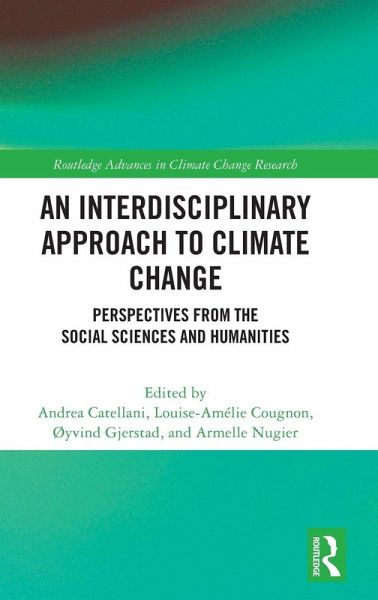
This book offers a comprehensive overview of the ways in which research and perspectives from the social sciences and humanities can be combined for a more effective understanding of climate change and its impacts. It will be of use to scholars, students, researchers, and practitioners.
This book offers a comprehensive overview of the ways in which research and perspectives from the social sciences and humanities can be combined for a more effective understanding of climate change and its impacts. It will be of use to scholars, students, researchers, and practitioners.
Andrea Catellani is Professor of Communication at the Université catholique de Louvain (UCLouvain, Belgium). He is one of the directors of the Study and Research Group "Communication, Environment, Science and Society" of the French Society of Information and Communication Sciences (SFSIC). He was the principal investigator of the research project "Overcoming Obstacles and Disincentives to Climate Change Mitigation" (funded by JPI Climate, 2020-2024). He has published several academic articles and books, particularly on environmental and climate communication and rhetoric, corporate social responsibility discourse, the semiotic approach to organizations, ethics in communication, and the relationship between religion and digital communication. Louise-Amélie Cougnon holds a PhD in sociolinguistics and leads research at MiiL, a technological platform at UCLouvain (Belgium). She specializes in the intelligibility of multimodal data, including social media, archives, and the press. Her expertise has been primarily applied in the fields of climate change and health disorders. She developed a profiling model based on qualitative and quantitative data, structured around values, emotions, practices, and attitudes towards norms (VEPRe). Dr. Cougnon also specializes in data ethics and research ethics. Øyvind Gjerstad is Associate Professor of French linguistics at the University of Bergen, Norway. Among his main research interests are linguistic polyphony and the narrativity of deliberative discourse. He has participated in several externally funded research projects on the linguistic and societal aspects of climate change, the last of which is the project "Overcoming Obstacles and Disincentives to Climate Change Mitigation", funded by the Joint Programming Initiative "Connecting Climate Knowledge for Europe" (2020-2024). Armelle Nugier is Assistant Professor of social psychology at Université Clermont Auvergne. She is co-head of the CNRS research team on "Social behaviors and collective dynamics" within the Laboratory of Social and Cognitive Psychology (LAPSCO) in Clermont-Ferrand. Her research focuses on social norms, prejudice, and discrimination. She has published numerous scientific articles and is the author of Les Influences Sociales (second edition) with Peggy Chekroun and of The Social and Political Psychology of Violent Radicalism with Serge Guimond.
Inhaltsangabe
Introduction Part 1: Climate change in discourse 1. Imagining action on climate change - a comparison of Belgian and Norwegian surveys 2. Climate change mitigation in the food, energy, and transport sectors in Belgium, France, and Norway: a comparative study of Instagram posts by environmental opinion leaders and opinion-leading organizations 3. Keeping young people informed and engaged: A linguistic analysis of climate change coverage in children's news 4. Greenwashing: an obstacle to the adoption of attitudes and behaviours of climate change mitigation? Part 2: Raising awareness and acting with communication 5. Science and literature in alliance against the Anthropocene: Andri Snær Magnason's On Time and Water and Aurélien Barrau's L'Hypothèse K 6. Overcoming Information Overload in Climate Change Communication: Visual Storytelling through Infographics 7. Assessing the effectiveness of corporate communication on climate change. A corpus-based, multimodal investigation of discourse practices in CSRs 8. The end of the "magic trash can": an info-communication approach to raising awareness of waste reduction Part 3: Changing for climate: representations, behaviors and emotions 9. Participative videos concerning climate change: The interplay between media experience, perceived effectiveness knowledge, attitudes, and behavioral intentions changes 10. Sport utility vehicles (SUVs): An obstacle to climate action? 11. The double-edged sword of (eco)anxiety: Antecedents and consequences on pro-environmental behaviors 12. A Local Lens: Studying Climate Perceptions in Chastreix - Sancy National Nature Reserve Part 4: Lessons learned from concrete actions 13. Rethinking Object Mutualization: Lessons on Behavioral vs Economic Barriers 14. Building Wildfire resilient communities 15. The Transformative Potential of Relational and Responsive Education
Introduction Part 1: Climate change in discourse 1. Imagining action on climate change - a comparison of Belgian and Norwegian surveys 2. Climate change mitigation in the food, energy, and transport sectors in Belgium, France, and Norway: a comparative study of Instagram posts by environmental opinion leaders and opinion-leading organizations 3. Keeping young people informed and engaged: A linguistic analysis of climate change coverage in children's news 4. Greenwashing: an obstacle to the adoption of attitudes and behaviours of climate change mitigation? Part 2: Raising awareness and acting with communication 5. Science and literature in alliance against the Anthropocene: Andri Snær Magnason's On Time and Water and Aurélien Barrau's L'Hypothèse K 6. Overcoming Information Overload in Climate Change Communication: Visual Storytelling through Infographics 7. Assessing the effectiveness of corporate communication on climate change. A corpus-based, multimodal investigation of discourse practices in CSRs 8. The end of the "magic trash can": an info-communication approach to raising awareness of waste reduction Part 3: Changing for climate: representations, behaviors and emotions 9. Participative videos concerning climate change: The interplay between media experience, perceived effectiveness knowledge, attitudes, and behavioral intentions changes 10. Sport utility vehicles (SUVs): An obstacle to climate action? 11. The double-edged sword of (eco)anxiety: Antecedents and consequences on pro-environmental behaviors 12. A Local Lens: Studying Climate Perceptions in Chastreix - Sancy National Nature Reserve Part 4: Lessons learned from concrete actions 13. Rethinking Object Mutualization: Lessons on Behavioral vs Economic Barriers 14. Building Wildfire resilient communities 15. The Transformative Potential of Relational and Responsive Education
Es gelten unsere Allgemeinen Geschäftsbedingungen: www.buecher.de/agb
Impressum
www.buecher.de ist ein Internetauftritt der buecher.de internetstores GmbH
Geschäftsführung: Monica Sawhney | Roland Kölbl | Günter Hilger
Sitz der Gesellschaft: Batheyer Straße 115 - 117, 58099 Hagen
Postanschrift: Bürgermeister-Wegele-Str. 12, 86167 Augsburg
Amtsgericht Hagen HRB 13257
Steuernummer: 321/5800/1497
USt-IdNr: DE450055826