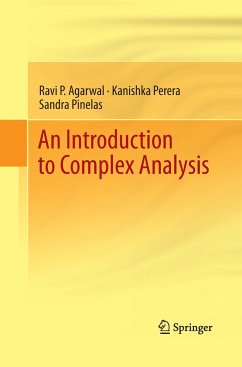
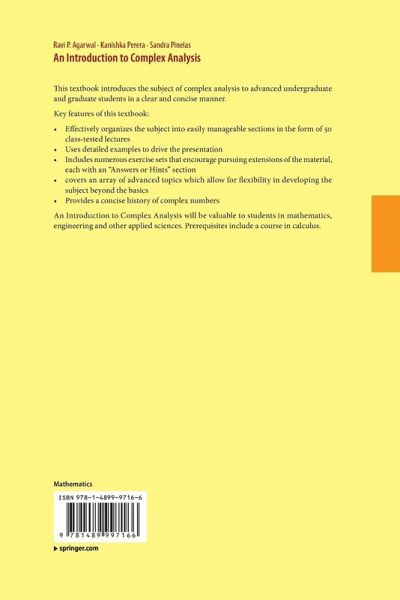
This textbook introduces the subject of complex analysis to advanced undergraduate and graduate students in a clear and concise manner. Key features of this textbook: effectively organizes the subject into easily manageable sections in the form of 50 class-tested lectures, uses detailed examples to drive the presentation, includes numerous exercise sets that encourage pursuing extensions of the material, each with an "Answers or Hints" section, covers an array of advanced topics which allow for flexibility in developing the subject beyond the basics, provides a concise history of complex…mehr
This textbook introduces the subject of complex analysis to advanced undergraduate and graduate students in a clear and concise manner. Key features of this textbook: effectively organizes the subject into easily manageable sections in the form of 50 class-tested lectures, uses detailed examples to drive the presentation, includes numerous exercise sets that encourage pursuing extensions of the material, each with an "Answers or Hints" section, covers an array of advanced topics which allow for flexibility in developing the subject beyond the basics, provides a concise history of complex numbers. An Introduction to Complex Analysis will be valuable to students in mathematics, engineering and other applied sciences. Prerequisites include a course in calculus.
Sumati Kumari Panda, Ph.D., is a Professor of Mathematics at the GMR Institute of Technology, India. Her research areas include fractional calculus, fixed point theory, neural networks, and their applications. She has published more than 100 research papers in reputed international journals and presented her work at several national and international conferences. She is currently serving as an Academic Editor for Scientific Reports (Springer, Scopus & SCIE-indexed). Dr. Panda received her Ph.D. in Mathematics from K.L. University in 2015. Velusamy Vijayakumar, Ph.D., is an Assistant Professor at the Vellore Institute of Technology (VIT), Vellore, India. His research interests include fractional calculus, dynamical systems, mathematical control theory, and neural networks. Dr. Vijayakumar has authored over 220 research articles in reputed scientific journals. Dr. Vijayakumar received his B.Sc, M.Sc, M.Phil, and Ph.D. degrees in Mathematics from Bharathiar University, Coimbatore, Tamil Nadu, India, in 2002, 2004, 2006, and 2016 respectively. Ravi P. Agarwal, Ph.D., is an Emeritus Research Professor in the Department of Mathematics and Systems Engineering at the Florida Institute of Technology (USA). He has authored or co-authored more than 50 books and more than 2,000 research articles. He has received numerus honors and awards from several universities of the world. His research interests include nonlinear analysis, differential and difference equations, fixed point theory, and general inequalities. Dr. Agarwal received his Ph.D. at the Indian Institute of Technology, Madras, India, in 1973.
Inhaltsangabe
Preface.-Complex Numbers.-Complex Numbers II .- Complex Numbers III.-Set Theory in the Complex Plane.-Complex Functions.-Analytic Functions I.-Analytic Functions II.-Elementary Functions I.- Elementary Functions II.- Mappings by Functions.- Mappings by Functions II.- Curves, Contours, and Simply Connected Domains.- Complex Integration.- Independence of Path.- Cauchy-Goursat Theorem.- Deformation Theorem.- Cauchy's Integral Formula.- Cauchy's Integral Formula for Derivatives.- Fundamental Theorem of Algebra.- Maximum Modulus Principle.- Sequences and Series of Numbers.- Sequences and Series of Functions.- Power Series.- Taylor's Series.- Laurent's Series.- Zeros of Analytic Functions.- Analytic Continuation.- Symmetry and Reflection.- Singularities and Poles I.- Singularities and Poles II.- Cauchy's Residue Theorem.- Evaluation of Real Integrals by Contour Integration I.- Evaluation of Real Integrals by Contour Integration II.- Indented Contour Integrals.- Contour Integrals Involving Multi-valued Functions .- Summation of Series. Argument Principle and Rouch´e and Hurwitz Theorems.- Behavior of Analytic Mappings.- Conformal Mappings.- Harmonic Functions.- The Schwarz-Christoffel Transformation.- Infinite Products.- Weierstrass's Factorization Theorem.- Mittag-Leffler's Theorem.- Periodic Functions.- The Riemann Zeta Function.- Bieberbach's Conjecture.- The Riemann Surface.- Julia and Mandelbrot Sets.- History of Complex Numbers.- References for Further Reading.- Index.
Preface.-Complex Numbers.-Complex Numbers II .- Complex Numbers III.-Set Theory in the Complex Plane.-Complex Functions.-Analytic Functions I.-Analytic Functions II.-Elementary Functions I.- Elementary Functions II.- Mappings by Functions.- Mappings by Functions II.- Curves, Contours, and Simply Connected Domains.- Complex Integration.- Independence of Path.- Cauchy-Goursat Theorem.- Deformation Theorem.- Cauchy's Integral Formula.- Cauchy's Integral Formula for Derivatives.- Fundamental Theorem of Algebra.- Maximum Modulus Principle.- Sequences and Series of Numbers.- Sequences and Series of Functions.- Power Series.- Taylor's Series.- Laurent's Series.- Zeros of Analytic Functions.- Analytic Continuation.- Symmetry and Reflection.- Singularities and Poles I.- Singularities and Poles II.- Cauchy's Residue Theorem.- Evaluation of Real Integrals by Contour Integration I.- Evaluation of Real Integrals by Contour Integration II.- Indented Contour Integrals.- Contour Integrals Involving Multi-valued Functions .- Summation of Series. Argument Principle and Rouch´e and Hurwitz Theorems.- Behavior of Analytic Mappings.- Conformal Mappings.- Harmonic Functions.- The Schwarz-Christoffel Transformation.- Infinite Products.- Weierstrass's Factorization Theorem.- Mittag-Leffler's Theorem.- Periodic Functions.- The Riemann Zeta Function.- Bieberbach's Conjecture.- The Riemann Surface.- Julia and Mandelbrot Sets.- History of Complex Numbers.- References for Further Reading.- Index.
Rezensionen
From the reviews: "This work, directed toward majors in the applied sciences, is presented as a series of 50 lectures on standard topics in introductory complex analysis. Agarwal and Perera (both, Florida Institute of Technology) and Pinelas (Azores Univ., Portugal) have organized each lecture/chapter around certain theorems and their proofs and accompany each with a problem set and solutions. ... Summing Up: Recommended. Upper-division undergraduates and graduate students." (D. Robbins, Choice, Vol. 49 (5), January, 2012) "This volume provides a compact and thorough introduction to complex analysis. The text takes account of varying needs and backgrounds and provides a self-study text for students in mathematics, science and engineering. ... This concise text not only provides efficient proofs but also shows students how to derive them. The excellent exercises are accompanied by selected solutions. ... The exposition is clear, concise, and lively. The book is mainly addressed to undergraduate and graduate students interested in complex analysis." (Teodora-Liliana Radulescu, Zentralblatt MATH, Vol. 1230, 2012) "It consists of 50 'class-tested lectures' in which the subject matter has been organized in the form of theorems, proofs and examples. Most of the lectures are ... followed by graded exercises that go from the routine to the richly informative. Solutions and hints are provided for nearly all of these, which means that the book is highly suited for self-tuition purposes. ... it is also suited to the needs of non-specialists, such as those concerned with the applied sciences." (P. N. Ruane, The Mathematical Association of America, October, 2011)…mehr
Es gelten unsere Allgemeinen Geschäftsbedingungen: www.buecher.de/agb
Impressum
www.buecher.de ist ein Internetauftritt der buecher.de internetstores GmbH
Geschäftsführung: Monica Sawhney | Roland Kölbl | Günter Hilger
Sitz der Gesellschaft: Batheyer Straße 115 - 117, 58099 Hagen
Postanschrift: Bürgermeister-Wegele-Str. 12, 86167 Augsburg
Amtsgericht Hagen HRB 13257
Steuernummer: 321/5800/1497
USt-IdNr: DE450055826