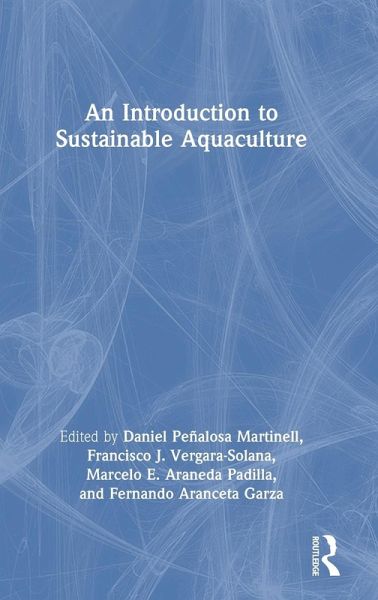
This new textbook provides an accessible introduction to sustainable aquaculture through its relationship with three key pillars: the environment, the economy and society.
This new textbook provides an accessible introduction to sustainable aquaculture through its relationship with three key pillars: the environment, the economy and society.
Daniel Peñalosa Martinell serves as Chief Scientific Officer at Shrimpl Pte Ltd., Singapore, and is Visiting Professor in the Interdisciplinary Center for Marine Sciences and Computational Research Center at the National Polytechnic Institute, Mexico. Francisco J. Vergara-Solana serves as Fisheries Outreach consultant for the Marine Stewardship Council. He is Professor at Baja California Sur Autonomous University, Mexico, and Visiting Professor in the Interdisciplinary Center for Marine Sciences and Computational Research Center at the National Polytechnic Institute, Mexico. Marcelo E. Araneda Padilla is Manager of the Bioeconomy and Control Unit at Benchmark Genetics, Chile, and Visiting Professor in the Interdisciplinary Center for Marine Sciences and Computational Research Center at the National Polytechnic Institute, Mexico. Fernando Aranceta Garza is a Researcher for Mexico at the National Council of Humanities, Sciences and Technologies, and the Fisheries Ecology Program in Northwest Biological Research Center, Baja California Sur, working on fisheries and aquaculture issues for federal, public, academic, and civil organizations.
Inhaltsangabe
PART I Basic concepts 1 Introduction 2 What is aquaculture? 3 What is sustainability? PART II Aquaculture and the environment 4 Effects of the environment on aquaculture organisms 5 Aquaculture's effect on the environment 6 Aquaculture and climate change PART III Aquaculture and economics 7 A brief introduction to economics and its relationship with aquaculture 8 Aquaculture and fisheries 9 Aquaculture value chain analysis 10 Aquaculture bioeconomics: a brief introduction 11 Aquaculture: uncertainty sources and risk quantification techniques PART IV Aquaculture and society 12 Aquaculture and food security 13 Aquaculture and employment: impact on livelihood and poverty 14 Aquaculture and animal welfare PART V Governance and technologies 15 Governance, partnerships, and cooperation 16 New technologies as a means to achieve sustainability PART VI Future expectations 17 Future directions
PART I Basic concepts 1 Introduction 2 What is aquaculture? 3 What is sustainability? PART II Aquaculture and the environment 4 Effects of the environment on aquaculture organisms 5 Aquaculture's effect on the environment 6 Aquaculture and climate change PART III Aquaculture and economics 7 A brief introduction to economics and its relationship with aquaculture 8 Aquaculture and fisheries 9 Aquaculture value chain analysis 10 Aquaculture bioeconomics: a brief introduction 11 Aquaculture: uncertainty sources and risk quantification techniques PART IV Aquaculture and society 12 Aquaculture and food security 13 Aquaculture and employment: impact on livelihood and poverty 14 Aquaculture and animal welfare PART V Governance and technologies 15 Governance, partnerships, and cooperation 16 New technologies as a means to achieve sustainability PART VI Future expectations 17 Future directions
Es gelten unsere Allgemeinen Geschäftsbedingungen: www.buecher.de/agb
Impressum
www.buecher.de ist ein Internetauftritt der buecher.de internetstores GmbH
Geschäftsführung: Monica Sawhney | Roland Kölbl | Günter Hilger
Sitz der Gesellschaft: Batheyer Straße 115 - 117, 58099 Hagen
Postanschrift: Bürgermeister-Wegele-Str. 12, 86167 Augsburg
Amtsgericht Hagen HRB 13257
Steuernummer: 321/5800/1497
USt-IdNr: DE450055826