The most well-known writer of the professional soldier and author from Ancient Greece named Xenophon's Anabasis. It describes the journey of a sizable army of Greek mercenaries sent by Cyrus the Younger to assist him in removing his brother Artaxerxes II from the throne of Persia in 401 BC. The Anabasis, which consists of seven books, was written around 370 BC. The title Anabasis is translated as The March Up Country or as The March of the Ten Thousand even though the Ancient Greek word "v" signifies "embarkation," "ascent," or "mounting up." The best-known of Xenophon's works, and one of the…mehr
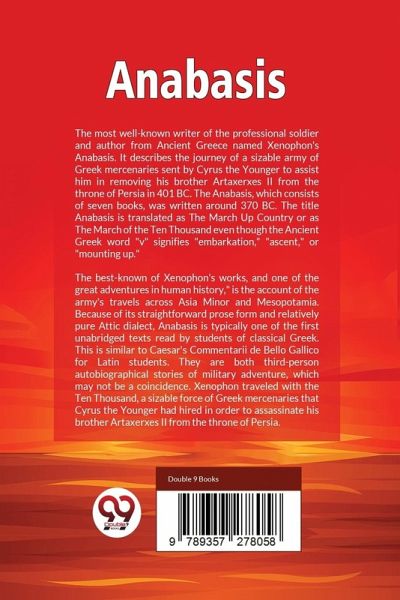
The most well-known writer of the professional soldier and author from Ancient Greece named Xenophon's Anabasis. It describes the journey of a sizable army of Greek mercenaries sent by Cyrus the Younger to assist him in removing his brother Artaxerxes II from the throne of Persia in 401 BC. The Anabasis, which consists of seven books, was written around 370 BC. The title Anabasis is translated as The March Up Country or as The March of the Ten Thousand even though the Ancient Greek word "v" signifies "embarkation," "ascent," or "mounting up." The best-known of Xenophon's works, and one of the great adventures in human history," is the account of the army's travels across Asia Minor and Mesopotamia. Because of its straightforward prose form and relatively pure Attic dialect, Anabasis is typically one of the first unabridged texts read by students of classical Greek. This is similar to Caesar's Commentarii de Bello Gallico for Latin students. They are both third-person autobiographical stories of military adventure, which may not be a coincidence. Xenophon traveled with the Ten Thousand, a sizable force of Greek mercenaries that Cyrus the Younger had hired in order to assassinate his brother Artaxerxes II from the throne of Persia.
Xenophon was a Greek historian, soldier, and philosopher born in Athens around 430 BC. He was a student of Socrates and fought as a mercenary in various conflicts throughout his life. In 401 BC, Xenophon joined the expedition of Cyrus the Younger, a Persian prince who sought to overthrow his brother, the king of Persia. After Cyrus was killed in battle, Xenophon led a group of Greek soldiers known as the Ten Thousand on a dangerous retreat across enemy territory, an event he later wrote about in his famous work, the "Anabasis". Xenophon also wrote several other works, including the "Hellenica", which covers the events in Greece from 411 BC to 362 BC, and the "Cyropaedia", a fictionalized biography of Cyrus the Great. In addition to his military and historical pursuits, Xenophon was also interested in philosophy and wrote several works on ethics, including "Memorabilia", a collection of Socratic dialogues. He believed in the importance of piety, obedience to the law, and the virtues of the Greek city-state system. Xenophon spent his later years in the Greek city of Corinth, where he continued to write and engage in philosophical discussions. He died around 354 BC at an advanced age.
Es gelten unsere Allgemeinen Geschäftsbedingungen: www.buecher.de/agb
Impressum
www.buecher.de ist ein Internetauftritt der buecher.de internetstores GmbH
Geschäftsführung: Monica Sawhney | Roland Kölbl | Günter Hilger
Sitz der Gesellschaft: Batheyer Straße 115 - 117, 58099 Hagen
Postanschrift: Bürgermeister-Wegele-Str. 12, 86167 Augsburg
Amtsgericht Hagen HRB 13257
Steuernummer: 321/5800/1497
USt-IdNr: DE450055826