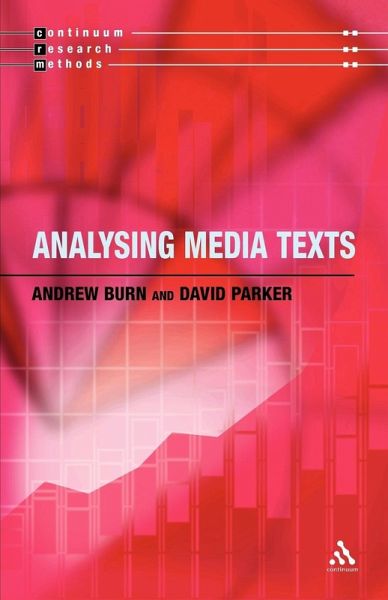
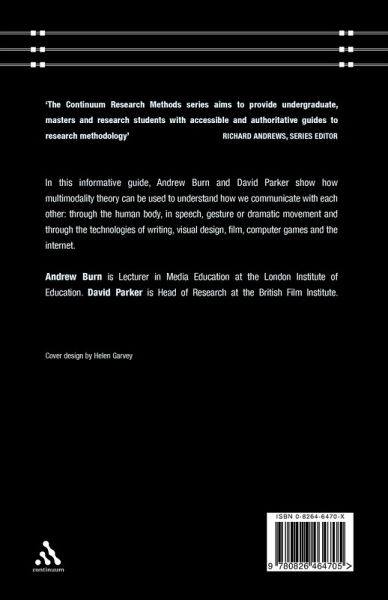
Andrew Burn and David Parker outline how multi-modality theory can be used to analyze texts whicj employ multiple semiotic modes and media, in such a way that a balanced consideration is given to the characteristics of each mode, how they integrate, and how they distribute textual functions between them. The medthods are rooted in a view of significance as dependent on social context, and fulfilling the social and communicative interests of both producers of textual production and use contingent upon digital formats will also be a determining content of the analytical method.
Dr Burn is a lecturer in Media Education at IOE, UCL's Faculty of Education and Society, University College London, UK.
Inhaltsangabe
1) Introduction What is multimodality theory? A funtional theory Why is modality of interest in research? 2) The scater and the old man Multimodal design and moving image production Skateboarding documentary video: discourse Design and production Leo and the Old Man: the kineikonic and its subsidiary modes 3) Chocolate politics: analysing websites The websties Organisation: the design of learning Orientation: teaching and selling 4) Returning to Hogwarts: the modality of computer games From cut scene to gameplay the player avatar link Sensory modality Technological modality the modality of children's games 5) Transforming Hannibal: interview data and textual analysis How can multimodal analysis be employed in the study of audiences? Chris and Hannibal 6) Conclusion
Es gelten unsere Allgemeinen Geschäftsbedingungen: www.buecher.de/agb
Impressum
www.buecher.de ist ein Internetauftritt der buecher.de internetstores GmbH
Geschäftsführung: Monica Sawhney | Roland Kölbl | Günter Hilger
Sitz der Gesellschaft: Batheyer Straße 115 - 117, 58099 Hagen
Postanschrift: Bürgermeister-Wegele-Str. 12, 86167 Augsburg
Amtsgericht Hagen HRB 13257
Steuernummer: 321/5800/1497
USt-IdNr: DE450055826