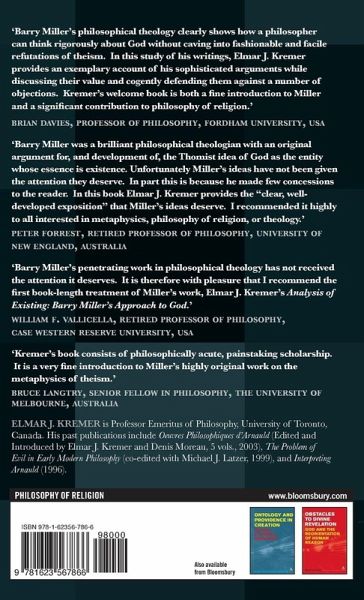
Miller's metaphysics, including his approach to God, is broad, deep, and original, with the potential to make a fruitful contribution to contemporary philosophy. Yet it has not received the critical attention it deserves. Miller's work deserves critical attention because of its thorough and original defense of three highly controversial positions: that existence is a real property of concrete individuals; that it is possible to prove, without assuming any principle of sufficient reason, that there is an uncaused cause of the universe; and that the uncaused cause is the simple God of classical…mehr
Miller's metaphysics, including his approach to God, is broad, deep, and original, with the potential to make a fruitful contribution to contemporary philosophy. Yet it has not received the critical attention it deserves. Miller's work deserves critical attention because of its thorough and original defense of three highly controversial positions: that existence is a real property of concrete individuals; that it is possible to prove, without assuming any principle of sufficient reason, that there is an uncaused cause of the universe; and that the uncaused cause is the simple God of classical theism. Miller's position on existence is an important alternative in current analytical philosophy to what Miller calls the "Frege-Russell-Quine" theory, and the neo-Meinongian positions of Terence Parsons and Ed Zalta. Miller's argument for an uncaused cause of the universe has been described one of the most ambitious theistic arguments produced by a well-respected, contemporary, analytic philosopher. Analysis of Existing: Barry Miller's Approach to God is the first clear, systematic interpretation of Miller's theistic philosophy.
Elmar J. Kremer is Professor Emeritus of Philosophy, University of Toronto, Canada. His past publications include Death before Birth (co-edited with E. A. Synan, Griffin House, 1972), Oeuvres Philosophiques d'Arnauld (Edited and Introduced by Elmar J. Kremer and Denis Moreau, 5 vols., Thoemmes Press, 2003), The Problem of Evil in Early Modern Philosophy (co-edited with Michael J. Latzer, University of Toronto Press, 1999), Interpreting Arnauld (University of Toronto Press, 1996), and The Great Arnauld and Some of His Philosophical Correspondents (University of Toronto Press, 1994).
Inhaltsangabe
Foreword iii Abbreviations v Introduction 1 Chapter One: Barry Miller's Philosophical Journey 6 I. Miller's life 6 II. Miller's philosophical theology 13 III. Looking ahead 21 Chapter Two: Beginning with Existence 22 I. Is existence a property of concrete individuals? 27 II. Is existence a real property of concrete individuals? 39 III. Miller's constituent ontology 45 IV. A new objection: How can a concrete individual be the subject of its existence? 50 V. Miller's argument for property instances 57 Chapter Three: From Existence to God 73 I. Fido exists qua dependent on something other than his existing and its constituents. 73 II. Ultimately, Fido exists qua dependent on an uncaused cause which is Subsistent Existence. 93 Chapter Four: Divine Simplicity 117 I. Views of God's nature and their controlling notions 117 II. Reformulating and clarifying the notion of Subsistent Existence 120 III: Is God identical with his non-existential properties? 133 IV. Which properties have limit case instances that are zero-bounding? 137 V. Omnipotence, Omniscience, and Divine Intellection 138 Chapter Five: Simplicity, Creation, and Human Freedom 150 I. The contingency of God's knowing 150 II. The contingency and freedom of creation 156 III. The causality of creatures and human freedom 169 Chapter Six: Objections and Replies 179 I. Graham Oppy's Objection to the argument from existence to God 179 II. Katherin A. Rogers' worry that Miller is "in danger of denying any positive meaning at all to our theological language" 182 III. Bruce Langtry's Criticism of Miller on the relation of God to creatures 186 IV. A Theological Postlude: Is Subsistent Existence the God of the Christian religion? 188 Bibliography 196
Foreword iii Abbreviations v Introduction 1 Chapter One: Barry Miller's Philosophical Journey 6 I. Miller's life 6 II. Miller's philosophical theology 13 III. Looking ahead 21 Chapter Two: Beginning with Existence 22 I. Is existence a property of concrete individuals? 27 II. Is existence a real property of concrete individuals? 39 III. Miller's constituent ontology 45 IV. A new objection: How can a concrete individual be the subject of its existence? 50 V. Miller's argument for property instances 57 Chapter Three: From Existence to God 73 I. Fido exists qua dependent on something other than his existing and its constituents. 73 II. Ultimately, Fido exists qua dependent on an uncaused cause which is Subsistent Existence. 93 Chapter Four: Divine Simplicity 117 I. Views of God's nature and their controlling notions 117 II. Reformulating and clarifying the notion of Subsistent Existence 120 III: Is God identical with his non-existential properties? 133 IV. Which properties have limit case instances that are zero-bounding? 137 V. Omnipotence, Omniscience, and Divine Intellection 138 Chapter Five: Simplicity, Creation, and Human Freedom 150 I. The contingency of God's knowing 150 II. The contingency and freedom of creation 156 III. The causality of creatures and human freedom 169 Chapter Six: Objections and Replies 179 I. Graham Oppy's Objection to the argument from existence to God 179 II. Katherin A. Rogers' worry that Miller is "in danger of denying any positive meaning at all to our theological language" 182 III. Bruce Langtry's Criticism of Miller on the relation of God to creatures 186 IV. A Theological Postlude: Is Subsistent Existence the God of the Christian religion? 188 Bibliography 196
Es gelten unsere Allgemeinen Geschäftsbedingungen: www.buecher.de/agb
Impressum
www.buecher.de ist ein Internetauftritt der buecher.de internetstores GmbH
Geschäftsführung: Monica Sawhney | Roland Kölbl | Günter Hilger
Sitz der Gesellschaft: Batheyer Straße 115 - 117, 58099 Hagen
Postanschrift: Bürgermeister-Wegele-Str. 12, 86167 Augsburg
Amtsgericht Hagen HRB 13257
Steuernummer: 321/5800/1497
USt-IdNr: DE450055826