
Andere Kunden interessierten sich auch für
 Mathematical and numerical analysis for coagulation-fragmentation eqns45,99 €
 Coagulation & Fragmentation Processes in Structured Population Models39,99 €
 Applications of Mathematics in Models, Artificial Neural Networks and Arts151,99 €
 Mathematical Models, Methods and Applications76,99 €
 Symmetric Models, Singular Cardinal Patterns, and Indiscernibles46,99 €
 Modelling Order and Disorder99,99 €
 Non-Newtonian Sequence Spaces with Applications155,99 €

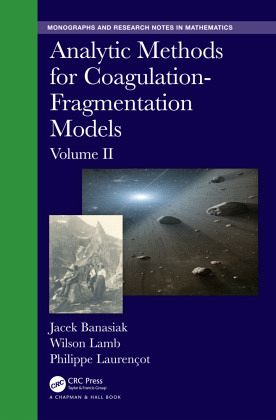
Analytic Methods for Coagulation-Fragmentation Models is a two-volume set that provides a comprehensive exposition of the mathematical analysis of coagulation-fragmentation models. Initially, an in-depth survey of coagulation-fragmentation processes is presented, together with an account of relevant early results obtained on the associated model equations. These provide motivation for the subsequent detailed treatment of more up-to-date investigations which have led to significant theoretical developments on topics such as solvability and the long-term behaviour of solutions. To make the account as self-contained as possible, the mathematical tools that feature prominently in these modern treatments are introduced at appropriate places. The main theme of Volume I is the analysis of linear fragmentation models, with Volume II devoted to processes that involve the nonlinear contribution of coagulation.
Features of Volume II:
A primer on weak compactness in L 1and dynamical systems
A comprehensive theory of solvability of the coagulation-fragmentation equation by both the semigroup and weak compactness methods, including a thorough analysis of the gelation and shattering phenomena
A detailed analysis of the long-term dynamics of the coagulation-fragmentation equations with a state-of-the-art discussion on self-similar solutions
Features of Volume II:
A primer on weak compactness in L 1and dynamical systems
A comprehensive theory of solvability of the coagulation-fragmentation equation by both the semigroup and weak compactness methods, including a thorough analysis of the gelation and shattering phenomena
A detailed analysis of the long-term dynamics of the coagulation-fragmentation equations with a state-of-the-art discussion on self-similar solutions