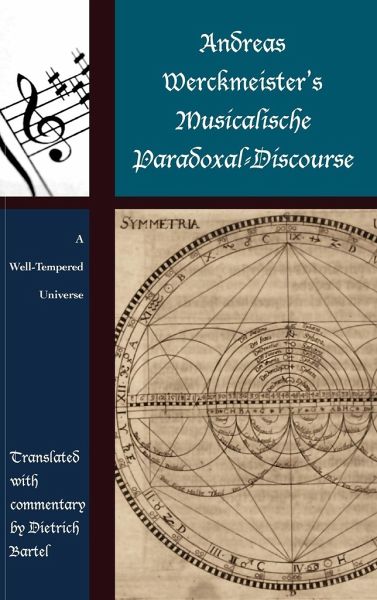
This book provides extensive commentary and an English translation of 17th-century German music theorist Andreas Werckmeister’s final treatise, the Musicalische Paradoxal-Discourse. Topics discussed include theological reflections on music, numerology in musical intervals, music notation and solmization, and tunings.
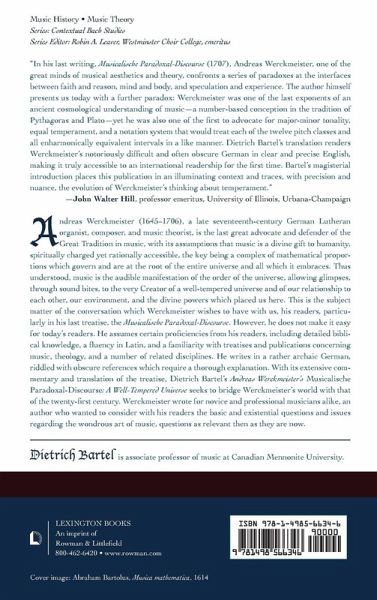
This book provides extensive commentary and an English translation of 17th-century German music theorist Andreas Werckmeister’s final treatise, the Musicalische Paradoxal-Discourse. Topics discussed include theological reflections on music, numerology in musical intervals, music notation and solmization, and tunings.
Dietrich Bartel is associate professor of music at Canadian Mennonite University.
Inhaltsangabe
Table of Contents Series Editor's Foreword Preface Part I Introduction to the Musicalische Paradoxal-Discourse Werckmeister Biography Werckmeister Treatises Contents and Sources of the Musicalische Paradoxal-Discourse Part IITranslation of the Musicalische Paradoxal-Discourse Title page and dedicatory comments Preface Index and contents of the chapters Chapter 1An introduction to this work: the division of the musical proportions Chapter 2A testimonial through mathematics and Holy Scriptures themselves, that the course of the heavens are harmonic Chapter 3How the mortal body and soul are harmonically created, and furthermore, on the influence of the stars Chapter 4Why humans find such pleasure in music, and whence composers and musicians arise Chapter 5As the image of God, humans are to praise the Creator with music. Buildings and eras in scripture are also harmonic wonders of spiritual music. Chapter 6On the abuse of music, which the authorities could abolish Chapter 7How the inclination of a people determines its attitude towards music, and how the heathens were so scattered in their views on music Chapter 8On the music of the early Christians, and the subsequent changes Chapter 9The great difficulties arising out of solmization and the linear staff-system Chapter 10Proof that the linear staff system is accompanied by great difficulties Chapter 11Proof of how everything can be played or sung through the twelve note-names Chapter 12Further proof, that the linear staff system has many more variants than the twelve note-names Chapter 13How the temperaments can be examined, and on German tablature Chapter 14How the chromatic system is to be applied to the tempered keyboard Chapter 15On the disorder of hymn singing Chapter 16On the simplicity of old organs Chapter 17How the musical modes can be differentiated Chapter 18On the nature and property of the harmonic numerals Chapter 19On the hidden meaning of the numerals Chapter 20On the properties of the harmonic numerals, when they themselves are subdivided Chapter 21On the subdivision of the harmonic numerals Chapter 22On the properties of the dissonant musical numerals Chapter 23How the harmonic radical numerals are transformed into a tempered tuning, and of their hidden meaning Chapter 24A comparison of incorrect tempered tuning with false Christianity Chapter 25How the temperament can be perfect or imperfect, and how the same can be compared with Christianity Chapter 26The Lord's Prayer in the musical proportional numerals Bibliography About the author
Table of Contents Series Editor's Foreword Preface Part I Introduction to the Musicalische Paradoxal-Discourse Werckmeister Biography Werckmeister Treatises Contents and Sources of the Musicalische Paradoxal-Discourse Part IITranslation of the Musicalische Paradoxal-Discourse Title page and dedicatory comments Preface Index and contents of the chapters Chapter 1An introduction to this work: the division of the musical proportions Chapter 2A testimonial through mathematics and Holy Scriptures themselves, that the course of the heavens are harmonic Chapter 3How the mortal body and soul are harmonically created, and furthermore, on the influence of the stars Chapter 4Why humans find such pleasure in music, and whence composers and musicians arise Chapter 5As the image of God, humans are to praise the Creator with music. Buildings and eras in scripture are also harmonic wonders of spiritual music. Chapter 6On the abuse of music, which the authorities could abolish Chapter 7How the inclination of a people determines its attitude towards music, and how the heathens were so scattered in their views on music Chapter 8On the music of the early Christians, and the subsequent changes Chapter 9The great difficulties arising out of solmization and the linear staff-system Chapter 10Proof that the linear staff system is accompanied by great difficulties Chapter 11Proof of how everything can be played or sung through the twelve note-names Chapter 12Further proof, that the linear staff system has many more variants than the twelve note-names Chapter 13How the temperaments can be examined, and on German tablature Chapter 14How the chromatic system is to be applied to the tempered keyboard Chapter 15On the disorder of hymn singing Chapter 16On the simplicity of old organs Chapter 17How the musical modes can be differentiated Chapter 18On the nature and property of the harmonic numerals Chapter 19On the hidden meaning of the numerals Chapter 20On the properties of the harmonic numerals, when they themselves are subdivided Chapter 21On the subdivision of the harmonic numerals Chapter 22On the properties of the dissonant musical numerals Chapter 23How the harmonic radical numerals are transformed into a tempered tuning, and of their hidden meaning Chapter 24A comparison of incorrect tempered tuning with false Christianity Chapter 25How the temperament can be perfect or imperfect, and how the same can be compared with Christianity Chapter 26The Lord's Prayer in the musical proportional numerals Bibliography About the author
Es gelten unsere Allgemeinen Geschäftsbedingungen: www.buecher.de/agb
Impressum
www.buecher.de ist ein Internetauftritt der buecher.de internetstores GmbH
Geschäftsführung: Monica Sawhney | Roland Kölbl | Günter Hilger
Sitz der Gesellschaft: Batheyer Straße 115 - 117, 58099 Hagen
Postanschrift: Bürgermeister-Wegele-Str. 12, 86167 Augsburg
Amtsgericht Hagen HRB 13257
Steuernummer: 321/5800/1497
USt-IdNr: DE450055826