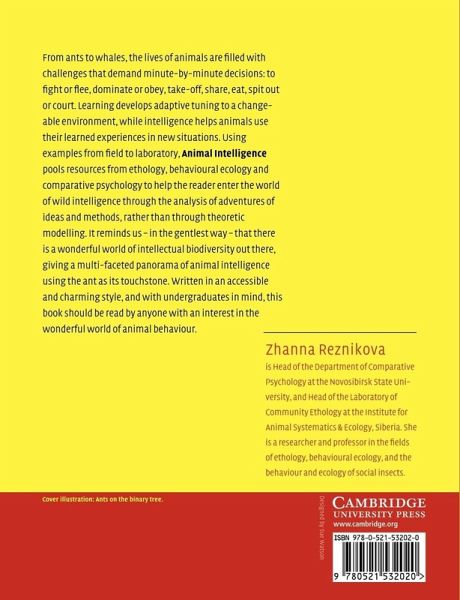
From ants to whales, the lives of animals are filled with challenges that demand minute-by-minute decisions: to fight or flee, dominate or obey, take-off, share, eat, spit out or court. Learning develops adaptive tuning to a changeable environment, while intelligence helps animals use their learned experiences in new situations. Using examples from field to laboratory, Animal Intelligence pools resources from ethology, behavioural ecology and comparative psychology to help the reader enter the world of wild intelligence through the analysis of adventures, of ideas and methods, rather than…mehr
From ants to whales, the lives of animals are filled with challenges that demand minute-by-minute decisions: to fight or flee, dominate or obey, take-off, share, eat, spit out or court. Learning develops adaptive tuning to a changeable environment, while intelligence helps animals use their learned experiences in new situations. Using examples from field to laboratory, Animal Intelligence pools resources from ethology, behavioural ecology and comparative psychology to help the reader enter the world of wild intelligence through the analysis of adventures, of ideas and methods, rather than through theoretic modelling. It reminds us that there is a world of intellectual biodiversity out there, providing a multi-faceted panorama of animal intelligence. Written in an accessible and charming style, and with undergraduate and graduate students in mind, this book should be read by anyone with an interest in the world of animal behaviour.
Professor Zhanna Reznikova is a behavioural ecologist and cognitive ethologist. She is an expert in using the information theory approach to study complex communicative means in animals, as well as in developing original field and laboratory experiments to solve intricate questions of inter-relations between competitors and symbionts in insect communities. Head of the Department of Comparative Psychology at Novosibirsk State University and Head of the Laboratory of Community Ethology at the Institute for Animal Systematics and Ecology RAS, she teaches courses in ecology, ethology and evolution, behavioural ecology, zoopsychology, human ethology, and ethological mechanisms of business and advertisement. She received her Dr.Sci. from Moscow State University in 1990 and her Ph.D. from the Institute for Evolutionary Problems of Animal Morphology and Ecology RAS, Moscow, in 1977.
Inhaltsangabe
Part I. Development of Ideas and Methods in Studying Animal Intelligence: 1. Evolution of views on animal intelligence; 2. Dramatic adventures of behaviourism; 3. Intelligence under a scalpel: starts and false starts of neuroscience; 4. Integrative approaches and coherent movement in studying animal intelligence; 5. Ethological approaches for studying animal learning; Part II. Animals are Welcome to the Class: Learning Classes: 6. Habituation and associative learning; 7. Learning classes beyond 'simple' associative learning; Part III. Past and Future in Animal Life: Remembering, Updating and Anticipation: 8. What memory is for an intelligent animal? 9. Chicks do not suffer from schizophrenia: briefly about brain mechanisms for processing and storing memory; 10. Behavioural mechanisms of experience of time; Part IV. To be in Time in the Right Place: Representation of Space and Objects in Animal Mind: 11. Navigation strategies in animals; 12. To what degree mapping is cognitive in animals? 13. 'Object permanence' in animals; Part V. Experimental Approaches to Studying Essential Activities of Animal Intelligence: 14. Conditional discrimination as a basic technique for studying rule learning; 15. Categorisation, abstraction, and concept formation: are animals logical?; 16. Conceptual behaviour based on relations; Part VI. Advanced Intelligence in Animals: Rule Extraction, Tool Using and Number Related Skills: 17. Insightful behaviour; 18. Tool using as a tool for experimental studying of animal intelligence; 19. Numerical competence in animals; Part VII. Knowledge is Power but not for all: Species-Specific Intelligence: 20. Is finding a common metric of intelligence possible in real animal life?; 21. A sketch on instinctive behaviour; 22. Guided learning and cognitive specialisation; 23. Developmental studies of animal intelligence: role of innate and acquired behaviour; 24. Imprinting; Part VIII. The Wisdom by Social Learning: 25. Ecological and cognitive aspects of social learning; 26. The spread of innovation within populations; 27. Culture in animal societies; Part IX. Intelligent Communication: 28. Can animals exchange meaningful messages?; 29. Communication, speech and language: what falls to the share of non humans?; 30. Direct dialogue with animals: language-training experiments; 31. A battle for the Rosetta Stone: attempts to decipher animals' signals; 32. A dialogue with a black box: using of ideas and methods of information theory for studying animal communication; Part X. Social Life and Social Intelligence in the wild: 33. Diversity of social systems in animals; 34. Evolutionary and behavioural aspects of altruism in animals; 35. Intelligence in a context of the functional structure of animals' communities; 36. What sort of intelligence is required to navigate social landscapes?; 37. Theory of mind.
Part I. Development of Ideas and Methods in Studying Animal Intelligence: 1. Evolution of views on animal intelligence; 2. Dramatic adventures of behaviourism; 3. Intelligence under a scalpel: starts and false starts of neuroscience; 4. Integrative approaches and coherent movement in studying animal intelligence; 5. Ethological approaches for studying animal learning; Part II. Animals are Welcome to the Class: Learning Classes: 6. Habituation and associative learning; 7. Learning classes beyond 'simple' associative learning; Part III. Past and Future in Animal Life: Remembering, Updating and Anticipation: 8. What memory is for an intelligent animal? 9. Chicks do not suffer from schizophrenia: briefly about brain mechanisms for processing and storing memory; 10. Behavioural mechanisms of experience of time; Part IV. To be in Time in the Right Place: Representation of Space and Objects in Animal Mind: 11. Navigation strategies in animals; 12. To what degree mapping is cognitive in animals? 13. 'Object permanence' in animals; Part V. Experimental Approaches to Studying Essential Activities of Animal Intelligence: 14. Conditional discrimination as a basic technique for studying rule learning; 15. Categorisation, abstraction, and concept formation: are animals logical?; 16. Conceptual behaviour based on relations; Part VI. Advanced Intelligence in Animals: Rule Extraction, Tool Using and Number Related Skills: 17. Insightful behaviour; 18. Tool using as a tool for experimental studying of animal intelligence; 19. Numerical competence in animals; Part VII. Knowledge is Power but not for all: Species-Specific Intelligence: 20. Is finding a common metric of intelligence possible in real animal life?; 21. A sketch on instinctive behaviour; 22. Guided learning and cognitive specialisation; 23. Developmental studies of animal intelligence: role of innate and acquired behaviour; 24. Imprinting; Part VIII. The Wisdom by Social Learning: 25. Ecological and cognitive aspects of social learning; 26. The spread of innovation within populations; 27. Culture in animal societies; Part IX. Intelligent Communication: 28. Can animals exchange meaningful messages?; 29. Communication, speech and language: what falls to the share of non humans?; 30. Direct dialogue with animals: language-training experiments; 31. A battle for the Rosetta Stone: attempts to decipher animals' signals; 32. A dialogue with a black box: using of ideas and methods of information theory for studying animal communication; Part X. Social Life and Social Intelligence in the wild: 33. Diversity of social systems in animals; 34. Evolutionary and behavioural aspects of altruism in animals; 35. Intelligence in a context of the functional structure of animals' communities; 36. What sort of intelligence is required to navigate social landscapes?; 37. Theory of mind.
Es gelten unsere Allgemeinen Geschäftsbedingungen: www.buecher.de/agb
Impressum
www.buecher.de ist ein Internetauftritt der buecher.de internetstores GmbH
Geschäftsführung: Monica Sawhney | Roland Kölbl | Günter Hilger
Sitz der Gesellschaft: Batheyer Straße 115 - 117, 58099 Hagen
Postanschrift: Bürgermeister-Wegele-Str. 12, 86167 Augsburg
Amtsgericht Hagen HRB 13257
Steuernummer: 321/5800/1497
USt-IdNr: DE450055826