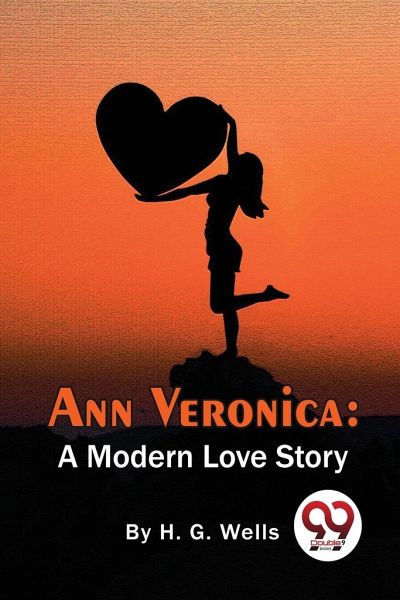
H. G. Wells wrote and published the book, Ann Veronica a modern love story in 1909. It talks of Ann Veronica Stanley's uprising against her middle-class father's strict patriarchal control as "a young woman of about two-and-twenty." The New Woman's issue in modern society is dramatized in the book. Except for a vacation to the mountains, it takes place in Victorian-era London and its surroundings. Ann Veronica provides snapshots of the British women's suffrage struggle and includes a chapter that was motivated by the suffragettes' failed effort to storm Parliament in 1908. The story revolves…mehr
H. G. Wells wrote and published the book, Ann Veronica a modern love story in 1909. It talks of Ann Veronica Stanley's uprising against her middle-class father's strict patriarchal control as "a young woman of about two-and-twenty." The New Woman's issue in modern society is dramatized in the book. Except for a vacation to the mountains, it takes place in Victorian-era London and its surroundings. Ann Veronica provides snapshots of the British women's suffrage struggle and includes a chapter that was motivated by the suffragettes' failed effort to storm Parliament in 1908. The story revolves around her father who forbids her from attending a ball, she leaves home to live independently. She borrows money from an older man to study and falls in love with Capes, the laboratory's "demonstrator". Due to the heroine's feminist sympathies and the romance Wells was having with Amber Reeves, the woman who served as the inspiration for Ann Veronica, the book caused a sensation when it was released in the autumn of 1909. Even though the book now seems fairly mild-mannered, Ann Veronica was criticized as "capable of poisoning the minds of people who read it" by The Spectator in its day as being a scandalous work.
Herbert George Wells was an influential English writer, best known for his works in science fiction, though his prolific output spanned various genres, including history, social commentary, politics, and autobiography. Born on September 21, 1866, in Bromley, London, Wells attended the Normal School of Science in London, where he studied biology under Thomas Henry Huxley. Wells initially worked as a teacher and journalist before turning to writing full time. Over his career, he penned more than fifty novels, along with numerous short stories and non-fiction works. His early works, such as "The Time Machine,The War of the Worlds," and "The Invisible Man," helped establish him as one of the pioneers of modern science fiction. He also explored themes of social justice, the possibilities of science and technology, and the complexities of human nature in works like "The History of Mr. Polly" and "The Shape of Things to Come." Throughout his life, Wells engaged in political and philosophical discourse, influenced by thinkers like Mark Twain and Plato. He died on August 13, 1946, in London, leaving behind a legacy that shaped the development of speculative fiction and continued to inspire future generations of writers and thinkers.
Es gelten unsere Allgemeinen Geschäftsbedingungen: www.buecher.de/agb
Impressum
www.buecher.de ist ein Internetauftritt der buecher.de internetstores GmbH
Geschäftsführung: Monica Sawhney | Roland Kölbl | Günter Hilger
Sitz der Gesellschaft: Batheyer Straße 115 - 117, 58099 Hagen
Postanschrift: Bürgermeister-Wegele-Str. 12, 86167 Augsburg
Amtsgericht Hagen HRB 13257
Steuernummer: 321/5800/1497
USt-IdNr: DE450055826