
40,99 €
inkl. MwSt.
Versandkostenfrei*
Versandfertig in 1-2 Wochen
payback
20 °P sammeln
  • Broschiertes Buch

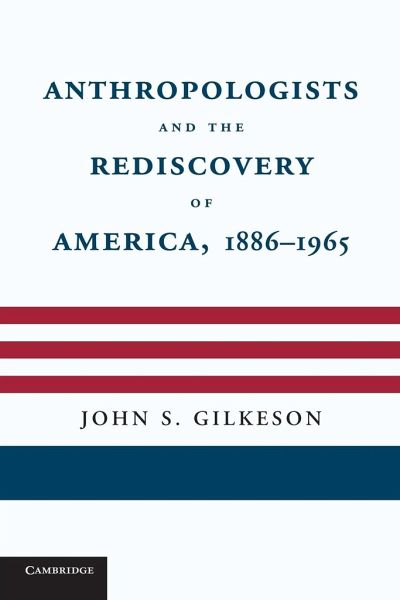
This book examines the intersection of cultural anthropology and American cultural nationalism from 1886, when Franz Boas left Germany for the United States, until 1965, when the National Endowment for the Humanities was established. Five chapters trace the development within academic anthropology of the concepts of culture, social class, national character, value, and civilization, and their dissemination to non-anthropologists. As Americans came to think of culture anthropologically, as a 'complex whole' far broader and more inclusive than Matthew Arnold's 'the best which has been thought…mehr

Produktbeschreibung
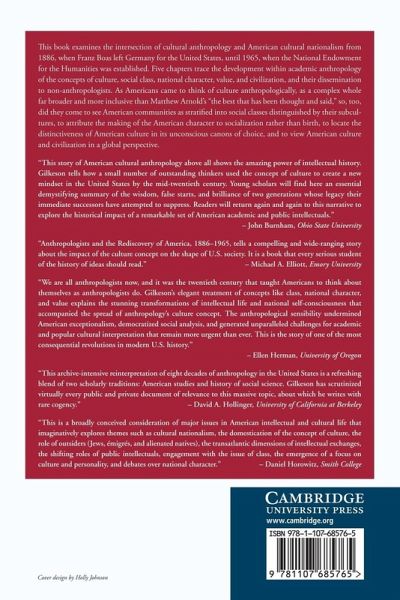
This book examines the intersection of cultural anthropology and American cultural nationalism from 1886, when Franz Boas left Germany for the United States, until 1965, when the National Endowment for the Humanities was established. Five chapters trace the development within academic anthropology of the concepts of culture, social class, national character, value, and civilization, and their dissemination to non-anthropologists. As Americans came to think of culture anthropologically, as a 'complex whole' far broader and more inclusive than Matthew Arnold's 'the best which has been thought and said', so, too, did they come to see American communities as stratified into social classes distinguished by their subcultures; to attribute the making of the American character to socialization rather than birth; to locate the distinctiveness of American culture in its unconscious canons of choice; and to view American culture and civilization in a global perspective.
Autorenporträt
John S. Gilkeson is Associate Professor of Humanities, Arts, and Cultural Studies at Arizona State University, where his teaching focuses on history and American studies. He has been Visiting Professor at the John F. Kennedy Institute for North American Studies at the Freie Universität Berlin and has held fellowships from the National Endowment for the Humanities, the Woodrow Wilson International Center for Scholars, and the Charles Warren Center for Studies in American History. He is the author of Middle-Class Providence, 1820-1940.