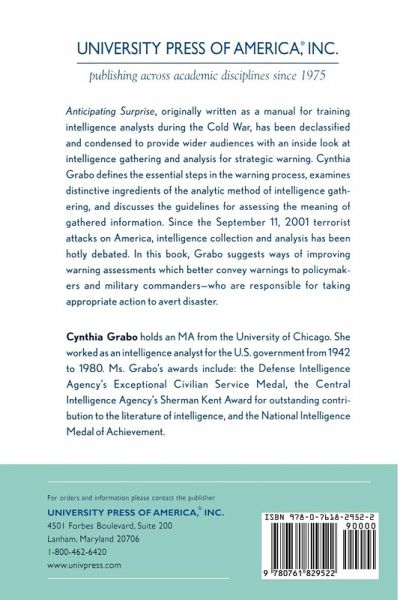
Since the September 11, 2001 terrorist attacks on America, intelligence collection and analysis has been hotly debated. In this book, Grabo suggests ways of improving warning assessments that better convey warnings to policymakers and military commanders who are responsible for taking appropriate action to avert disaster.
Since the September 11, 2001 terrorist attacks on America, intelligence collection and analysis has been hotly debated. In this book, Grabo suggests ways of improving warning assessments that better convey warnings to policymakers and military commanders who are responsible for taking appropriate action to avert disaster.
Cynthia Grabo holds an MA from the University of Chicago. She worked as an intelligence analyst for the U.S. government from 1942 to 1980. Ms. Grabo's awards include: the Defense Intelligence Agency's Exceptional Civilian Service Medal, the Central Intelligence Agency's Sherman Kent Award for outstanding contribution to the literature of intelligence, and the National Intelligence Medal of Achievement.
Inhaltsangabe
Chapter 1 Forward Chapter 2 Editor's Preface Chapter 3 Introduction Chapter 4 The Role of Warning Intelligence: General Nature of the Problem; What is Warning; Intentions versus Capabilities Chapter 5 Introduction to the Analytical Method: Indicator Lists: Compiling Indications; Fundamentals of Indications Analysis; Specifics of the Analytical Method Chapter 6 Military Indications and Warnings: The Nature of Military Indicators; Order-of-Battle Analysis in Crisis Situations; Logistics is the Queen of Battles; Other Factors in Combat Preparations Chapter 7 Political Factors for Warning: Ambiguity of Political Indicator; A Problem of Perception; Considerations in Political Warning Chapter 8 Warning from the Totality of Evidence: The Relative Weight of Political and Military Factors; Isolating the Critical Facts and Indications; Some Guidelines for Assessing the Meaning of Evidence; Reconstructing the Adversary's Decisionmaking Process Chapter 9 Surprise and Timing: Principal Factors in Timing and Surprise; Examples of Assessing Timing; Warning is Not a Forecast of Imminence Chapter 10 The Problem of Deception: Infrequency and Neglect of Deception; Principals, Techniques and Effectiveness of Deception; Types of Deception; What Can We Do About It? Chapter 11 Judgments and Policy: Facts Don't "Speak for Themselves"; What Do Top Consumers Need, and Want, to Know?; Intelligence in Support of Policy; Assessing Probabilities Chapter 12 Improving Warning Assessments: Some Conclusions: Factors Influencing Judgments and Reporting; General Warning Principals; Most Frequent Impediments to Warning Chapter 13 Index
Chapter 1 Forward Chapter 2 Editor's Preface Chapter 3 Introduction Chapter 4 The Role of Warning Intelligence: General Nature of the Problem; What is Warning; Intentions versus Capabilities Chapter 5 Introduction to the Analytical Method: Indicator Lists: Compiling Indications; Fundamentals of Indications Analysis; Specifics of the Analytical Method Chapter 6 Military Indications and Warnings: The Nature of Military Indicators; Order-of-Battle Analysis in Crisis Situations; Logistics is the Queen of Battles; Other Factors in Combat Preparations Chapter 7 Political Factors for Warning: Ambiguity of Political Indicator; A Problem of Perception; Considerations in Political Warning Chapter 8 Warning from the Totality of Evidence: The Relative Weight of Political and Military Factors; Isolating the Critical Facts and Indications; Some Guidelines for Assessing the Meaning of Evidence; Reconstructing the Adversary's Decisionmaking Process Chapter 9 Surprise and Timing: Principal Factors in Timing and Surprise; Examples of Assessing Timing; Warning is Not a Forecast of Imminence Chapter 10 The Problem of Deception: Infrequency and Neglect of Deception; Principals, Techniques and Effectiveness of Deception; Types of Deception; What Can We Do About It? Chapter 11 Judgments and Policy: Facts Don't "Speak for Themselves"; What Do Top Consumers Need, and Want, to Know?; Intelligence in Support of Policy; Assessing Probabilities Chapter 12 Improving Warning Assessments: Some Conclusions: Factors Influencing Judgments and Reporting; General Warning Principals; Most Frequent Impediments to Warning Chapter 13 Index
Es gelten unsere Allgemeinen Geschäftsbedingungen: www.buecher.de/agb
Impressum
www.buecher.de ist ein Internetauftritt der buecher.de internetstores GmbH
Geschäftsführung: Monica Sawhney | Roland Kölbl | Günter Hilger
Sitz der Gesellschaft: Batheyer Straße 115 - 117, 58099 Hagen
Postanschrift: Bürgermeister-Wegele-Str. 12, 86167 Augsburg
Amtsgericht Hagen HRB 13257
Steuernummer: 321/5800/1497
USt-IdNr: DE450055826