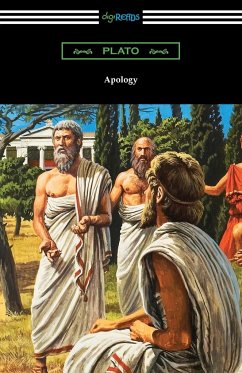
Apology: Translated By Benjamin Jowett This book is a result of an effort made by us towards making a contribution to the preservation and repair of original classic literature. In an attempt to preserve, improve and recreate the original content, we have worked towards: 1. Type-setting & Reformatting: The complete work has been re-designed via professional layout, formatting and type-setting tools to re-create the same edition with rich typography, graphics, high quality images, and table elements, giving our readers the feel of holding a 'fresh and newly' reprinted and/or revised edition, as…mehr
Apology: Translated By Benjamin Jowett This book is a result of an effort made by us towards making a contribution to the preservation and repair of original classic literature. In an attempt to preserve, improve and recreate the original content, we have worked towards: 1. Type-setting & Reformatting: The complete work has been re-designed via professional layout, formatting and type-setting tools to re-create the same edition with rich typography, graphics, high quality images, and table elements, giving our readers the feel of holding a 'fresh and newly' reprinted and/or revised edition, as opposed to other scanned & printed (Optical Character Recognition - OCR) reproductions. 2. Correction of imperfections: As the work was re-created from the scratch, therefore, it was vetted to rectify certain conventional norms with regard to typographical mistakes, hyphenations, punctuations, blurred images, missing content/pages, and/or other related subject matters, upon our consideration. Every attempt was made to rectify the imperfections related to omitted constructs in the original edition via other references. However, a few of such imperfections which could not be rectified due to intentional\unintentional omission of content in the original edition, were inherited and preserved from the original work to maintain the authenticity and construct, relevant to the work. We believe that this work holds historical, cultural and/or intellectual importance in the literary works community, therefore despite the oddities, we accounted the work for print as a part of our continuing effort towards preservation of literary work and our contribution towards the development of the society as a whole, driven by our beliefs. We are grateful to our readers for putting their faith in us and accepting our imperfections with regard to preservation of the historical content. HAPPY READING!
Plato (428/27-348/47 bce) Plato was an Athenian philosopher from the Classical Period in Ancient Greece. He grew up during the Peloponnesian War (431-404 bce), and came of age around the time of Athens' final defeat and the turmoil that followed. He was a close associate of the great Greek philosopher Socrates, who is considered to be the founder of Western philosophy; he was later condemned to death. The Socratic method of dialogue and debate are extensively found in Plato's works. He wrote approximately 35 dialogues with Socrates as a character in order to bring out the ideas and beliefs of his teacher. Two of his notable works are Apologia, which recounts Socrates' trial, and Phaedo, a dialogue that chronicles the conversations on the day that Socrates was put to death. Following the execution of Socrates, Plato travelled to Egypt, Sicily, and Italy. He studied and contributed to philosophy, mathematics, and science. Upon his return to Athens, he founded the Academy-the first institution of higher learning in the West. The institute focused on research around philosophy and science. One of the famous students at Plato's Academy was Aristotle, who went on to challenge some of Plato's views on literature and poetry.
Es gelten unsere Allgemeinen Geschäftsbedingungen: www.buecher.de/agb
Impressum
www.buecher.de ist ein Internetauftritt der buecher.de internetstores GmbH
Geschäftsführung: Monica Sawhney | Roland Kölbl | Günter Hilger
Sitz der Gesellschaft: Batheyer Straße 115 - 117, 58099 Hagen
Postanschrift: Bürgermeister-Wegele-Str. 12, 86167 Augsburg
Amtsgericht Hagen HRB 13257
Steuernummer: 321/5800/1497
USt-IdNr: DE450055826