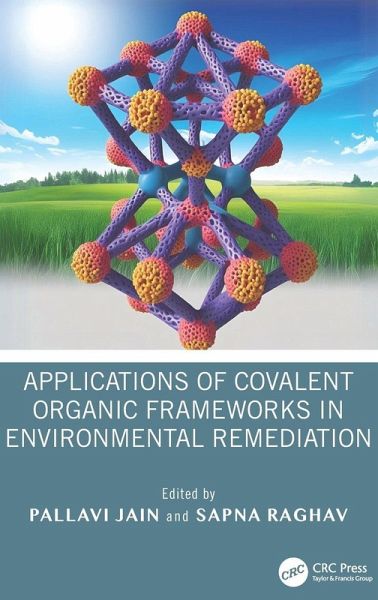
This book provides a comprehensive overview of Covalent Organic Frameworks (COFs) and their growing significance in environmental applications. With their highly ordered, porous structures and tunable properties, COFs offer innovative solutions for challenges such as water purification, air filtration, and pollutant degradation.
This book provides a comprehensive overview of Covalent Organic Frameworks (COFs) and their growing significance in environmental applications. With their highly ordered, porous structures and tunable properties, COFs offer innovative solutions for challenges such as water purification, air filtration, and pollutant degradation.
Pallavi Jain has a very luminous academic and professional career. She is currently heading Student Welfare Department at SRM Institute of Science and Technology Delhi-NCR Campus, Modinagar, Ghaziabad, India. She received her Ph.D. degrees in Chemistry from the Department of Chemistry, Banasthali Vidyapith, Rajasthan, India in 2017. She has extensive teaching experience of about 19 years. Her research interest focuses on the development of transition metal complexes incorporating Schiff base ligands for their biological importance in drug delivery. Her research interests also focus on the synthesis of Deep eutectic solvents. She has authored and co-authored over 80 publications in journals of international repute and contributed more than 60 book chapters. Citation of her work is more than 1000. She has also edited three books. Sapna Raghav, born in Haryana, India, is an accomplished academic and researcher in the field of Chemistry. She earned her Ph.D. in 2019 from the Department of Chemistry at Banasthali University, Rajasthan. Her primary research interests lie in Environmental and Materials Chemistry, with a focus on water decontamination, sensing technologies, and material science. She has contributed over 25 research articles in reputed international journals. In addition, she has authored more than 50 book chapters with renowned publishers. She has actively participated in numerous national and international conferences and has served as a Women Scientist in Intellectual Property Rights under the DST-TIFAC scheme in New Delhi. She currently holds the position of State Vice President of the Haryana Geographical Indication (GI) Tagging Council under WICCI. With four years of teaching experience, she is presently working as Head, Department of Chemistry at Shri Jagdishprasad Jhabarmal Tibrewala University, Jhunjhunu, Rajasthan.
Inhaltsangabe
1. Introduction of Covalent Organic Frameworks 2. Advanced Synthesis Techniques for Covalent Organic Frameworks 3. Characterization Methods for Covalent Organic Frameworks 4. Structural Properties and Strategies of Covalent Organic Frameworks 5. History and Classification of Covalent Organic Frameworks 6. Remediation of Radioactive Contaminants in Aquatic Environment Using Covalent Organic Frameworks 7. Absorption and Photocatalytic Degradation of Environmental Pollution Using Covalent Organic Framework 8. Environmental Applications of Two and Three-dimensional Covalent Organic Frameworks 9. Environmental Applications of Magnetic Covalent Organic Frameworks 10. Adsorption of Heavy Metal Ions by Covalent Organic Frameworks 11. Carbon dioxide Conversion and Utilization with Covalent Organic Framework 12. Covalent Organic Frameworks for Water Purification Methods 13. Applications of Covalent Organic Frameworks in Gas Adsorption and Storage 14. Applications of Covalent Organic Frameworks in Degradation of Volatile Organic Compounds 15. Challenges, Future Perspectives and Emerging Trends in COF's Research
1. Introduction of Covalent Organic Frameworks 2. Advanced Synthesis Techniques for Covalent Organic Frameworks 3. Characterization Methods for Covalent Organic Frameworks 4. Structural Properties and Strategies of Covalent Organic Frameworks 5. History and Classification of Covalent Organic Frameworks 6. Remediation of Radioactive Contaminants in Aquatic Environment Using Covalent Organic Frameworks 7. Absorption and Photocatalytic Degradation of Environmental Pollution Using Covalent Organic Framework 8. Environmental Applications of Two and Three-dimensional Covalent Organic Frameworks 9. Environmental Applications of Magnetic Covalent Organic Frameworks 10. Adsorption of Heavy Metal Ions by Covalent Organic Frameworks 11. Carbon dioxide Conversion and Utilization with Covalent Organic Framework 12. Covalent Organic Frameworks for Water Purification Methods 13. Applications of Covalent Organic Frameworks in Gas Adsorption and Storage 14. Applications of Covalent Organic Frameworks in Degradation of Volatile Organic Compounds 15. Challenges, Future Perspectives and Emerging Trends in COF's Research
Es gelten unsere Allgemeinen Geschäftsbedingungen: www.buecher.de/agb
Impressum
www.buecher.de ist ein Internetauftritt der buecher.de internetstores GmbH
Geschäftsführung: Monica Sawhney | Roland Kölbl | Günter Hilger
Sitz der Gesellschaft: Batheyer Straße 115 - 117, 58099 Hagen
Postanschrift: Bürgermeister-Wegele-Str. 12, 86167 Augsburg
Amtsgericht Hagen HRB 13257
Steuernummer: 321/5800/1497
USt-IdNr: DE450055826