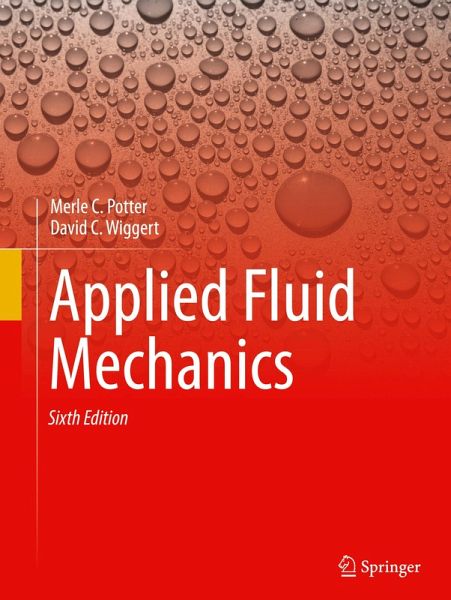
This textbook can be used for the second required course in fluid mechanics. It can be used for the mechanical engineering or civil engineering programs. This book reviews the more conventional elemental approach for pipe flow, channel flow, and flow between cylinders. It discusses the derivation and application of the Navier-Stokes equations to several flow situations. The content presented in this book is especially designed for civil engineering students, with detailed text on open channel flow, piping systems, turbomachinery, and for mechanical engineering students, with detailed text on…mehr
This textbook can be used for the second required course in fluid mechanics. It can be used for the mechanical engineering or civil engineering programs. This book reviews the more conventional elemental approach for pipe flow, channel flow, and flow between cylinders. It discusses the derivation and application of the Navier-Stokes equations to several flow situations. The content presented in this book is especially designed for civil engineering students, with detailed text on open channel flow, piping systems, turbomachinery, and for mechanical engineering students, with detailed text on the potential flow, external flows including boundary-layer theory and compressible flow. The text is designed to allow students to better understand each topic, aided by numerous examples and home problems. Students often find it quite difficult to understand many concepts encountered in fluid mechanics, such as laminar flow, the entrance region, the separated region, and turbulence. Thebook ensures that these concepts are presented correctly and in an easy-to-understand format. This book also presents all derivations and phenomena in such a way that they are more easily understood when compared with the presentations of other textbooks.
¿Dr. Merle Potter joined Michigan State University in 1965 after earning his Ph.D. in Engineering Mechanics from the University of Michigan; he also earned degrees in Mechanical Engineering and Aerospace Engineering. He spent two summers at each of the following research facilities: Stanford University, the NASA Glenn Research Center, and DOE's Oak Ridge National Lab. He conducted research in fluid mechanics and energy analysis of buildings. He has received research grants that supported both MS and PhD theses. He developed both undergraduate and graduate courses in fluid mechanics, thermodynamics, and applied mathematics. As chairman of the college's curriculum committee, he led the college to develop a new undergraduate program in Applied Engineering Sciences. He authored or co-authored over 35 books including 7 textbooks, 5 Schaum's Outlines, and numerous exam review books for engineers. He is a recipient of numerous awards including the James Harry Potter Gold Medal. Dr. Elaine Scott joined the School of Engineering in August 2019, becoming the first female dean in the history of the School. She also holds the John M. Sobrato Endowed Professorship. She comes to Santa Clara University from the University of Washington in Bothell, where she was the founding dean of the School of STEM. Prior to that, she led the growth of the engineering programs at Seattle Pacific University and helped establish the Virginia Tech-Wake Forest School of Biomedical Engineering and Sciences and its related graduate degree programs. She earned her bachelor's and master's degrees in agricultural engineering from the University of California, Davis, and doctoral degrees in mechanical engineering and agricultural engineering from Michigan State University. She has served as a professor of Mechanical Engineering at Virginia Tech, Seattle Pacific University, and the University of Washington, Bothell. Dr. Scott is a Fellow of the American Society ofMechanical Engineers, was named the Academic Engineer of the Year by the Puget Sound Engineering Council and received Distinguished Engineering Alumni Awards from Michigan State University and from the University of California, Davis.
Inhaltsangabe
Introduction to fluids in motion.- The integral forms of the fundamental laws.- The differential forms of the fundamental laws.- Dimensional analysis and similitude.- Internal flows.- External flows.- Compressible flow.- Flow in open channels.- Flows in piping systems.- Turbomachinery.
Introduction to fluids in motion.- The integral forms of the fundamental laws.- The differential forms of the fundamental laws.- Dimensional analysis and similitude.- Internal flows.- External flows.- Compressible flow.- Flow in open channels.- Flows in piping systems.- Turbomachinery.
Es gelten unsere Allgemeinen Geschäftsbedingungen: www.buecher.de/agb
Impressum
www.buecher.de ist ein Internetauftritt der buecher.de internetstores GmbH
Geschäftsführung: Monica Sawhney | Roland Kölbl | Günter Hilger
Sitz der Gesellschaft: Batheyer Straße 115 - 117, 58099 Hagen
Postanschrift: Bürgermeister-Wegele-Str. 12, 86167 Augsburg
Amtsgericht Hagen HRB 13257
Steuernummer: 321/5800/1497
USt-IdNr: DE450055826