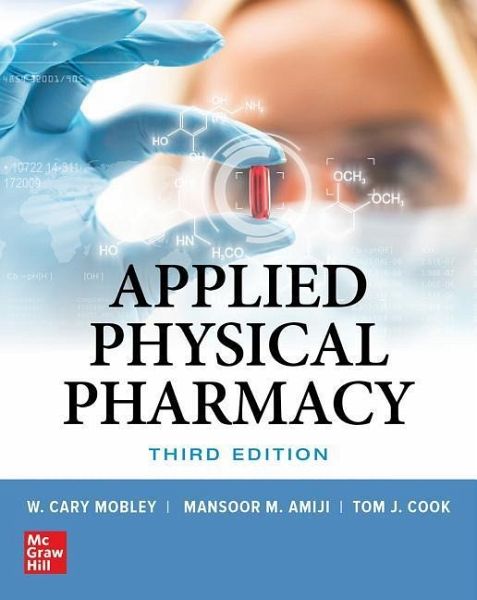
Publisher's Note: Products purchased from Third Party sellers are not guaranteed by the publisher for quality, authenticity, or access to any online entitlements included with the product. A complete practice-oriented introduction to physical pharmacy Written to clearly and simply explain how drugs work, this textbook explores the fundamental physicochemical attributes and processes important for understanding how a drug is transformed into a usable product that is administered to a patient to reach its pharmacological target, and then exists the body. Applied Physical Pharmacy, Third Edition…mehr
Publisher's Note: Products purchased from Third Party sellers are not guaranteed by the publisher for quality, authenticity, or access to any online entitlements included with the product. A complete practice-oriented introduction to physical pharmacy Written to clearly and simply explain how drugs work, this textbook explores the fundamental physicochemical attributes and processes important for understanding how a drug is transformed into a usable product that is administered to a patient to reach its pharmacological target, and then exists the body. Applied Physical Pharmacy, Third Edition begins with a review of the key biopharmaceutics concepts of drug liberation, absorption, distribution, metabolism, and excretion. These concepts, and others, set the framework for the subsequent chapters that describe physicochemical properties and process related to the fate of the drug. Other physical pharmacy topics important to drug formulation are discussed in the chapters that follow, which describe dispersal systems, interfacial phenomena, and rheology. The textbook concludes with an overview of the principles of kinetics that are important for understanding the rates at which many of the processes discussed in previous chapters occur. Chapters in this Third Edition retain the acclaimed learning aids of previous editions, including Learning Objectives, Practice Problems, Key Points, and Clinical Questions. In order to be of greater value to the pharmacy student, more clinical questions have been added, and many tables have been updated with more current products and excipients.
McGraw-Hill authors represent the leading experts in their fields and are dedicated to improving the lives, careers, and interests of readers worldwide
Inhaltsangabe
Contributors Preface 1. Introduction to Biopharmaceutics Introduction Drug Disposition-The Fate of the Drug After Administration Ladme Conclusion Key Point Clinical Questions 2. States of Matter Related to Pharmaceutical Formulations Introduction Intermolecular Forces States of Matter Stability of Solids Acknowledgment Problems Answers Key Points Clinical Questions Appendix 3. Physical Properties of Solutions General Considerations Concentration Expressions Classification of Aqueous Solution Systems Physical Properties of Solutions Physiologic Applications of Colligative Properties Isotonic Solutions Sodium Chloride Equivalent Values (E) Problems Answers Key Points Clinical Questions Appendix 4. Ionic Equilibria and Buffers Electrolytes Versus Nonelectrolytes Importance of Ionization in Pharmacy Acids and Bases Ionization of Water Ionization of Electrolytes Ionization of Salts Buffers Ionization of Amphoteric Electrolytes Ionization of Polyprotic Acids Activity and Activity Coefficient Acid-Base Titration and Titration Curve Problems Answers Key Points Clinical Questions Appendix Suggested Readings 5. Solubility, Dissolution, and Partitioning Solubility Dissolution Dissolution of Particles Factors Affecting Drug Dissolution Partitioning Solubility Problems Answers Dissolution Problems Answers Partitioning Problems Answers Key Points Clinical Questions Appendix 6. Mass Transport Introduction Transport Systems Diffusion Through a Membrane Significance of Diffusion Significance of Osmosis Problems Answers Key Points Clinical Questions 7. Complexation and Protein Binding Introduction Types of Complexes Metal-Ion Coordinate Complexes Cyclodextrin Complexes Ion-Exchange Resins Protein-Ligand Interactions Plasma Protein Binding Problems Answers Key Points Clinical Questions Appendix 8. Dispersed Systems Dispersed Systems Classified by Their Phases Dispersed Systems Classified by Their Particle Size Physical Stability of Dispersed Systems Summary Problems Answers Key Points Clinical Questions Suggested Readings 9. Interfacial Phenomena Surface Tension Electrical Double Layer Adsorption Problems Answers Key Points Clinical Questions Appendix 10. Rheology Introduction Newtonian Flow Viscosity of Newtonian Fluids Effect of Temperature on Viscosity Non-Newtonian Flow Thixotropy Viscoelasticity Significance of Rheology Viscosity Modifiers Problems Answers Key Points Clinical Questions Appendix 11. Chemical Kinetics of Pharmaceuticals Common Drug Degradation Reactions Order of Reaction Determination of the Order of a Reaction Stability and Shelf-Life of Drugs Enzyme Catalysis Reactions Pharmacokinetics: An Extension of Reaction Kinetics Problems Answers Clinical Questions Suggested Readings Appendix: Basic Mathematical Concepts Equations Logarithmic Function Exponential Function Differentiation and Integration Functions Bibliography Mathematical Tables Endnotes Index
Es gelten unsere Allgemeinen Geschäftsbedingungen: www.buecher.de/agb
Impressum
www.buecher.de ist ein Internetauftritt der buecher.de internetstores GmbH
Geschäftsführung: Monica Sawhney | Roland Kölbl | Günter Hilger
Sitz der Gesellschaft: Batheyer Straße 115 - 117, 58099 Hagen
Postanschrift: Bürgermeister-Wegele-Str. 12, 86167 Augsburg
Amtsgericht Hagen HRB 13257
Steuernummer: 321/5800/1497
USt-IdNr: DE450055826