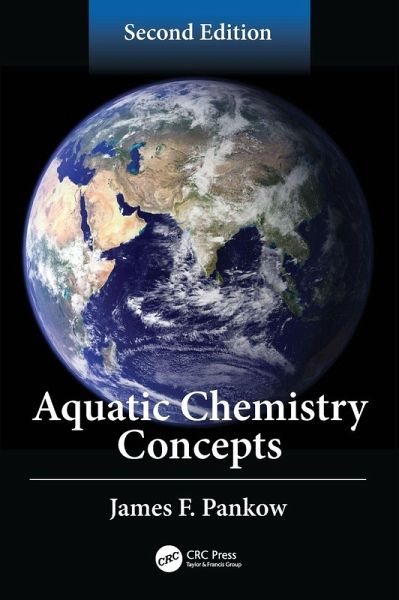
Filling the need for an accessible, easy-to-use book on the topic, this volume delves into the details behind some of the complicated equations and principles of aquatic chemistry. It examines the chemistry of natural water systems such as lakes and rivers, along with the chemistry of rainwater. Highlights in the new edition include an increased focus on the Electroneutrality Equation (ENE), metal adsorption to solid surfaces, and general aspects of the acid/base chemistry of blood and other physiological fluids. Solved problems are included in every chapter, making this an excellent reference…mehr
Filling the need for an accessible, easy-to-use book on the topic, this volume delves into the details behind some of the complicated equations and principles of aquatic chemistry. It examines the chemistry of natural water systems such as lakes and rivers, along with the chemistry of rainwater. Highlights in the new edition include an increased focus on the Electroneutrality Equation (ENE), metal adsorption to solid surfaces, and general aspects of the acid/base chemistry of blood and other physiological fluids. Solved problems are included in every chapter, making this an excellent reference for clear explanations of aquatic chemistry principles.Aquatic Chemistry Concepts, Second Edition. Fully revised and updated, this textbook fills the need for a comprehensive treatment of aquatic chemistry and covers the many complicated equations and principles of aquatic chemistry.
James F. Pankow earned a BA in chemistry at the State University of New York at Binghamton in 1973, training in the laboratory of Dr. Gilbert E. Janauer. He earned a PhD in environmental engineering science at the California Institute of Technology in 1979, training in the laboratory of Dr. James J. Morgan (1966-1974, Editor-in-Chief, Environmental Science and Technology; 1999, Clarke Water Prize; 1999, Stockholm Water Prize). Dr. Pankow's awards include the John Wesley Powell (U.S. Geological Survey) National Citizen Achievement Award (1993), the American Chemical Society Award for Creative Advances in Environmental Science and Technology (1999), and the Haagen-Smit Prize (2005). He was elected to the National Academy of Engineering in 2009.
Inhaltsangabe
Part I: Introduction 1. Overview 2. Thermodynamic Principles Part II: Acid/Base Chemistry 3. The Proton (H+) in Aquatic Chemistry 4. The Electroneutrality Equation, Mass Balance Equations, and the Proton Balance Equation 5. Quantitative Acid/Base Calculations for Any Solution of Acids and Bases 6. Dependence of ¿ Values on pH, and the Role of Net Strong Base 7. Titrations of Acids and Bases 8. Buffer Intensity ß 9. Chemistry of Dissolved CO2 Part III: Metal/Ligand Chemistry 10. Complexation of Metal Ions by Ligands Part IV: Mineral Solubility 11. Simple Salts and Metal Oxides/Hydroxides/Oxyhydroxides 12. Solubility Behavior of Calcium Carbonate and Other Divalent Metal Carbonates in Closed and Open Systems 13. Metal Phosphates 14. Which Solid Is Solubility Limiting? Examples with Fe(II) for FeCO3(s) vs. Fe(OH)2(s) Using Log pCO2 vs. pH Predominance Diagrams 15. The Kelvin Effect: The Effect of Particle Size on Dissolution and Evaporation Equilibria 16. Solid/Solid and Liquid/Liquid Solution Mixtures Part V: Redox Chemistry 17. Redox Reactions, EH, and pe 18. Introduction to pe-pH Diagrams: The Cases of Aqueous Chlorine, Hydrogen, and Oxygen 19. pe-pH Diagrams for Lead (Pb) with Negligible Dissolved CO2 20. pe-pH Diagrams for Lead (Pb) in the Presence of CO2 with Fixed CT, and Fixed CT and Phosphate 21. pe and Natural Systems 22. Redox Succession (Titration) in a Stratified Lake during a Period of Summer Stagnation Part VI: Effects of Electrical Charges on Solution Chemistry 23. The Debye-Huckel Equation and Its Descendent Expressions for Activity Coefficients of Aqueous Ions 24. Electrical Double Layers in Aqueous Systems 25. Colloid Stability and Particle Double Layers
Es gelten unsere Allgemeinen Geschäftsbedingungen: www.buecher.de/agb
Impressum
www.buecher.de ist ein Internetauftritt der buecher.de internetstores GmbH
Geschäftsführung: Monica Sawhney | Roland Kölbl | Günter Hilger
Sitz der Gesellschaft: Batheyer Straße 115 - 117, 58099 Hagen
Postanschrift: Bürgermeister-Wegele-Str. 12, 86167 Augsburg
Amtsgericht Hagen HRB 13257
Steuernummer: 321/5800/1497
USt-IdNr: DE450055826