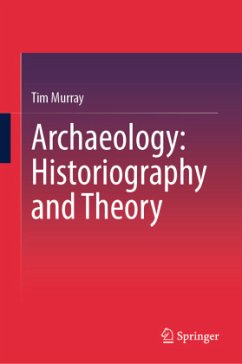
This book examines our understanding of the ways in which we produce and consume archaeological knowledge and proposes that this should play a greater role in our attempts to describe and comprehend the nature and purpose of archaeology, and the nature of archaeological knowledge. During the past fifty years prehistoric archaeologists have sought to promote or oppose several redefinitions of archaeological goals and approaches that have emphasized, variously, the liberating or constraining power of critical self-reflection. While practitioners have continued to expand the storehouse of…mehr
This book examines our understanding of the ways in which we produce and consume archaeological knowledge and proposes that this should play a greater role in our attempts to describe and comprehend the nature and purpose of archaeology, and the nature of archaeological knowledge. During the past fifty years prehistoric archaeologists have sought to promote or oppose several redefinitions of archaeological goals and approaches that have emphasized, variously, the liberating or constraining power of critical self-reflection. While practitioners have continued to expand the storehouse of archaeological data, they have also been engaged in active investigation of archaeological goals and approaches, and in intensifying debate over what it is proper or relevant for practitioners to do. Prehistoric archaeology is now much more than a method of data collection and analysis which is transformed into culture history (or exemplifications of material culture theory) by the acts of comparison and interpretation.
The central premise of this book is that the kind of understanding sought here should significantly improve our ability to work towards convincing solutions to many of the practical puzzles and problems with which we currently concern ourselves. The author also argues that this understanding will help to redefine the terms under which the collectivity of archaeological practitioners can be considered to be a functioning community.
Tim Murray has taught archaeology at Sydney, La Trobe, Cambridge, Leiden, Paris 1, Göteborg, the Institute of Archaeology, University College London, the École des hautes études en sciences sociales (Paris), and the Nordic Archaeological Institute. He has twice been Director’s Fellow at the Getty Research Institute, Los Angeles. Murray has published over 30 books, the most recent being (with Penny Crook) Exploring the Archaeology of Immigration and the Modern City in Nineteenth-Century Australia (Springer, 2019), and many book chapters and journal articles. Two collections of his essays have also been published: From Antiquarian to Archaeologist: The History and Philosophy of Archaeology (2014); Archaeology: History, Theory, Philosophy (2025). He is a Fellow of the Society of Antiquaries of London and of the Australian Academy of the Humanities. Murray is currently Honorary Professorial Fellow at the University of Melbourne, and Emeritus Professor of Archaeology at La Trobe University.
Inhaltsangabe
Chapter 1. Introduction. Chapter 2. Themes and Goals. Chapter 3. Methodology and Structure. Chapter 4. Some Aspects of Antiquarianism Before the Three Age System. Chapter 5. Prehistoric Archaeology and the Development of Ethnology. Chapter 6. The Consequences of High Human Antiquity. Chapter 7. National and Ethnic Prehistory. Chapter 8. Prehistoric Archaeology in the ‘Parliament of Science’. Chapter 9. Archaeology from 1960: Transformation, Continuity and Divergence. Chapter 10. Expanding the Theoretical: Processual and Post Processual Archaeologies 1960 1990. Chapter 11. Expanding the Empirical: Transforming Time, Process and Duration. Chapter 12. Expanding the Significance of Social and Cultural Context. Chapter 13. Archaeological Epistemology, Middle Range Theory, and the Prospect of Intractable Problems? Chapter 14. Historiography and Archaeological Theory.
Chapter 1. Introduction. Chapter 2. Themes and Goals. Chapter 3. Methodology and Structure. Chapter 4. Some Aspects of Antiquarianism Before the Three Age System. Chapter 5. Prehistoric Archaeology and the Development of Ethnology. Chapter 6. The Consequences of High Human Antiquity. Chapter 7. National and Ethnic Prehistory. Chapter 8. Prehistoric Archaeology in the ‘Parliament of Science’. Chapter 9. Archaeology from 1960: Transformation, Continuity and Divergence. Chapter 10. Expanding the Theoretical: Processual and Post Processual Archaeologies 1960 1990. Chapter 11. Expanding the Empirical: Transforming Time, Process and Duration. Chapter 12. Expanding the Significance of Social and Cultural Context. Chapter 13. Archaeological Epistemology, Middle Range Theory, and the Prospect of Intractable Problems? Chapter 14. Historiography and Archaeological Theory.
Es gelten unsere Allgemeinen Geschäftsbedingungen: www.buecher.de/agb
Impressum
www.buecher.de ist ein Internetauftritt der buecher.de internetstores GmbH
Geschäftsführung: Monica Sawhney | Roland Kölbl | Günter Hilger
Sitz der Gesellschaft: Batheyer Straße 115 - 117, 58099 Hagen
Postanschrift: Bürgermeister-Wegele-Str. 12, 86167 Augsburg
Amtsgericht Hagen HRB 13257
Steuernummer: 321/5800/1497
USt-IdNr: DE450055826